Covid-19 Joint Committee calls for stronger supports for people in direct provision
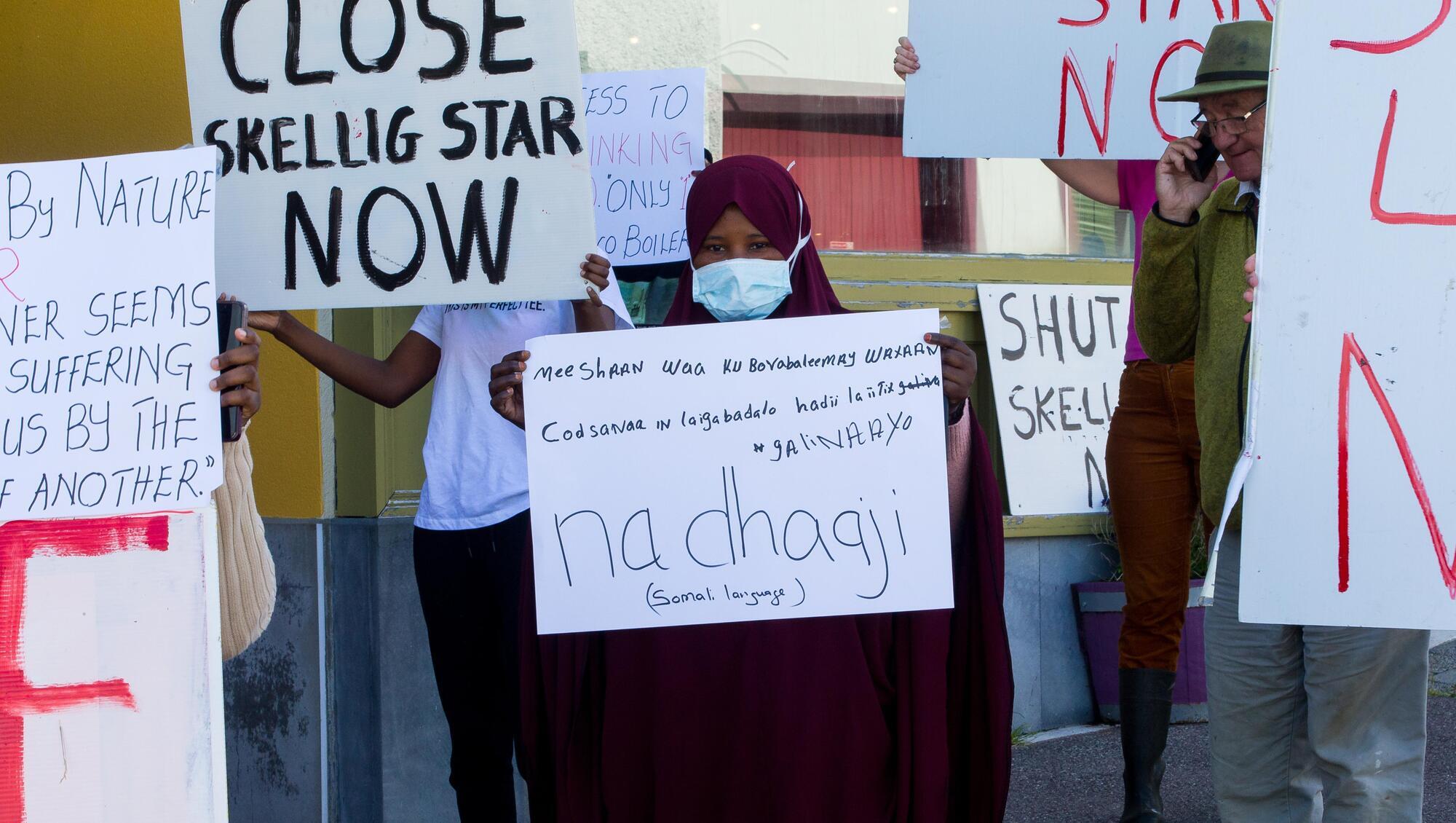
Residents of the Skellig Star Direct Provision Centre in Cahersiveen protest outside the centre in July. Photo: Alan Landers.
The Joint Committee on Covid-19 is calling for a stronger framework to protect people in direct provision.
The Special Oireachtas Committee on Covid-19 Response has today published its report on its hearings.
On May 26, the Committee met to discuss the impact of the virus on people in direct provision centres and paid particular attention to the movement of people from a Dublin hotel to the Skellig Star centre in Cahirsiveen, Co Kerry.
The Committee was told that people were transported from Dublin to the Kerry centre at very short notice and there was a lack of consultation with the residents who already lived in the Skellig Star.
The Department of Justice stated that around 600 people were moved to different accommodations within two-and-a-half weeks and time constraints led to difficulties. Other problems arose from a lack of data sharing and a "chain of command" involved in decisions involving multiple agencies and departments.
When the Committee asked why the people who travelled from Dublin were untested, the HSE said that advice at the time was that only those with symptoms of the illness should be tested.
The HSE's failure to inform the Department of Justice of a positive test at the Dublin hotel prior to residents being bussed to Kerry was also queried.
The Committee heard that there were a number of weaknesses present in the direct provision system prior to the pandemic, with centres at almost 100% capacity in addition to the use of hotels and B&Bs.
The Department said that shared accommodation is common in congregated settings such as student accommodation and homeless services but said it posed specific challenges with regard to public health guidelines.
Extra cleaning services, staggered meal times, PPE, translation facilities and a telephone helpline were all provided to people in direct provision centres, according to the Department of Justice.
Raising its concerns at the hearing MASI, an independent organisation for the movement of asylum seekers in Ireland, said: "People have been stripped of their fundamental human right to privacy and the dignity that comes with it."
They described the system as "warehousing of asylum seekers… in inhumane conditions” with overcrowding in crammed conditions in for-profit direct provision centres.
10 current outbreaks in Direct Provision are not a surprise to us. In May we told the Dáil's Special Committee on Covid-19 that there is no containing the virus when you have strangers sharing intimate living spaces such as bedrooms, bathrooms, kitchens, canteens... pic.twitter.com/pqhTwmFD03
— MASI - Movement of Asylum Seekers in Ireland (@masi_asylum) October 5, 2020
The Department acknowledged that there are “weaknesses” in the direct provision system and that the report currently being undertaken by Dr Catherine Day’s advisory group will encompass a review of the system.
Speaking on the publication of the committee's report outgoing chairperson Michael McNamara said the Government must do more to protect vulnerable groups such as asylum seekers.
“We need a stronger regulatory framework to protect our older population, people in direct provision and low-paid workers like those in meat plants, many of whom do not have access to sick pay."
"We need to address long-term systemic issues such as greater levels of public health support which will allow as many as possible of our elderly to be cared for in their communities and away from long-term institutional."
"The State has a huge job to do to achieve this but that is the challenge we now face,” he concluded.

CONNECT WITH US TODAY



Be the first to know the latest news and updates