Former Anglo bank employee jailed for theft of over €600k from friends and family
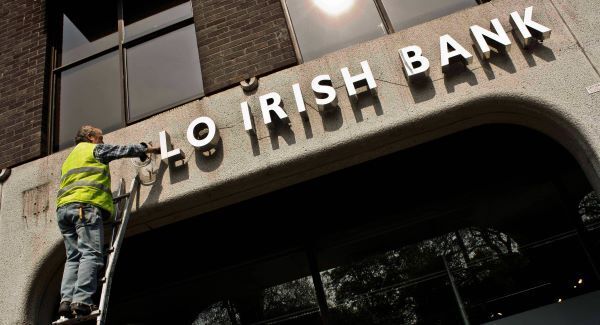
A former Anglo Irish Bank employee who stole over €600,000 from his friends and family has been jailed for five-and-a-half years.
Stephen Keogh (48) persuaded various friends and in-laws to invest money in high interest accounts, while actually lodging the money in his own account and providing false documents to hide his thefts.
Dublin Circuit Criminal Court heard that Keogh had “essentially created a fiction that he was far more successful than he in fact was” and stole the money because he was “living way beyond his means”.
Keogh with an address at The Lawn, Athlumney Abbey, Navan, Co Meath, pleaded guilty to stealing a total of €611,139.35 from seven victims at various locations in Co Dublin and Co Meath on dates between May 15, 2002 and April 27, 2010.
Detective Garda John Trimble told Fionnuala O'Sullivan BL, prosecuting, that Keogh worked for Anglo Irish Bank between 2001 and 2005 and that he ultimately ended up working for Fiat in 2008.
Det Gda Trimble said that Keogh persuaded various people including his mother-in-law, his sister-in-law and an old family friend to invest very large amounts of money in high interest bank accounts with Anglo Irish Bank.
Keogh instead lodged the majority of this money into his own account. He also took money from his brother-in-law and the best man at his wedding to pay for cars that were never placed in their names.
He was also drawing money from his wife's credit card account without her knowledge. His family realised what had been going on in 2009 following an incident where his mother-in-law phoned to ask whether a cheque was missing from her chequebook and Keogh ran out of the house.
Keogh was asked to leave the family home in 2010 and went to the United States. He returned in 2011 and gave a voluntary interview to gardaí in which he accepted responsibility for the offences and said he had no money left.
“I created this monster,” said Keogh during the interview. “I don't know how it started and how it began. I wish it hadn't and I wish I knew better.”
Keogh left Ireland again following this interview. As part of his work with a company that provided services to U.S. Military bases, he spent time in Afghanistan and Iraq, countries from which it was not possible to extradite him.
He finally returned to the country in November 2019 and was arrested at the airport. He has no previous convictions.
Det Gda Trimble agreed with Niall Gallagher BL, defending, that his client has never sought to deny his offences. He agreed that Keogh told gardaí he did not intend to defraud people from the start and believed he could fix things before they got out of control.
Mr Gallagher said his client had “essentially created a fiction that he was far more successful than he in fact was” and that he was “living way beyond his means”. He said Keogh felt under pressure to maintain this image and had let his spending outstrip his income.
Judge Martin Nolan said that Keogh decided to subsidise his earnings by stealing from his friends. He said Keogh “left a lot of destruction in his wake“ to feed his lifestyle and to give an impression of wealth and success.
Judge Nolan said his moral culpability was high and he behaved in an entirely devious way. He said that the way in which Keogh met the case gave him no credit as he must have known that charges were in the offing and he left the scene.
He sentenced Keogh to five-and-a-half years imprisonment. After passing the sentence, Judge Nolan addressed Keogh directly to say that he has “made life miserable for a lot of people”.
“My only crime was trusting a friend,”

Det Gda Trimble told Ms O'Sullivan that Carmel Conway, the accused's mother-in-law, went to him in 2002 for financial advice. Keogh opened an account for her and a large sum of money was lodged in this account.
In May 2002, Keogh effectively began to transfer money from this account to an account of his own by lodging cheques from his mother-in-law's account into his own account. By May 2005 the balance of the account had been brought down to zero.
Ms Conway also routinely handed him bank drafts for lodgement, but none of these were ever lodged in her account. Over the years she received false documents, including certifications of interest, which led her to believe her money was being lodged in her account.
The total loss of money she suffered was €220,548.93. None of this money has been recovered.
Rankin Dobson was a lifelong friend of the accused's parents. Mr Dobson was self-employed and did not have a pension, but he had accumulated savings and his wife had received a lump sum from her previous employment.
Mr Dobson and his wife wished to invest €50,000 in bank shares and believing that Keogh was still employed by Anglo Irish Bank, they agreed he would set up an investment account for them in October 2005.
Keogh never opened this account and instead lodged the money in his own account. Further investments made by Mr Dobson and his wife were also lodged in Keogh's account and they were also provided with false documentation.
The couple at one point decided to cash some of their interest and Keogh transferred them approximately €6,000 to make it seem as though they were earning interest.
Their total financial loss was €178,460.78.
In his victim impact statement, which was read before the court, Mr Dobson said he wished to appear in court, but as he was over 70 he was “cocooning” due to Covid-19.
Mr Dobson said he took great pride in earning his income through hard work. He said he did not have a pension so this money was his and his wife's “nest egg”.
He said they were later told that Keogh had “squandered our life's savings”. He said they had to endure almost a decade of waiting for justice because Keogh fled the country and it felt like “he was taunting us from afar”.
Mr Dobson said that while for some of the others there was time to start again, “for us it is too late”.
Antoinette Conway, the accused's sister-in-law, also began to give Keogh money to invest beginning in January 2006. No bank account was ever opened in her name and the money was instead lodged in Keogh's account.
Ms Conway was also persuaded by Keogh to twice take out loans of €25,000 in order to make further investments. Keogh lodged these funds in his own account and she eventually had to pay back both of these loans herself with interest.
The total loss of money she suffered was €96,235.14.
David Conway, the accused's brother-in-law, wanted to buy a new car in June 2009 and was told by Keogh he could get him an employee discount with Fiat. Keogh lodged the €13,000 payment for the car in his own account and delivered a car to Mr Conway.
Mr Conway struggled when attempting to register the car for tax and contacted Fiat, who informed him that he should never have been given the car. The car was seized and he was left at a loss of €13,000.
Martin Regan, who had been the best man at the accused's wedding, allowed Keogh to stay in his house after he had been asked to leave the family home in early 2010.
In April 2010 he wished to buy a car and believing that Keogh still worked for Fiat, Mr Reagan was told that if he wanted a discount then Keogh would have to buy the car and then sell it on to him.
Mr Reagan wrote him a cheque for €22,500 which Keogh lodged in his account. No car was ever delivered and Keogh soon became uncontactable.
Shona Conway, the former wife of the accused, trusted her then husband to take care of financial matters. After registering for internet banking in December 2009, she saw that her Visa Card was €10,000 overdrawn.
Keogh told Ms Conway that he was in financial trouble and that had needed the money quickly. Sums of €600 had been withdrawn on almost a daily basis and a total of €8,900 was withdrawn from her credit card without her knowledge.
Garda Robert Collins told Ms O'Sullivan that Michelle Scott, a former co-worker and good friend of the accused, was made redundant in 2008 and made the decision to lodge her lump sum in an Anglo Irish Bank account.
Gda Collins said that Keogh offered to lodge the cheque into an account at a time following an operation after which Ms Scott was somewhat incapacitated.
Ms Scott wished for €2,500 to be transferred each month from this account to her current account for living expenses. These payments were made up until February 2010, after which she discovered that no money had ever been lodged in her account.
Keogh later admitted that he had lodged the money into his own account and had been transferring the money on a monthly basis to Ms Scott, stopping when he ran out of money. €65,500 of her money was never recovered.
In her victim impact statement, which she read out in court, Ms Scott said that overnight she had no financial means and that “everything around me came crashing down”.
Ms Scott said she could not afford to pay legal fees to make an effort to obtain the lost funds and that she made ends meet by selling items from her home. She said she wished sometimes she “could sleep and never wake up”.
“My only crime was trusting a friend,” she told the court.