'I'm here because my family farm is at risk': Views from the front line at today's farmers protest
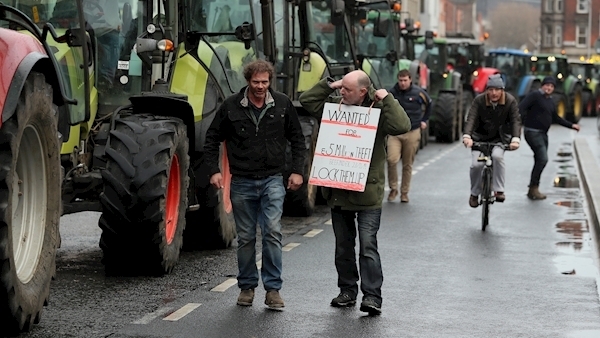
Michael Coyle had tears in his eyes and dark circles under them when he spoke about his struggle to keep his family farm.
He was one of several farmers who came to Dublin to demand better prices for cattle and the lifting of injunctions against two farmers.
“We are independent farmers who are here on a peaceful protest,” said Mr Coyle who has a farm in Arva, Co Cavan.
“I am here because my family farm is at risk. I lost money last year and I am going to lose more this year. I can't keep going the way things are and every beef farmer is the same.
“The cattle I sold dropped €200 in one month this year. They went from €410 per kilo base price to €360. That's 50c a kilo on a 400-kilo beast.”

Mr Coyle was one of the persons named in injunction proceedings by Liffey Meats that were struck out by the High Court in September.
“I have been very stressed since the last protest and did not think we would have to come back to Dublin to fight our cause again.
“I got up before 5am on Tuesday and came up to Dublin. I have to go home to work but other people are coming,” he said this morning.
Mr Coyle said he had four children and would not ask any of them to be a farmer.
“I have no other business but I am glad that my wife has an off-farm job and my family is reared. I put all of my children through college and all of them are working.”
Another protester, Jolene Smith, who has a farm in Ballyjamesduff, Co Cavan, said beef prices had collapsed.
“Beef prices are on the floor. We can't sell our cattle. We have 30 cattle standing in a field which are ready to be sold but we can't sell them at the prices that are there,” she said.
Ms Smith and her husband, Ciaran, have sheep and suckler cows. “The price of sheep is going up at the minute but it is not enough,” she said.
The couple has five children between the ages of 15 and one year and they worry about their future.
“We need action for our families; we need action for our farms,” said Ms Smith, who was one of the five farmers to met the Minister for Agriculture, Michael Creed, to discuss their concerns.
"This could have been done and dusted on Tuesday night if the minister had met us then but we were stopped from going down Kildare Street to hand in our submission. That did not happen until the following morning."
Ms Smith said there were around 50 tractors around the centre of the city. The farmers had worked with the gardaĂ and they were happy to leave them where they were.
“We are here for the long-haul. That is what it is looking like. Christmas is on hold and so are our lives. We sat for eight weeks outside factories trying to get an increase in our cattle prices and we are still no further on.”
Ms Smith became tearful when she talked about having around 100 sheep stolen from their farm this year. “We have had to deal with that too,” she said.

John Joe Kennedy, a suckler and sheep farmer from Ballinasloe, Co Roscommon, said he and his wife, who had an off-farm job, were paying €25,000 a year to keep two children in college in Dublin.
“We are taking a loss for our animals because we have to sell them to get the money to pay for our children's education. We can't keep going like this.”
James Roche, a dairy farmer from Tullaher, Co Kilkenny, said he was a dairy farmer who sold calves to other farmers who produce them for beef.
“I have skin in the game because I want those farmers to keep buying my calves,” he said.
“I will be suffering in January if my neighbours don't come back to buy the calves off me."
And they’re off! Protesting farmers pull out of Dublin with road closures likely to end soon @rtenews pic.twitter.com/0bmVQsLnvS
— Fran McNulty (@franmcnulty) November 27, 2019
Pat Walsh, a beef farmer from Fethard, Co Tipperary, said the price of beef was going in the right direction all over Europe but had become stagnant in Ireland.
"The gap is widening and needs to be rectified. There isn't a living to be made in beef anymore," said Mr Walsh, who also works off the farm.
"Everything is closing down in the countryside and the minister is suggesting that we all plant trees. Climate change is a big issue but there is no point telling us to plant trees while they are being cut down somewhere else to replace the beef. The beef is a major issue but it is really about the rural fabric - it has been torn."