Airspace closure: Cause still not known
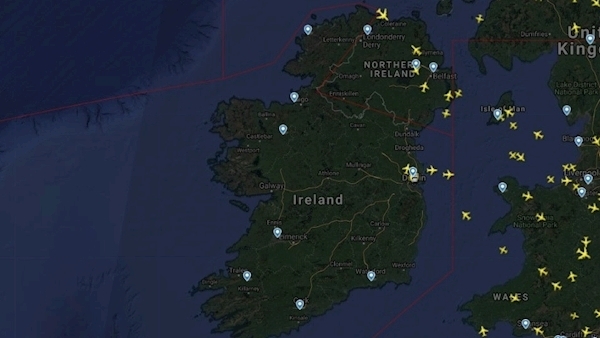
Aviation chiefs have admitted they still don’t know what caused a major systems failure that forced the temporary closure of much of Irish airspace Tuesday.
Flow-control measures restricting the number of aircraft operating in Irish airspace remained in place for a time yesterday as the Irish Aviation Authority (IAA) attempted to get to the bottom of the problem.
The failure paralysed regular operations at Shannon Air Traffic Control (ATC) centre for a number of hours on Tuesday evening, forcing the deployment of an emergency backup system and the temporary shutdown of much of Irish airspace.
The IAA said there was nothing to suggest hacking or cybercrime was involved.
It described the breakdown as “not a radar problem” and “most likely a simple software issue in a complex system”.
However, it conceded that it did not know the cause and that its technical experts were working to isolate the root cause of the issue.
The IAA said its systems were complex and identifying the cause could take some time.
The Commission for Aviation Regulation was continuing to describe the incident yesterday as “radar failure in Irish Airspace” and advised passengers of what steps to take if their flights were delayed or cancelled “as a result of the event”.
Eurocontrol, the European Organisation for the Safety of Air Navigation, also described the breakdown as a radar failure that led to a “zero flow rate”. This effectively means aircraft movements were shut down in areas serviced by Shannon ATC, which includes Shannon Airport, Cork Airport, and transatlantic overflights, but not Dublin Airport.
The IAA said Dublin’s system is “entirely independent and was not and is not affected”.
Asked why Eurocontrol had classified the problem as “radar failure”, the IAA said “EuroControl assign a limited number of classifications across a broad range of issues”.
“However, we can absolutely confirm that this is a technical issue with an air traffic control system and not a radar issue which is a separate system.”
The IAA failed to clarify if the two systems were mutually exclusive.
The IAA said it was continuing to provide “a full, safe, secure Air Traffic Control service” and that there had been no impact on flights yesterday.
The authority said it had moved “to a fully independent backup system” and that “all flights in that area are operating normally on this backup system”.
“We continue to provide a full service on this backup system indefinitely,” the IAA said.
Its director of commercial technology, Philip Hughes described the breakdown as “highly rare”.
He said it had happened at “a relatively quiet time” — before the overnight transatlantic overflight traffic kicked in.
The IAA’s Area Control Centre in Shannon handles over 90% of all air traffic on the North Atlantic. This equates to approximately 1,400-1,500 aircraft every 24 hours during the busy summer months, according to its website.
In 2017, Shannon Air Traffic Control safely handled over 343,000 flights.
At its widest, it takes 40 minutes to transit Irish-controlled airspace and 20 minutes at its narrowest. It covers some 451,000 square km.
According to the IAA, the airspace controlled by the Shannon Centre “is unique in that it acts as an interface between North Atlantic (non-radar environment) and domestic European air traffic (radar environment), two traffic streams that must be managed and integrated on a daily basis”.
Over Europe aircraft fly along pre-determined routes “that are effectively motorways in the sky”.
However, the North Atlantic system differs in that while aircraft fly on prescribed tracks, the position of these tracks change on a daily basis, mainly due to the weather.