Bond poison and hot toddies used to treat ‘Spanish Flu’
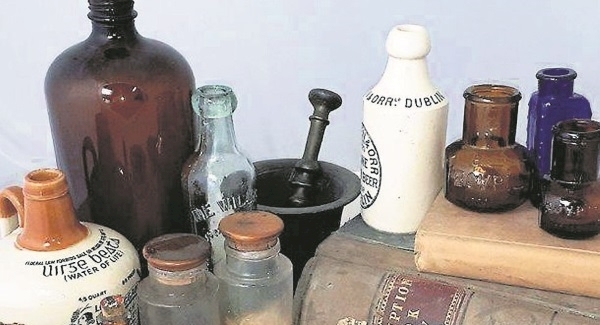
Strychnine, the assassin’s poison of choice in James Bond, was just one of the strange but dangerous remedies administered by doctors to treat ‘Spanish Flu’ a century ago.
The virus claimed more than 20,000 lives in Ireland, and infected 800,000. Its devastating impact is captured in The Enemy Within: The Spanish Flu in Ireland 1918-19, a new exhibition which opens today at the National Museum of Country Life in Mayo.
Ida Milne, a social historian who has written the definitive book on Spanish Flu in Ireland (Stacking the Coffins, Influenza, War and Revolution in Ireland 1918-1919) said whiskey was a particular favourite among medics, largely as a preventative medicine.
Doctors would swill their mouths out with whiskey before tending to patients, as did workers tasked with removing the bodies of the dead,” she said.
Dr Milne’s research has been widely quoted in publicity relating to the exhibition although she was not invited to take part in promoting it.
Her work includes using oral histories with survivors and the families of victims. The exhibition also intends to focus on local stories of personal loss and public service breakdown forced by the flu outbreak, with members of the public encouraged to share and archive their Spanish Flu stories on the website Ouririshheritage.org.
Among Dr Milne’s interviewees was Tommy Christian, from Kildare, the county worst affected by the outbreak, who had his first hot toddy at age five.
He told me it was a taste that stayed with him for life. And he lived till the age of 99.
Dr Milne, a lecturer at Carlow College, said patients were also given calomel, a mercury chloride mineral, which had a laxative effect, and trional, a sedative-hypnotic, as well as quinine to reduce fever, but removed from the pharmaceutical list in the 1940s because it could cause blindness when taken in large quantities.
While the pandemic officially claimed more than 20,000 lives in Ireland, including more than 1,400 in Cork, Dr Milne believes the number of deaths is far higher. “People were dying so fast and doctors were so busy treating the ill, they didn’t always have time to register the deaths.”
She said its description as “Spanish Flu” is a misnomer, that it affected the combatants engaged in the First World War, but governments suppressed this information.
“Because the Spanish king was the first to confirm that his courtiers had it, it became known as Spanish Flu,” said Dr Milne.
Globally, the virus infected an estimated 500m people and killed 3%-5% of the world’s population, making it the deadliest pandemic in human history.
Unlike previous flu outbreaks, this strain concentrated on the able-bodied and the strong. Doctors reported patients experiencing extreme loss of blood through projectile nosebleeds, coughing, and vomiting.
From the point of infection, death occurred in a matter of a few excruciating days. Spells of insanity and suicides were also linked to infection. As the most productive age group succumbed to flu, services, farms, villages, and towns ground to a halt.
Stories submitted by the public to the exhibition will be linked to an online interactive map of Ireland, which will allow a global audience to view Irish experiences of the Spanish Flu. As well as the exhibition and public participation, there will be a nationwide lecture series.

CONNECT WITH US TODAY



Be the first to know the latest news and updates