Brian Rattigan to appeal conviction for supplying drugs from prison in first case of its kind
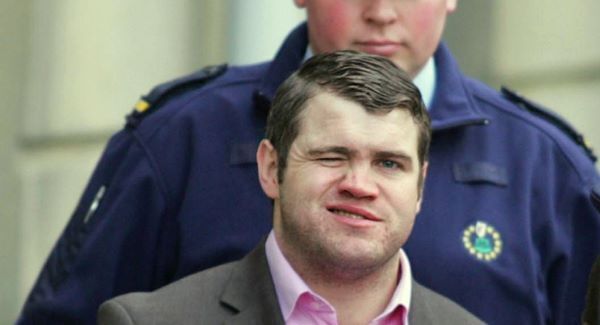
Dublin criminal Brian Rattigan has moved to appeal his conviction for directing the supply of drugs from prison.
Rattigan (37), formerly of Cooley Road, in Drimnagh, had pleaded not guilty at the non-jury Special Criminal Court to possession of heroin and two counts of possession of the drug for sale or supply on Hughes Road South, Walkinstown, Dublin 12 on May 21, 2008.
The three-judge Special Criminal Court agreed with the prosecution case that Rattigan was the director of a drugs gang conducting a €1m heroin deal. He became the first drug dealer to be found guilty of charges connected to directing the supply of drugs while in prison.
During the trial he was cleared of two counts relating to the possession of two mobile phones at Cell 42, E1 Landing, Portlaoise Prison while an inmate at the prison on May 22, 2008, which he had also denied.
Sentencing Rattigan to 17 years in prison, Mr Justice Paul Butler, presiding, said the Special Criminal Court had regard to the “very frightening” evidence of drugs expert Detective Sergeant Brian Roberts, who told the court of the effect heroin had on society as well as the “alarming” 3,972 drug-related deaths in Ireland between 2004 and 2010.
The sentence, imposed on March 20, 2013 and backdated to June 2008, was directed to run in tandem with a life sentence he was then serving for the murder of 21-year-old Declan Gavin outside an Abrakebabra fast-food restaurant in Crumlin on August 25, 2001.
However, in December last year, the Supreme Court quashed Rattigan's conviction for the murder of Mr Gavin over closing remarks made by the trial judge to the jury which, a majority of the Supreme Court found, had gone further than was desirable.
Rattigan moved to appeal his drugs conviction today in the Court of Appeal where judgment was reserved.
His barrister, Brendan Grehan SC, submitted that there was insufficient evidence of possession, within the sense of the word control, for the Special Criminal Court to have found him guilty.
At its height, Mr Grehan said the evidence of telephone contact, accounting methods (tick lists) and so forth, were consistent with a lower level of involvement than actual control.
To say somebody has knowledge of what’s happening from prison, wasn’t enough, he submitted, and there was evidence that at least one other person was “equally likely” to have been “calling the shots”.
Mr Grehan further submitted that the prosecution had come to court “without bothering to test” any of the samples of the drugs for purity. In a case of such alleged magnitude, the idea that that wasn’t done was “extraordinary”. Without testing, it was not possible to say how much heroin was present.
Instead, Mr Grehan said the Special Criminal Court placed reliance on Detective Garda Robert’s view that ‘'it doesn’t matter to the end user if the drugs are 0.1% or 30% pure'’.
In the UK, Mr Grehan said the authorities had moved from measuring market value to measuring purity. “It is at least scientific”.
He referred to the historical case of a man caught with a tea spoon’s worth of drugs in two pounds worth of substance and added: “He should have been convicted of fraud”.
Mr Grehan further submitted that the prosecution should have established the basis on which a garda gave “expert opinion” on the meaning of various slang words used when people allegedly make reference to different drugs.
He said opinions on the meaning of words in the minds of others was a “novel area of expertise”. Every single new area of expertise (from fingerprint expertise more than 100 years ago to ballistics and telecommunications expertise today) went through a “baptism of fire” until they were accepted as recognised areas of speciality.
In those fields, he said the State goes to great length, sometimes spending up to ten minutes, setting out the facts of the recognised speciality including the expert’s training and experience.
“This was different. I’m not aware of any case where this has happened before.”
While Dt Sgt Roberts had a statutory exception to give his opinion on market value, he didn’t have any statutory basis to give opinion evidence on what a particular word meant.
He said the basis for the detective sergeant’s expertise was not properly established. Instead, the approach was to say: ‘I’m 18 years in the business. I’ve been in the drugs squad. Take it from me,’ and the Special Criminal Court accepted his opinion without the kind of scrutiny a “novel area of expertise” should get.
He said the detective sergeant referred to a 400-page glossary of slang or code words referring to drugs. The glossary was from the UK and there was no way of knowing what words transferred to the Irish drugs trade.

Rattigan’s junior counsel, Siobhán Ní Chúlacháin BL, submitted that a warrant used to search the premises on Hughes Road mistakenly bore the title Dublin Metropolitan District and had a harp on it.
It was in fact issued by a peace commissioner in his home during court hours. The application wasn’t recorded and no notes were taken, Ms Ní Chúlacháin said, and a person looking at the warrant would think it was issued by a court, with the weight of a court behind.
She submitted that the law had to “scrutinise” warrants, especially those issued by a peace commissioner because they weren’t legally trained.
Referring to another warrant, issued in respect of a separate property, Ms Ní Chúlacháin said it appeared to have been issued by a District Court judge. However, the signature on the warrant was illegible and the garda who obtained the warrant couldn’t recall which judge issued it.
Counsel for the Director of Public Prosecutions, John O’Kelly SC, said phone traffic clearly put Rattigan at the centre of the operation. It was the only inference that made sense, which the Special Criminal Court was entitled to draw.
Mr O’Kelly said Detective Sergeant Roberts had been a garda for 18 years, 15 of which were spent in the drugs unit, and heroin featured significantly in the work that he did.
He said the detective sergeant had been involved with Europol in an advisory capacity and had organised studies into undercover operations. If anyone was to have the knowledge of either valuation, or the language used by people in the drugs trade, “it was Detective Sergeant Roberts,” Mr O’Kelly said.
Mr O’Kelly said anybody looking at the warrant issued by the peace commissioner would be in no doubt who issued it. It was signed at the bottom by the peace commissioner in his name and title.
Mr Justice John Edwards, who sat with Mr Justice John Hedigan and Mr Justice Brian McGovern, said the court would reserve its judgment.

CONNECT WITH US TODAY



Be the first to know the latest news and updates