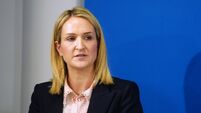
McAliskey recalls her Bloody Sunday movements
The former MP and civil rights leader, Bernadette McAliskey, has told the Bloody Sunday Tribunal in Derry about her terror as she watched British Army soldiers open fire.
She also said she didn't believe the Inquiry could get to the truth of what happened on Bloody Sunday because it was funded and controlled by the British state.
She began by emphasising her hazy recollection of events, as Counsel to the Inquiry Christopher Clarke QC started taking her through her written statements.
She had said in the statements that she did not know Sinn Fein's Martin McGuinness, either by name or in person, at the time of Bloody Sunday.
Mr McGuinness announced earlier this month that he was the IRA's number two in Derry at the time.
Mrs McAliskey also claimed to have had no personal knowledge of any arrangements made with the IRA to stay away from the demonstration.
She added: "I had no reason to consider the matter or ask the question 'Where will the IRA be?' or 'Where will the IRA's weapons be while we are marching?'"
In her deposition she continued: "It is, on the basis of personal experience, my honest belief that at the highest level of British government, military and significant sections of the media acquiesced, conspired, organised and/or participated in, and covered up terror and murder for political gain on 30 January 1972 and repeatedly thereafter.
"It is also my belief, without prejudice to the individual integrity of those currently conducting and participating in this inquiry that no inquiry established, funded and controlled by such a powerful, vindictive, deceitful, ruthless and experienced perpetrator of terror as the British State can reasonably be expected to bring in an honourable verdict of 'guilty as charged' against that State."
Mrs McAliskey described three waves of shooting, the first two from the high walls overlooking the Bogside to the east before a third burst of gunfire came from the south - the direction from where Paratroopers moved into the area on the ground.
After the first shots "somebody in front of me says that they are shooting at me", she said, adding: "All of that happens very quickly while I am turning my head. I say to people something to the effect of 'They would not dare shoot us', something to the effect of `Stand your ground' but as soon as I say it I know that I have now heard the next shots," she continued.
Speaking about the reaction of the crowd, she said they did not run away, adding: "There is nowhere to run with 30,000 people. This was not a scattering match in the street. This was 30,000 people like one wave. One moment I was looking at faces looking up at me, the next moment I was looking at the crowns of people's heads. I was telling them to stay down, to get off the streets."
At times she broke off during her testimony when reliving events, speaking of finding herself under or near the coal lorry where she had been speaking: "It was now clear to me that the Army was shooting the people off the streets. 30,000 people were being shot at. The street cleared very very quickly."
She then looked down the street at what she thought were dead bodies. "I think it may be registers that there is nobody here, only me, dead people and the British Army coming down in front of me towards me," she said.
"The only clear memory I have - which I have now as I speak of it - is terror. That is all I remember, sheer terror. I remember my mouth was dry, I think could taste coal dust. There was a pain in the bottom of my back. My stomach was like lead and yet I couldn't feel anything at all.
"I was looking at something and yet it was happening in front of my eyes in slow motion. I could not hear myself saying two different things, and I do not know which of them I was saying out loud. I may well have been thinking that people should not run, and I may well have been saying out loud the ritual prayers for the dying or I may have been doing it the other way round."
Later Mrs McAliskey was asked about journalists' notes taken from the Sunday Times archive about what she was supposed to have said about why the lorry leading the march changed direction - this before the troops came in.
After answering the question she added: "Nor in honesty do I believe that all this nitty-gritty has the slightest bearing or relevance to Bloody Sunday. I do not think the issue is about whether the lorry went this way, or that way, whether McShane did this or that.
"These are not the issues of importance and it is part of my problem with the whole procedure - this has no bearing on the real issue, which is that a crowd of unarmed civilians were fired on by Her Majesty's Armed Forces on Her Majesty's Government's orders.
"Whether I said 'Oh why are you taking the lorry away, Rory', is neither here nor there," prompting a round of applause from the public gallery. The document itself was "a singular piece of work" which bore "an uncanny resemblance to the quality of document you might get in an intelligence report".
"It is the culmination of many years' work of dubious quality, compiled by people of little intelligence and dubious integrity," she added.