Public service unions want talks as soon as possible
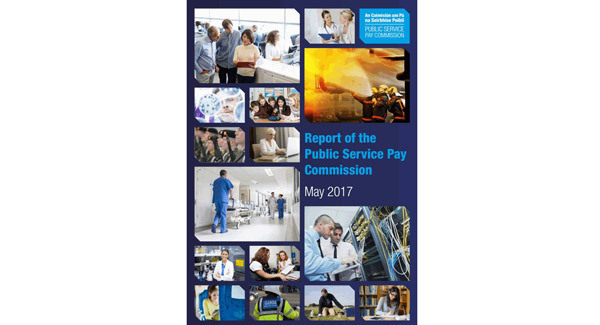
A spokesman for the public services committee of the Irish Congress of Trade Unions said: “It is now time to move swiftly into negotiations with a view to accelerating pay recovery for workers whose incomes are significantly lower than they were eight years ago.
"Our priorities in the talks will be to restore incomes as quickly as is sustainably possible and to protect the value of retirement incomes.”
The Association of Higher Civil and Public Servants pointed out that while the commission’s report confirms that average public service earnings are 8% lower than in 2008, “we know from research we commissioned that our members are earning up to 60% less than they would be if they were in a similar role in the private sector”.
“Our members were subject to more pay deductions that any other section of the public sector during the financial emergency,” said AHCPS general secretary Ciaran Rohan.
“Not only were their salaries reduced and taxes increased, they have also been working with increased workloads, serious staffing shortages and changes to their terms and conditions, many of which were very anti-family friendly. The financial emergency is now over and it’s time for our members to receive the pay recovery that they have waited for longer than anyone else.”
The Alliance of Retired Public Servants said it was disappointed the commission failed to address the issue of pension restoration for those 140,000 former public servants who are living off their pensions: “The Programme for Partnership Government commits the current administration to fully restore pensions for retired public servants by 2021 and the Alliance is looking to bring this timeline forward.”
The alliance said it had sought a formal process of engagement between pensioners’ representatives and the Government.
In that context it said it took heart from recent comments by Oonagh Buckley, chief executive of the Workplace Relations Commission, indicating that retired public servants will be included in the forthcoming talks process.
Meanwhile, employers’ body Ibec said an “orderly” approach to pay bargaining is vital to ensuring the public sector remains dynamic and efficient.
Ibec chief Danny McCoy said: “Ibec acknowledges that the report of the Public Service Pay Commission provides a framework to develop a stronger, more cost-efficient and even more reliable public service with conditions that reflect current economic realities.
“We welcome the focus the report offers on the value of public sector pensions, which it values at 12%-18% above their private sector counterparts. This premium needs to be reflected in any public sector pay negotiations.
"Coupled with this, it remains important to Ireland that the public service addresses skill shortages and that it attracts the best and the brightest young people as they enter the workforce.”
The Association of Secondary Teachers Ireland (ASTI) remains the only union not signed up to the Lansdowne Road Agreement, but it is open to it to take part in the upcoming talks.
However, Public Expenditure Minister Paschal Donohoe reiterated past Government assertions that its members would not be entitled retrospectively to any benefits of the LRA, even if they accept any new deal.
The ASTI yesterday announced a convention on June 10 to discuss a motion proposing that, pending the outcome of the public service pay talks, it suspend industrial action in relation to the LRA and junior cycle reforms.
However, this would be provisional on ASTI members being treated equally to other public servants who signed up to the LRA.
The event is to be held in response to a petition with more than 1,000 signatures, largely prompted by concerns ASTI members are not eligible for permanent contracts after two years like other teachers whose unions accepted the LRA.