Navy gears up for further Med migrant rescue missions
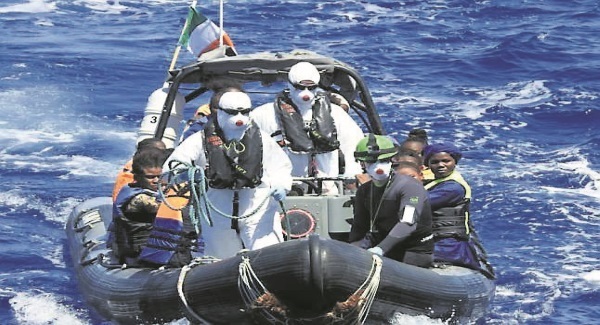
The Italian authorities, who helped co-ordinate LÉ Róisín’s rescue of 125 migrants yesterday, have reported a significant rise in the number of Syrian refugees being taken from potentially lethal wooden barges and inflatable dinghys.
LÉ Róisín, which is captained by Lieutenant Commander Ultan Finegan and has a 57-strong crew, plucked 107 men and 18 women “crammed like sardines” from a dinghy after being alerted by the Italian authorities to the presence of the vessel 74km north-east of the Libyan coast at 10.47am.
All the migrants were taken onboard by 2.45pm, were given food, water, and medical treatment, while the naval vessel awaited orders about either transferring them to another rescue ship or taking them into an Italian port for processing.
LÉ Róisín was steaming to an Italian port last night after a further 240 migrants were transferred to her by the Italian ship, Comandante Borsini, which rescued them in a similar area.
The Irish mission is running seperately to a more aggressive one led by some other EU countries which are trying to stop refugees leaving the Libyan coast.
According to a leaked document, plans are being put in place to create “a floating hotspot” to process up to 1,000 migrants at a time.
The plan was contained in a memo sent from the Dutch presidency of the European Council to other national governments, including the British, to take more aggressive action to prevent people-smugglers from launching craft from camps crammed with refugees.
It was LÉ Róisín’s first migrant rescue since she left Haulbowline on May 1 and adds to the total of 8,592 plucked from the sea in the region last year by the crews of LÉ Eithne, LÉ Niamh, and LÉ Samuel Beckett.
Meanwhile, the Immigrant Council of Ireland (ICI) said the need for search and rescue missions on the dangerous crossing from Libya to Italy remains great.
ICI chief executive Brian Killoran said LÉ Róisín’s latest rescue was a source of national pride, but our efforts must not stop there and it’s important we also offer safety, protection and hope to the rescued.
“Our government must honour its commitment to take in 4,000 people by the end of next year and at EU level ensure that those who are in immediate danger are offered legal channels to enter Europe,” he said.
Analysis: 13