President: Will refugee response be defined by barbed wire and tear gas?
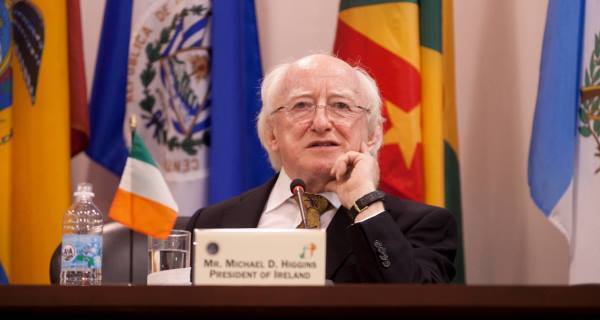
Mr Higgins said some member states took a ruinously and narrowly self-interested response to the crisis of more than 1m refugees fleeing war and persecution.
In a speech on the future of the EU, the President asked why a continent of 500m people felt so threatened by those in need.
He told the Irish Association of Contemporary European Studies in Dublin that Greece, Italy, and Malta have been left to rely largely on their own limited resources after an EU quota system for migrants was rejected.
“European media have tended to conflate the image of Europe with that of the small Greek island of Lesbos; they have presented to us a vision of Europe as a frail isolated rock overwhelmed by a tsunami of uprooted people,” he said.
“When one considers the prosperity and the rich diversity of so much of Europe — where so many people from all regions of the globe have settled peacefully and successfully over so many decades — confidence, not apprehension, should guide our response to the arrival of new migrants.”
The President called on people to breathe new life into the EU vision.
He said: “Can we leave millions of mothers and fathers, teenagers, children, and babies, to wait in uncertainty, hopeless poverty, and squalor?
“Can we avert our gaze from the even larger numbers of those who are trapped in precarious camps in Turkey, Lebanon, and Jordan? Is our response to be defined by barbed wire, tear gas, and rubber bullets?”
President Higgins outlined other areas of difficulty facing the EU, which he said were daunting. He highlighted enduring economic and financial difficulties and youth unemployment, the terror threat in the wake of the Paris and Brussels attacks, xenophobic populism, and “political strategies that put at risk genuine democratic pluralism in several member states”.
“The combined effects of such difficulties are deeply corrosive of our citizens’ confidence in both their national and European institutions,” he said. “Alarmingly, those various crises only fuel and amplify one another.”
The President said European leaders are trying harder to curb the numbers of refugees “at all costs”.
He said they are doing this out of fear exacerbated by the threat of terrorism and to reassure public opinion which tends to view a “security crisis” and “refugee crisis” through the same lens.
Mr Higgins
said the controversial Turkey-EU deal to curb the smuggling of migrants and refugees to Europe was an important step.
But he added: “I strongly believe we should be wary of bending European and international human rights legislation to breaking point.”
President Higgins asked if a politically convenient response today could jeopardise the European Union in the future.
He said the EU has a duty under the Geneva Convention to help refugees.
“To give protection, food, and shelter to those who are fleeing war, oppression, or starvation is a matter of fundamental, universal human solidarity. It is also a matter of legal responsibility,” he said. “There can be no cap on this fundamental responsibility, no limit set on the number of those eligible to request asylum.”