National Archives 1985: Thatcher- FitzGerald talks on a knife-edge
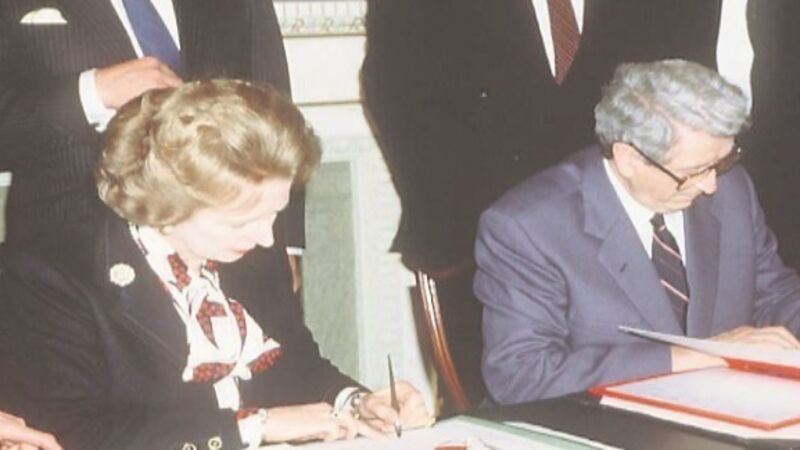
Then taoiseach, Garret FitzGerald warned the then British prime minister, Margaret Thatcher, in 1985 that he could not go ahead with signing the Anglo-Irish Agreement unless the establishment of joint courts was part of the deal.
National Archives 1985: Thatcher- FitzGerald talks on a knife-edge

The Fine Gael leader also expressed concern that members of his own government were becoming sceptical about negotiations on the agreement.

“I have persuaded them to go along with what is happening but with difficulty,” said the Taoiseach of his cabinet colleagues.


State papers released under the 30-year rule show that Dr Fitzgerald feared the damage a breakdown in talks between the two governments could do to political stability in Northern Ireland.

Thatcher believed that hostile reaction to the agreement could result in civil war: “Both parts of Ireland could be in danger,” she observed.

At an hour-long meeting between the two leaders in Milan on the fringes of an EEC summit on June 29, 1985, Dr Fitzgerald said the agreement at that stage was “just about saleable” to voters in the Republic.

Joint courts which would include a member of the judiciary from the Republic were a necessary part of the proposed agreement, said the Taoiseach.

However, Mrs Thatcher said there was no possibility of her agreeing to such a measure in advance of the signing of the agreement.

The Taoiseach insisted the issue had to be addressed in advance as there was a view among the Irish public that he had been “led up the garden path”.

He argued the establishment of three-judge courts without a jury should not cause controversy, citing Ireland’s Special Criminal Court as an example. The British prime minister countered that the unionists would regard the setting up of joint courts as “a foot in the door”. Comparisons could not be drawn with the Special Criminal Court in Dublin as there would be judges from different jurisdictions acting in situations of heightened tension.

The Anglo-Irish Agreement which was signed in November 1985 gave the Irish government an advisory role in the governance of Northern Ireland in return for no change in the constitutional position of Northern Ireland without agreement by the majority of its people.

In the preceding months, both leaders considered the possibility of announcing associated measures, such as reform of the security forces, at the same time as the signing of the agreement.

But the Taoiseach said: “By the time the measures you mention are put in force, in the way you are speaking, the whole effect of the agreement will have evaporated. I have put my personal authority on the line here.”

He told the British prime minister that she must understand he was not seeking these things for the benefit of citizens in the Republic. “Our people just do not want to be involved in Northern Ireland. The Irish people are not really interested in the North — they are switched off that subject for the moment,” said Dr FitzGerald.

She heard that Irish voters were more concerned about tax and unemployment than the situation in Northern Ireland. The Troubles would never have started if the right thing had been done back in 1969 when nationalists wanted a right to be represented in parliament, said Dr FitzGerald. In an emotional speech, the taoiseach spoke of the personal risks he was taking, but stressed that Margaret Thatcher could be doing what British policy had been trying to prevent for more than 800 years — allowing Ireland become a base for attacking Britain.

“This is a historic opportunity, I do not know what history will say if we miss it,” Dr FitzGerald remarked.

He pointed out the Irish government had the same interest in avoiding an uncontrollable unionist reaction as Britain.

Thatcher became visibly moved when the taoiseach outlined how an RUC officer who had been involved in controversial incidents including the death of a child in the Divis Flats in Belfast and the burning of homes in a Catholic area at the start of the Troubles had recently been promoted to one of the highest offices within the RUC.

She doubted Mr Hurd would have been aware of the situation — an observation which was pounced upon by the taoiseach who said it was the point he was trying to make.

She stressed the significance of Dublin being given a constitutional right to consultation under the proposed agreement. “To [John] Hume that may not look much. But it will bring out the Paisleyites,” observed Mrs Thatcher.

“That reaction could put the whole thing in jeopardy,” she added.

A briefing note prepared by a senior Irish diplomat involved in the bilateral negotiations just weeks before the meeting observed that Ms Thatcher “wanted to do something”.

However, he observed that she had “no real historic feel for the issue”.

He also noted: “Each time she meets the taoiseach she is ‘re-energised’ on the issue. But she also misses a lot of what he says, through too-rapid delivery on his part.”

x

More in this section

Lunchtime News

Newsletter

Keep up with stories of the day with our lunchtime news wrap and important breaking news alerts.

Cookie Policy Privacy Policy Brand Safety FAQ Help Contact Us Terms and Conditions

© Examiner Echo Group Limited