Most Irish roads have some surface or structural damage
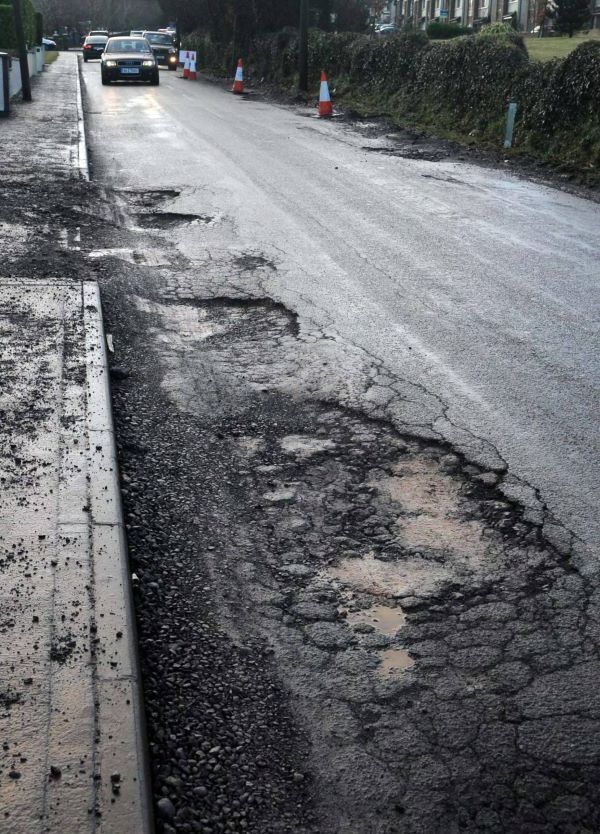
Most of the damage is to road surfaces with almost three quarters of all roads displaying some degree of erosion, shallow cracking, or impaired grip for drivers.
But structural distress — mainly deep cracks, potholes and disintegration — is evident on almost a third of tertiary roads, the most minor public roads.
Conditions vary widely across the country. Kildare has the highest proportion of larger roads that are severely deteriorated with 2.3% of its regional roads and 2.5% of its local primary roads classified as “virtually undriveable” — a description that also applies to 16.3% of the tertiary roads in Mayo.
Offaly has the most structurally deficient roads overall, with an average of 36.4% of its roads in some degree of structural distress.
Yet Offaly also has one of the biggest proportions of roads in top condition — on average 26%. Dublin City has the highest overall at an average of 30.6%.

Every council was asked to contribute to the survey for the National Oversight and Audit Commission (NOAC), but the scale of task meant only a handful had details on every single road in their jurisdiction by year’s end.
NOAC said that while the data was incomplete, key messages had emerged that illustrated the difficulty in improving the 90,000km of regional and local roads.
The survey found just 24% of all regional roads were in top condition. Almost half, 44%, had moderate to extensive surface damage, 24% had moderate to significant damage and 8% were suffering structural distress.
Conditions deteriorated for local roads and worst of all were tertiary roads with just 10% classed in top condition, 59% found with surface damage, and 31% with structural problems.
Around two thirds of all fatal accidents take place on local and regional roads but spending on repairs and maintenance of these roads fell by 38% from 2007-2012.
The Road Safety Authority said the age of some roads — which date back to famine times — and recent bad weather also contributed to poor conditions.
Spokesman Brian Farrell said: “Our roads, and especially local minor roads, have taken a battering after the severe weather and especially all the heavy rain. Potholes have been formed and there has been some subsidence as well on roadsides and margins.”

However, he said driver error remained the major problem.
“Good quality roads are essential but the vast majority of collisions are caused unfortunately by our own behaviour,” said Mr Farrell. “We know what the weather’s like, we know how conditions are and we know the road surface has been damaged so we have to tailor our driving accordingly.”
NOAC said the maintenance and improvement of roads presented “difficult decisions” for councils in allocating public funds.