Former presidents and taoisigh remember the ‘peacemaker’
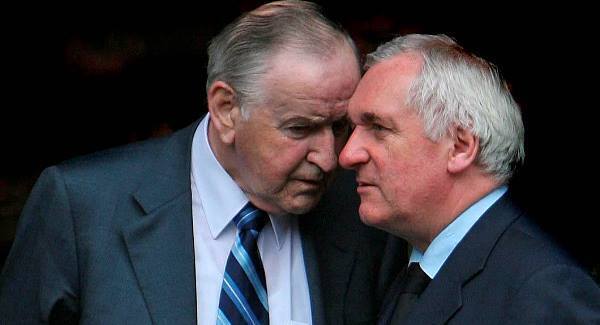
Former presidents, taoisigh and cabinet colleagues have paid tributes to peacemaker and former taoiseach Albert Reynolds, who died after a long illness.

Former presidents and taoisigh remember the ‘peacemaker’

Former president Mary McAleese said Mr Reynolds was able to navigate “dangerous waters” when he persuaded British prime minister John Major to stay with the peace plans.

“That was his great capacity to see a deal through to conclusion and be essentially the main navigator.

“It was Albert who coined the idea that 90% of something was a lot better than 100% of nothing. That was the pragmatic, the entrepreneur in him, the consensus builder, that was the experienced dealmaker.”

He was the “linchpin” of the peace process, she told RTÉ radio.

Former president Mary Robinson said: “I remember him saying ‘we’ve got to stop the violence, let’s not be political about this, let’s stop the violence’.”

“The bond between Albert Reynolds and John Major was very important. It cemented a process where the two governments would stay together, no matter what happened, and there were many pitfalls afterwards. He said ‘We’ve got to get peace, people cannot go on being killed, we cannot go on with this kneecapping of youngsters’.”

President Michael D Higgins, who served as a Labour minister under him in the early 1990s, remembered his dynamic manner.

“When I served in cabinet with him, I found him to be very supportive of many of the cultural initiatives which I introduced. I recall his great courtesy and relaxed manner in all our dealings on various issues.

“He was also a successful businessman and continually used his business contacts in his work on Northern Ireland.”

Former US president Bill Clinton said Mr Reynolds worked hard and risked much as taoiseach to advance the Northern Ireland peace process.

“His leadership alongside British prime minister John Major was instrumental in laying the foundation for the Good Friday Agreement, and our world owes him a profound debt of gratitude. I will always be grateful for his encouragement, advice, and support in the peace process.

Dick Spring, who lead Labour into coalition with Mr Reynolds’s Fianna Fáil in 1992 said: “He displayed admirable negotiating skills in his dealings with John Major, with whom he had a very special relationship, in bringing president Clinton to play an important role in the peace process, and in his dealings with Sinn Féin/IRA, which brought about the 1994 ceasefire, without which a solution would not have been arrived at. The Downing Street Declaration was the foundation stone which led to the Good Friday Agreement.

“He deserves to be remembered and respected for his major contribution to bringing an end to the violent conflict on the island of Ireland, which blighted our history for so many decades.”

Former taoiseach Brian Cowen, first appointed by Mr Reynolds to cabinet in 1992, said he was a statesman who had a simple objective to end violence.

“He was the driving figure in bringing about the Downing Street Declaration, which laid firm foundations for peace to be built. The other great triumph of negotiation from Albert’s time as taoiseach was the IRA ceasefire in 1994, which was closely followed by a loyalist cessation.”

The 20-year anniversary for that same IRA ceasefire falls on Saturday week.

“He was a man who came to that job with a mission really. He had in mind to do something, and it wasn’t the quantity of time he was going to spend, it was the quality of time.”

Taoiseach Enda Kenny said: “As taoiseach he played an important part in bringing together differing strands of political opinion in Northern Ireland and as a consequence made an important contribution to the development of the peace process which eventually lead to the Good Friday Agreement.”

Tánaiste Joan Burton said he would leave behind a legacy of achievement for his country, most notably working with tánaiste Dick Spring for peace in the North.

Fianna Fáil’s Micheál Martin praised the former party leader’s business acumen and role in securing huge funds from Brussels.

“He brought an entrepreneurial spirit to the fore in Government, transforming the telecommunications industry in this country and developing the concept of county enterprise boards, enabling community-based entrepreneurship and creating an infrastructure that survives to this day.

“He built many strong relationships with leaders in the European Union and used these to ensure real influence for Ireland, which culminated in him securing an unprecedented allocation of structural funds for the country.”

Remains to lie in repose at Mansion House

by Juno McEnroe, Political Reporter

Members of the public will get a chance to pay their final respects to Albert Reynolds, whose remains will lie in repose in Dublin’s Mansion House tomorrow ahead of a state funeral on Monday.

Books of condolences have opened in a number of locations for the twice-serving Taoiseach, who died at the age of 81 yesterday morning following a long illness.

His family confirmed that he passed away peacefully at 2.52am with his wife Kathleen and others by his side.

Tribute messages are being left at the headquarters of Fianna Fáil, Government Buildings, and at Mr Reynolds’s home county of Longford. Messages have also been left at the Department of Finance, where he was once minister.

Mr Reynolds’s remains will lie in repose at the Mansion House between 1pm and 6pm tomorrow.

Members of the public will have an opportunity to file past the coffin and pay their respects to Mr Reynolds and to sign a book of condolences.

Mr Reynolds’s remains will then be removed to the Sacred Heart Church in Donnybrook for 7.30pm.

Following a service there, the public will be able to offer their condolences to the family.

The funeral Mass will commence at noon on Monday. Some seating will be reserved and a limited number of remaining seats will be available for the public. The service will be relayed outside the church.

Mr Reynolds will be buried with full military honours at Shanganagh Cemetery, Shankill, Dublin.

The cortege is expected to arrive at the cemetery between 2pm and 2.30pm.

President Michael D Higgins, Taoiseach Enda Kenny, former Fianna Fáil leaders, Archbishop Diarmuid Martin, and other dignitaries are expected to be in attendance.

Flags will be flown at half- mast on Government buildings until after the funeral.

Mr Reynolds first entered the Dáil in 1977 and went on to be Taoiseach in two separate terms between 1992 and 1994, in Fianna Fáil’s coalition with the Progressive Democrats, and then with Labour.

He was Taoiseach during controversies such as the X case and the Beef Tribunal.

He played a key role in advancing the North’s peace process, including the 1994 IRA ceasefire.

His relationship with former British prime minister John Major, according to Fianna Fáil leader Micheál Martin was “instrumental” in the peace process.

Mr Reynolds’s successor Bertie Ahern, said he played a key role in securing resources that “gave the kick-off in the 90s to the Irish economy”.

Mr Reynolds is survived by his wife Kathleen, two sons, and five daughters.

x

More in this section

Lunchtime News

Newsletter

Get a lunch briefing straight to your inbox at noon daily. Also be the first to know with our occasional Breaking News emails.

Cookie Policy Privacy Policy Brand Safety FAQ Help Contact Us Terms and Conditions

© Examiner Echo Group Limited