World-record signing for school visitors’ book
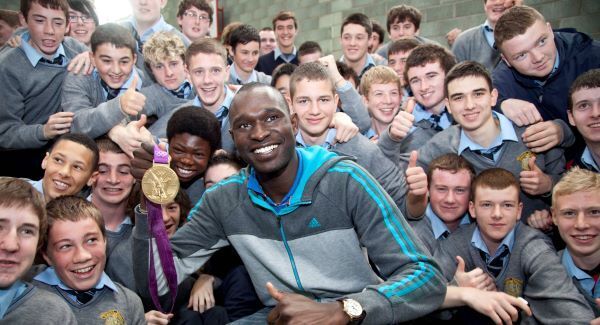
If your name is David Rudisha, your entry is, literally, unbeatable. It reads: “800m 1:40:91 (WR),” and it accounts for the latest entry in the log at Mallow Patrician College.
With none of the razzmatazz we associate with celebrity, the world-beating Kenyan runner drew up in the yard of the North Cork college yesterday in a well-travelled blue Ford Focus driven by his modest but brilliant coach, Brother Colm O’Connell.
Teachers and students were out in force to welcome the pair to the first official event at the school’s new €1m sports centre.
Wearing a tracksuit top and jeans, and devoid of any bling apart from a certain gold medal, the soft-spoken world-record holder stopped on his way to the centre for a few words with fifth year student Solomon Adebisi.
Originally from Nigeria, but living in Ireland for the last 10 years, Adebisi is a rising star in athletics and was part of the team that won the Munster multi-event 4x100 U19s this year.
“He told me to keep working on improving myself, to make sure to stay motivated, to train very, very, hard,” Adebisi said, with more than a hint of Cork in his accent. Adebisi later persuaded his hero to sign a pair of shorts belonging to his club colleague Dean Cronin, Irish 800m champion and member of Blarney/Inniscarra AC.
“Mallow of all places,” he said, bemused, when asked how he felt about Rudisha visiting his school. “It’s insane. But it’s a dream come true.”
It was always going to be Mallow when you consider where his coach and mentor hails from. Br Colm comes from Caherduggan, a couple of miles down the road, and attended primary school at St Patrick’s Boys National School in Mallow, where the pair also paid a visit yesterday. The decision to visit Mallow was mutual — Br Colm has met Rudisha’s family and been to his ancestral home in Kenya and it was important to both that the visit was reciprocated.
“It’s very special for me, you know; he is the person behind my success” Rudisha said. “I didn’t expect this reception. It was great, because I love to be associated with students, it’s good to be a role model for them and to inspire them.”
And he was inspirational. When he stood up in the new sports hall to address the crowd to a cheer almost as rousing as the time he crossed the line in London’s Olympic Stadium, he had every student’s attention.
“You are the future of this country,” he said. “You are the future of the world... I know you have a lot of dreams... keep on working very hard because that is what will change your future.”
He also spoke of the need to respect teachers, parents, “the people around you”, and of the need to be willing to make sacrifices in order to succeed. He sacrificed his summer holidays and the opportunity to visit his family in order to train under the astute eye of Br Colm, Rudisha said.
Br Colm, who left Irish shores in 1976 to join the Patrician Brothers in Kenya, has developed extensive training camps there and is visited by all kinds of experts in the field of athletics who want to learn from his success — he has produced eight Olympic medallists and 20-plus World Champions. “I concentrate on the person and not just the talent,” Br Colm says when asked what his secret is.
“Sometimes we start from where we would like to be, not from where we are. I try to develop the whole person and not just the athlete. In today’s world, individualism can creep in.”
The success of his approach has prompted invites from clubs all over Africa and Europe and visits from no less than Irish Olympian Eamonn Coghlan, from Fionnuala Britton, Irish steeplechase specialist, and Sligo sports psychologist Caroline Currid, who has worked with the Munster rugby team, as well as the victorious Tipperary hurlers in 2010 and the Dublin footballers in 2011.
The good news is the Kilkenny hurlers can be beaten. “It’s like saying the Kenyan runners can’t be beaten. It’s nothing to do with genetics — research has shown that. It’s a culture. You can’t start thinking your opponent can’t be beaten,” Br Colm says. “It won’t get you anywhere.”