Timely eye test saved Sinéad’s sight
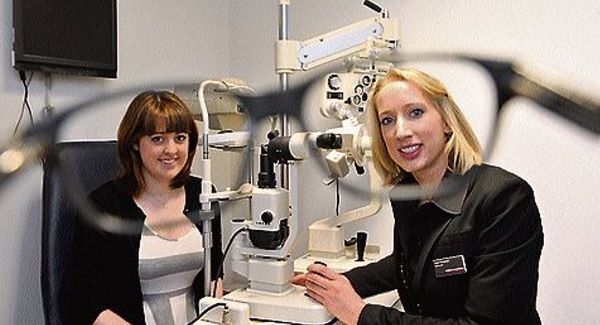
Sinéad Ryan, 21, went back to her opticians yesterday to thank the optometrist who spotted the “one-in-100,000” abnormality in her eyes which, undetected, could have cost her eyesight or triggered a potentially fatal stroke.
Last month Sinéad, from Passage West, Co Cork, began suffering constant headaches. A GP prescribed migraine tablets but warned her that if the headaches persisted, she should go to hospital.
When the headaches continued, Sinéad’s mother took her for an eye test at Vision Express, Merchant’s Quay, Cork.
“I was expecting to come out with glasses. I really wasn’t expecting to be going to the emergency department,” said Sinéad.
Jean Donovan, resident optometrist in Vision Express, spotted retinal haemorrhage and unusual swelling around Sinéad’s optic nerve heads.
The symptoms, normally found in obese women over 40, can indicate a potentially fatal brain tumour.
She referred Sinéad to the emergency department of Cork University Hospital where, following a barrage of CT scans and a lumbar puncture, doctors ruled out a tumour and diagnosed high pressure in the fluid around Sinéad’s brain.
“That lumbar puncture was best thing they ever did. That evening I could feel all the pressure in my head was gone,” she said.
An eye test is recommended every two years. It costs €27 and takes 20 minutes, but is free if you have PRSI cover or a medical card.
The number of people with a diagnosed stroke is expected to increase by more than 25% to 29,000 by 2020, it has emerged.
The research, published yesterday by the Institute of Public Health, says greater focus on healthier lifestyles could help moderate the increase.
Experts have predicted a 6,000 rise in the number of adults with a diagnosed stroke between 2010 and 2012.
Age, family history, diabetes, high blood pressure, high cholesterol, smoking, unhealthy diet, physical inactivity, and alcohol misuse are the main risk factors for strokes.
Geriatric medicine consultant, Dr Ken Mulpeter, said a greater focus on prevention would help moderate the increases.
He also emphasised the value of early diagnosis of a suspected stroke.