City puts its faith in tower of strength
THE narrow lift is more akin to a cage and the buttons which control it are unglamorous and industrial: green for go and red for stop.
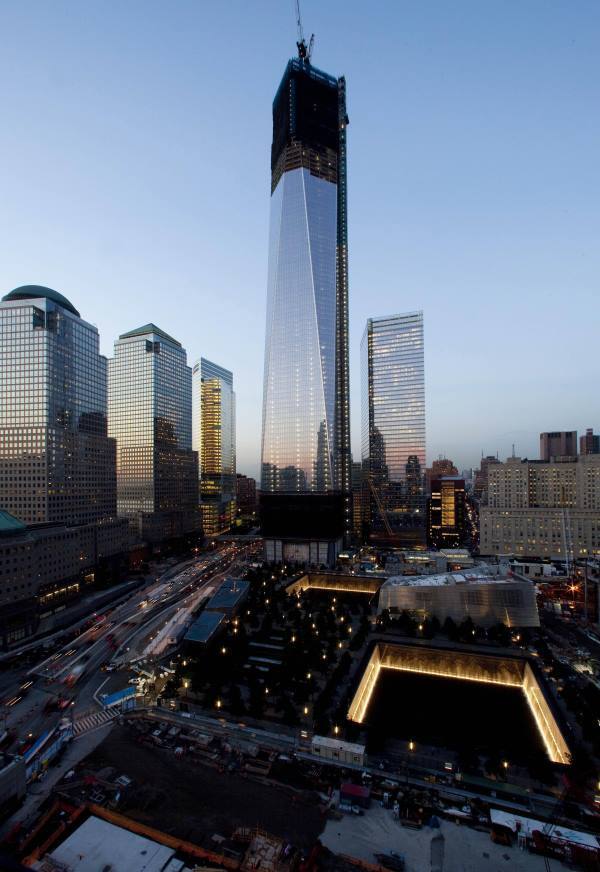
These functional surroundings are more than enough for now. One World Trade Center, previously known as the Freedom Tower, has topped out at 105 floors but it’s still one of the most complex building sites in the world. The signature skyscraper of a resculpted Lower Manhattan has cast an increasingly glorious shadow over the financial district since its foundations were finally completed in 2010 after a tense period of design, redesign and construction.
As the lift starts to rise, New Jersey and the Hudson River begin to shrink beneath us. The loud din distracts from the significant wobbling of our carriage as the Irish Examiner climbs skywards courtesy of the Port Authority, the New York/New Jersey alliance which oversees a vital network of infrastructure for citizens who dwell on either side of the river.
The first temporary base camp is the 39th floor. Turn down a bare corridor and a small Irish flag suddenly appears, hanging limply from a steel beam. A sizeable number of the 3,000 workers who make this a round-the-clock project are Irish and many more have come and gone. Over the last decade a total of 26,000 people have at one stage or another helped bring the World Trade Center to the brink of completion.
The design — both original and revamped — brought together a star cast of architects, artists, and urban developers, including Santiago Calatrava, David Childs, Norman Foster, Frank Gehry, Daniel Libeskind, Fumihiko Maki, and Richard Rogers.
Spaniard Calatrava was the man behind both the James Joyce and Samuel Beckett Bridges in Dublin, the latter bearing a not too dissimilar motif to his design for the new train station at WTC. The single soaring arc in the bridge is echoed by the futuristic glass-and-steel wings which sprout up from the newest major transportation hub in New York since Grand Central Station.
The station is intended to eventually accommodate 250,000 pedestrians per day while those retractable 150-ft-high wings will allow natural light to pass through to the rail platforms 60ft below street level which in turn will connect easily to the five WTC office towers, the World Financial Center, 13 subway lines and a proposed rail link to JFK airport.
Piling into another lift, it’s already starting to feel cooler, a welcome relief from the stifling heat of a late August Thursday afternoon in New York City.
From the huge base through to the top, the inner core of Tower One is exposed, waiting patiently to be spruced up. In no way does it look vulnerable though. Getting a close-up look at the steel and concrete which renders this incredible structure all the more powerful is the only way of really comprehending why Irish-American deputy director of the Port Authority Bill Baroni refers to 1WTC as the “strongest office building ever constructed”.
“We have to accept the fact that this is a target,” Baroni explained while strolling through what will be the imposingly large lobby.
“Every aspect of the design has safety as the primary concern. The glass is shatter proof. The concrete is about 14,000 lb/square inch as opposed to a sidewalk which is 2,000 lb/per square inch. There are separate stairwells for first responders in case of emergency.”
Despite the high-pressure manual labour going on all around us, the atmosphere is more relaxed than you’d expect. Even the industrial lift pipes out music although you’re more likely to hear Pearl Jam than inoffensive muzak.
After we step off the last of three lifts, we climb a slender ladder for about 20 feet and pull ourselves up on to the 103rd floor, the first of three floors which will form the observation deck. Through the red netting can be seen Brooklyn and Queens and the rest of Long Island. You’d dare not approach for fear of tripping over the obstacle course of nuts and bolts and long strips of steel. Stretching north is the rest of Manhattan and then west is New Jersey and everything else.
Save for a few midweek mountaineers in the Rockies, we’re perched higher than anyone in the country at 1,368 ft. The antenna, which is due to slot in later this year, will eventually bring it to the purposefully patriotic figure of 1,776 ft — to mark the year of the signing of the Declaration of Independence. 1WTC will be America’s tallest building, overtaking Chicago’s Willis Tower. Even the 88-story 2WTC will outstrip the evergreen Empire State Building when it is completed.
The main tower has risen up at an alarming rate, about a floor a week until this summer. But the controversy which marred and delayed the development of the 16-acre site was matched only by the complications enforced upon the designers “Lower Manhattan is more populous now than it was before 2001,” points out Baroni. “This area is a vital transportation hub and we had to be conscious of keeping everything moving.”
Making everyone’s life more difficult was last year’s tenth anniversary deadline. In order for the Sep 11 memorial site to be completed in time, improvisation was required and builders were forced to essentially build on stilts.
“When I first got here in 2010, this was still a hole in the ground,” recalls Baroni. “The work that had been done on the foundations was difficult to see. In some ways, we see the tower as a memorial to all those people who died in 2001 and 1993 but also a tribute to everyone who has worked here over the years.”
* American Airlines and United Continental must face trial over a lawsuit in which the lease holders of the World Trade Center allege that lax security allowed hijackers to destroy the Twin Towers on Sept 11, 2001.
Federal Judge Alvin Hellerstein in New York this week rejected a motion by American and United to have World Trade Center Properties’ suit seeking compensation thrown out.
The “defendants’ motion is denied”, the judge ruled. “The overlap between WTCP’s insurance recovery and its potential tort recovery presents issues of fact requiring trial.”
Al-Qaeda terrorists in hijacked planes from the two airlines smashed into the World Trade Center’s biggest skyscrapers on 9/11, demolishing both in a fiery collapse that killed nearly 3,000 people.
The owners had paid $2.805bn for the lease to the World Trade Center only two months before.
WTCP says that the airlines’ poor security at the time was to blame for their losses.
“But for the aviation defendants’ negligence, the terrorists could not have boarded and hijacked the aircraft and flown them into the Twin Towers,” the plaintiff alleges.
In his ruling, Hellerstein imposed a limit on what WTCP can seek of $2.805bn — the value of the lease, rather than the plaintiff’s original sum of $8.4bn, which it said would amount to a replacement for the lost towers.
The airlines had argued that WTCP had no right to seek further compensation as it has already received $4.091bn in insurance money.