Austerity Ireland gives the Government one last chance
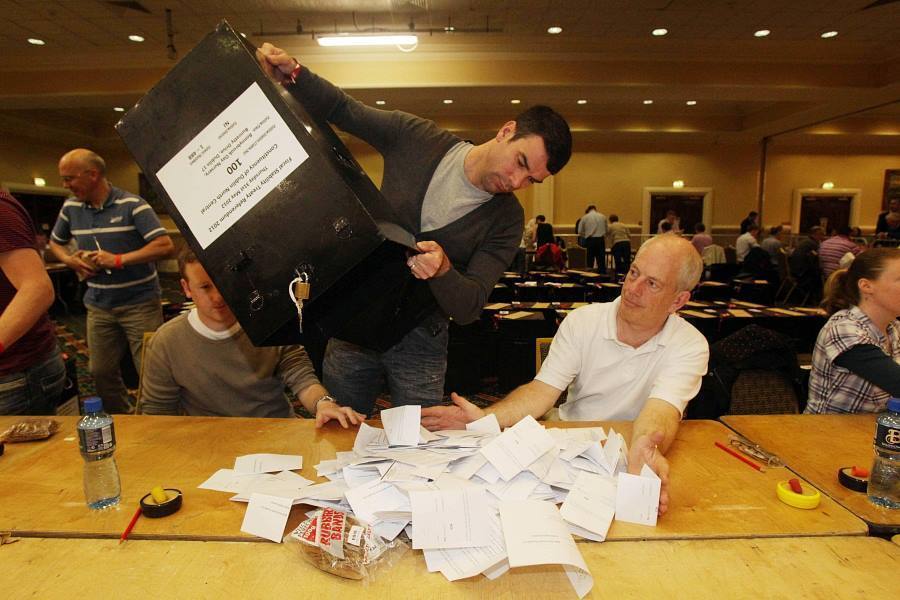
What made this referendum different to the other eight was that no sideshows were introduced into the debate. The old EU debate reliables of abortion, euthanasia and conscription which cropped up routinely in other referendum campaigns were nowhere to be seen.
Neither were the campaigns to save various hospitals, where local issues which had no relevance to European treaties became central to the referendum debate in certain constituencies. Groups such as the Roscommon Hospital Action Committee, which actively campaigned against the first Lisbon treaty although it accepted there was no link between the agreement and the hospital issue, were nowhere to be seen on this occasion. The coupling of unrelated issues, such as the IFA linking Lisbon and the World Trade Organization talks, was also absent in this campaign.
This time the campaign, and the debate, was pretty straightforward. Beyond the decision to enter the EEC in 1972, EU referenda in Ireland had become increasingly complicated, open to misunderstanding and downright manipulation on some occasions. Questions relating to such issues as enlargement of the EU, qualified majority voting, and a myriad of rules concerning how the union did its business often went over the heads of the electorate. The result was that the EU and its governance became incomprehensible to the general public. Moreover, a certain cynicism crept into Irish attitudes toward the EU. Nothing epitomised this more than the revelation that a serving government minister, Eamon Ó Cuív, declared he had voted against the first Nice Treaty, even though he had campaigned for a yes vote. In that context it was no surprise that the first Nice and Lisbon treaties were lost.
The fiscal treaty referendum was different. Firstly it was pretty easy for the electorate to understand, given that at its heart the treaty was concerned with rules limiting the size of government deficits. More important was the treaty’s introductory statement stating that countries which wanted to gain access to the EU’s permanent bailout fund — the European Stability Mechanism — would only be able to get funding if they had ratified the treaty.
And in those two words — “get funding” — we have at heart why the referendum was comfortably passed. This is not the Ireland of Nice I in June 2001 when the Celtic Tiger was booming, squandermania was at its height, and then finance minister Charlie McCreevy welcomed the result as showing the independence of the Irish voter. Neither is it the Ireland of Lisbon I in June 2008, where McCreevy, by then shipped to Brussels, but more worryingly Brian Cowen boasted they had not read the treaty, and where most citizens were oblivious to the portending doom of the bank guarantee scheme and the shuddering collapse of the economy.
No, this is the Ireland of the troika and the bailout. Most people expect the country to have to seek recourse to a second slice of funds from our current paymasters of the EU/ECB/IMF. This is the Ireland where hospitals and schools are being kept open only by the faceless bureaucrats.
We may complain about the interest rate. We may complain about the austere budgets. We may complain that we are slaves to German fears of high inflation. All of these complaints are valid. But the Irish electorate is sophisticated enough to know that the alternative is much, much worse.
And that was the problem the no campaign always had in this referendum. Nobody is for austerity. Nobody one is against growth. While labelling the treaty the “austerity treaty” was a nice touch the reality for those on the no side was that for ordinary working people voting no was just too big a risk to take. The simplicity of the view advanced by no campaigners — that by voting yes austerity would be institutionalised — was counterbalanced by more persuasive arguments of the yes side: That Ireland would be isolated in Europe by voting no. And that such isolation would by its nature bring even more austerity as the Government’s inability to access the ESM or borrow on the bond markets due an exorbitant interest rate would only result in one thing: yet more austerity.
Notwithstanding the comfortable yes vote, austerity Ireland is not going to go away anytime soon. People will expect action on the banking debt. The tragedy of private banking debt becoming sovereign debt did for Fianna Fáil in last year’s general election. If the Fine Gael/Labour coalition cannot make headway on this fundamental issue it runs the risk of a similar, if maybe not quite so catastrophic, fate. If nothing else Declan Ganley’s late foray into the campaign has put the question of a deal on banking debt full centre to the post-referendum world of Irish politics.
That is a world that is becoming increasingly complicated and congested. Fianna Fáil, particularly its leader Micheál Martin, had a good campaign. Nobody can doubt he put the country first during this campaign. Fianna Fáil has not always acted with such honour in opposition. The United Left Alliance had a reasonably decent campaign but for it to make a significant breakthrough in Irish politics there must come a time when it needs to articulate what it is for as opposed to what it is simply against.
SINN Féin faces something of a similar dilemma. It clearly poses a massive threat to Labour in urban areas. Chameleon-like, it put itself forward as the anti-austerity party but come the next general election it too will have to move beyond the platitudes that it is for growth. For it to truly realign Irish politics it will have to persuade that massive phalanx of yes voters that Sinn Féin’s constant opposition to EU treaties is more than just populist posturing. Otherwise its electoral success will stagnate around the border counties and the disadvantaged areas of urban Ireland.
That leaves Fine Gael and Labour. They have the hardest task of all. Now that the referendum is won they must get a deal for Ireland which brings hope to the people. If they can’t do it, this victory will mean nothing in a few years’ time as a people worn down with austerity are unlikely to give them another victory.
* Gary Murphy is associate professor of politics at Dublin City University
CONNECT WITH US TODAY



Be the first to know the latest news and updates