CORY listens to cosmos for signs of ET
Greg Johnson, who piloted the space shuttle Endeavour’s final mission in June, flicked the switch at the Big Dish Project at the National Space Centre’s (NSC) Elfordstown Earthstation facility at Midleton, Co Cork, making it the largest radio dish available for educational purposes in Europe.
Within seconds, the first cosmic microwave background sounds crackled through. The dish picked up the hiss from hydrogen atoms in a cloud up to 100m light years away, first emitted when dinosaurs roamed the Earth.
And while it will spend most of its time hunting and tracking giant hydrogen clouds — the birthplace of stars — it will also be able to detect digital or repeating signals from space which would indicate the existence of intelligent life.
The 32-metre telescope is being co-ordinated by Cork Institute of Technology in conjunction with its department of applied physics and instrumentation.
It will be linked to the award-winning Blackrock Castle Observatory, which is owned by Cork City Council and operated by CIT.
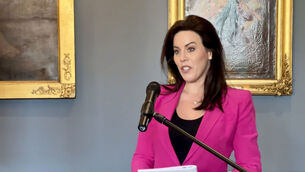
CIT’s head of research, Dr Niall Smith, said the dish was a great example of industry and education working together to educate and inspire the next generation of scientists and engineers.
“Today marks an important milestone in the new life of the 32m dish — as the community of users grows the limits to what can be achieved will shrink in equal measure.”
The dish will detect radio waves at 1.4 gigahertz and will provide a visual and audio display of the signals received. But it will also enable astronomers to “listen” to phenomena including:
* Enormous galaxy-scale jets from quasars.
* Violent eruptions of stars.
* Eruptions from the solar surface.
The dish was built in 1984 to transmit telephone calls between Europe and the US, but was retired in the mid-1990s when the underground transatlantic cables were laid.
To build such a device today could cost between €10 million and €15m.
However, scientists at CIT have upgraded it with new detectors for about €10,000.
Blackrock observatory ran a nationwide schools competition to name it and the winner, Rebecca Cantwell, 13, of Regina Mundi College in Cork, who christened it CORY — Computer Operated Radio Yoke — attended the switch on.
CORY can scan radiowaves 24 hours a day, even through clouds, giving radio astronomy a huge advantage over visible light astronomy.
It will be a testbed for engineering and science projects from primary through to PhD research, and will also be available to researchers around the country and abroad.
The aim is to link it via the internet to Irish schools, allowing pupils to control its movement and point it towards deep space objects.
CONNECT WITH US TODAY



Be the first to know the latest news and updates