Varadkar willing to sell Aer Lingus holding
Mr Varadkar said the sale of the stake was “certainly under consideration” but that no final decision had been made.
Ryanair said it would not bid for the Government’s 25% stake if the Government said its bid was not welcome. It also said in those circumstances it would consider selling its own near 30% holding to a third party.
The Cabinet is due to discuss a draft memorandum on the potential sale of state assets at its meeting today.
“We’re committed under the Programme for Government to find at least €2 billion in state asset sales, and then obviously the troika would like us to go further than that,” Mr Varadkar said.
“So a number of things are under consideration, certainly the energy companies and the aviation sector as well.
“No decisions are made, but that’s definitely one of the candidates,” he said of Aer Lingus.
He said the practical effects of the 25% holding in Aer Lingus were questionable, given it didn’t give the Government any control over the airline.
“The 25% was held in the thinking that it would give us some control over the company. In fact, it doesn’t. 25% is much the same as having 0%. And a blocking minority is 30% anyway,” he said.
“But it’s not as straightforward as that of course. The share price is quite weak at the moment and there are issues with the pension fund. So I’d only be able to sell the stake, or be willing to sell the stake, at the right time and at a good price, but in principle I have no difficulty doing so.”
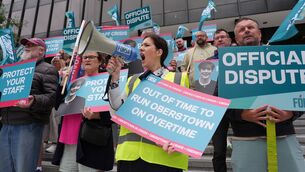
IMPACT trade union which represents Aer Lingus cabin crew said selling the “core strategic asset” would have long term consequences for the Irish economy.
“The consideration of the sale of the state’s share of Aer Lingus needs to be mindful of the lessons of the past, like the sale of Eircom.
“On that occasion the sale of strategic assets ensured that Ireland’s broadband services have, to this day, remained in the dark ages,” said the union’s national secretary Matt Staunton.
“We have learned, very much to our cost, what it means to abandon core assets that serve the interests of the state, its citizens and its industries in haste.”
Meanwhile, Finance Minister Michael Noonan welcomed the decision by Germany’s top court rejecting a challenge to the country bailing out other eurozone countries.
“We’re very pleased because if they had decided it was unconstitutional, the July 21 (EU) agreement would have all fallen apart and we wouldn’t have the interest rate reduction,” Mr Noonan said.
He also said it was important that the EU increase the size of its bailout fund to try and end the debt crisis.
“I think the fund is too small for what it is expected to do. But there are negotiations going on all the time.”
On domestic matters, he said the Government had yet to decide on the ratio of spending cuts to tax increases that would be announced in the Budget.
“No, we haven’t gone into that,” he said, adding that the Cabinet would first consider the spending review being prepared by the Department of Public Expenditure.