He was a political stalwart, loved despite his unpopular decisions
NEWS just after Christmas 2009 that Brian Lenihan was staying on in his high-pressure job as Finance Minister, though stricken by pancreatic cancer, caused no surprise to those who knew him well.
Politics was a central part of his life from his very first days. His father, grandfather, aunt and brother all served in Dáil Éireann and remarkably, up to yesterday, there had been a family member in Leinster House continuously since 1957.
Though racked by illness and the debilitating side-effects of chemo therapy, he soldiered on with vainly trying to steer a course for the nation through the worst financial crisis in the state’s history.
At Leinster House yesterday, the announce- ment of his untimely death, just over two weeks after his 52nd birthday, was greeted with deep sadness by all politicians.
Fate decreed that he was the main author of a whole series of deeply unpopular decisions which were also often decried as ineffective. But his bravery and persistence must also be recognised and yesterday there was a clear feeling that a huge amount of talent, commitment and ability had been stolen away with his passing.
Brian Lenihan was born in Dublin on May 21, 1959, into an intensely political family. His father, Brian senior, was already a member of the Seanad and was soon to become a major Fianna Fáil figure, holding some of the most senior posts through a very eventful lifetime in politics.
Brian’s grandfather, Paddy Lenihan, though perceived as a Fine Gael supporter, had been chosen by Fianna Fáil minister Seán Lemass to head a state-backed textile firm in Athlone, where he also branched out into the hotel business. Four years after Brian Lenihan senior was elected a TD, his father Paddy was also elected to Dáil Éireann and served until his sudden death in 1970 at the age of 67.
Brian’s aunt, Mary O’Rourke, had a three-decade career at Leinster House as TD, senator, minister and deputy leader of Fianna Fáil before defeat in the general election last February. His brother, Conor, completed the line-up, being elected TD in 1997, serving as a junior minister but also losing his Dáil seat in the recent election.
Unsurprisingly, Brian Lenihan came to Leinster House in the time- honoured fashion of Irish political dynasties — winning a by-election in 1996 in Dublin West following his father’s early death from cancer. But he got nothing easy in politics — even FF insiders had doubts about winning that by-election.
He had excelled at school in Belvedere College in Dublin, where he was also school captain. After studying law at Trinity College he went on to study at Cambridge, returning to teach law at TCD and also practise as a barrister.
He married lawyer Patricia Ryan, who is now a Circuit Court judge and they have a son and a daughter.
In politics, he had to wait until June 2007 for full ministerial rank.
Some observers blamed an uneasy relationship with Taoiseach and Fianna Fáil leader Bertie Ahern, possibly dating back to the very fraught 1990 presidential election, in which Brian Lenihan senior was candidate and Ahern director of elections. Others put it down to circumstance.
Under Ahern, he was appointed Minister of State for Children in 2002, a post which allowed him attend cabinet. It was widely believed he had been set for the more senior post of Government chief whip but circumstances intervened at the last minute. However, his handling of children’s policy — then, as now, a very tricky political job — was rated safe and competent.
After Ahern was returned for a third consecutive term in May 2007, Brian Lenihan was appointed justice minister — a job held by his father from 1964 to 1968. He brought his trademark courtesy to the post and collaborated with the Green Party in framing a draft civil partnership law which gave a wide range of rights to gay couples, but stopping short of marriage.
When Ahern was obliged to quit amid ongoing controversy about his personal finances, the new Taoiseach, Brian Cowen, appointed Lenihan finance minister in May 2008. Along with Tánaiste Mary Coughlan, he was meant to be the mainstay of a “younger, new-look, can-do government team”.
But reality intervened within weeks. Govern- ment revenues were in free-fall, the banks were mired in a mammoth crisis and there were some decidedly ropy early public performances by both a gaffe-prone Coughlan and by Brian Lenihan.
In September 2008, amid fears that the banks were on the verge of collapse, Lenihan and Cowen got government approval to guarantee bank deposits up to a maximum of €100,000 — a move worth a potential €400 billion in taxpayers liability.
The rest of his tenure was dogged by a deepening banking crisis, leading to the virtual nationalisation of all banks. These problems were compounded by arrogant behaviour from key banking figures and very slow progress in bringing anyone to book.
He brought forward that year’s budget day to October and soon found himself having to apologise and recant on key aspects of it — limiting pensioners’ medical cards and a levy on the minimum wage — after major outcry. One Fianna Fáil veteran at Leinster House noted at the time: “Rarely has so much political credibility been so squandered in pursuit of so little.”
By April 2009, Lenihan was left with little choice but to implement an emergency budget that set aside all previous measures. €3.25bn in taxes and spending cuts were introduced. Lenihan gained some credibility for his frank statement on the need to get the nation’s finances in order and restore confidence for potential investors.
This was followed in December 2009 with what was ranked as Ireland’s harshest budget in decades. Budget 2010 was characterised by huge public service pay cuts and tax increases. Lenihan erred again here by suggesting that the worst was over and the economy had “turned the corner”.
But amid all the tribulations and some public errors, Lenihan remained popular with the public for long periods. He was viewed by many within Fianna Fáil as a potential saviour in a repeatedly rumoured coup against Brian Cowen, which never appeared to materialise.
His popularity grew after news of his terrible illness broke, and he handled the following media scrutiny with dignity and fortitude. But the harsh realities of political made prospects of his succeeding Brian Cowen unlikely.
Things went from bad to worse for a crisis-hit economy and a foundering government. In November 2011 the EU/IMF came in and a huge amount of fiscal autonomy was ceded in the resultant bailout.
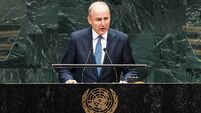
Brian Lenihan did stand for the FF leadership when Cowen was finally forced to stand down in January. But Micheál Martin easily won the leadership contest.
In the general election, however, Lenihan held his Dublin West seat — the only Dublin FF deputy to do so. He was appointed deputy leader and FF finance spokesman.
But the illness he battled for 18 months took its toll. And he died early yesterday at his home with his beloved wife Patricia and his children.