Banking bailout bill set to top €80bn
The Irish Stock Exchange has suspended trading in shares of Bank of Ireland and AIB from 6.30am today until details of the stress tests are announced and the Government makes clear its plans for rescuing the banks.
The stock exchange said trading was being suspended “to avoid the possibility of a disorderly market due to the circulation of information or rumours during the day”.
Shares in Irish Life & Permanent had been suspended yesterday after plunging earlier in the week following reports that the Government would take control of the financial institution.
The latest development came as the Government announced it was not going ahead with the sale of EBS to a private consortium.
A statement from the National Treasury Management Agency said the process was ended because Finance Minister Michael Noonan decided the bid was “not sufficiently commercially attractive to the state to merit continuing with the sale process”.
But the development places further pressure on the coalition as it seeks to show it has a viable plan to restructure the sector.
The Cabinet will meet this morning to sign off on Finance Minister Michael Noonan’s proposals. The Central Bank will then announce the results of the stress tests at 4.30pm.
Mr Noonan will inform the Dáil a short while later of the amount of money the Government intends pumping into the banks and how they will be restructured.
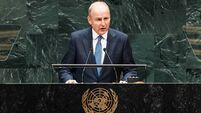
Taoiseach Enda Kenny told the Dáil that Mr Noonan would outline “definitive steps to ensure that we have a strong, working, credible banking structure”.
More than €46bn has already been pumped into the banks. Under the EU/IMF bailout, €35bn more was set aside. Of that €10bn has already been pledged, with €25bn seen as a contingency fund to be drawn down in the case of emergencies.
Analysts fear that figure will be swallowed up when the results of the tests are revealed today.
Part of the problem is trying to calculate the size of the black hole in the banks’ residential mortgage books.
Following stress tests last year, banks allowed for losses of about 5% on their mortgage loans books. This time around, that figure has been increased to 12%.
It is expected that both Bank of Ireland and IL&P will end up being more than 50% owned by the State under the new, tougher stress tests undertaken by the Central Bank and Blackrock Securities.
To date they escaped that fate, although Bank of Ireland is 36% owned by the taxpayer while AIB and EBS are already under state control. Both Anglo and Irish Nationwide, which are in the process of being wound up, are also owned by the taxpayer.
Revelations that IL&P could require up to €2bn in additional capital to fund its Permanent TSB banking arm rocked the markets. The bank will have no option but to rely on the state for that funding, which could mean the sale of its insurance arm.
Oliver Gilvarry, head of research at Dolmen Securities, said under the new circumstances it was hard to envisage that either IL&P or Bank of Ireland could avoid falling under “majority state ownership”.
IL&P refused to comment on that prospect, but a spokeswoman for Bank of Ireland said the bank hoped it would be given time to raise funds through independent means that would avoid the state having to pump more money into it.
Mr Gilvarry said the most crucial thing for the banks at this stage was “that this latest round of stress testing will draw a line in the sand as far as the ECB and the markets are concerned in relation to the banks”.