Woman ‘not entitled’ to make submission in embryo case
The submission was to have been made on grounds the Attorney General had, during the appeal, “completely misrepresented” the intentions of herself and some 850,000 people who voted in favour of the anti-abortion amendment in 1983.
The Attorney General’s argument that an embryo created as a result of IVF treatment is not an “unborn” within the meaning of the 1983 amendment (Article 40.3.3) and attracts no constitutional protection did not reflect her intention “to protect human life” when she voted in 1983, Esme Caulfield, of Brookwood Park, Artane, said.
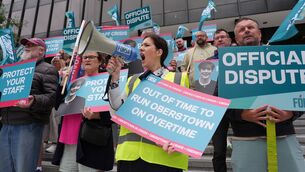
Ms Caulfield, who had supporters in and outside court, asked the judges to join her to the appeal as an amicus curiae (assistant to the court on legal issues) so as to make those arguments.
The Chief Justice, Mr Justice John Murray, told Ms Caulfield she did not meet the criteria for an amicus curiae and could not be joined at this late stage.
When Ms Caulfield persisted with questions as to how she could raise her concerns, Mr Justice Murray, warned her she was in danger of being in contempt of court and asked her to sit down.
The appeal, which opened earlier this month, then proceeded and concluded later with the five judge court reserving judgment.
A separated mother of two brought the appeal against the High Court’s refusal to order a Dublin clinic to release the three frozen embryos to her with a view to becoming pregnant against the wishes of her estranged husband.
The embryos were created after fertility treatment undertaken by the woman, now 43, and her husband in early 2002 and are stored at the SIMS fertility clinic, Rathgar, Dublin. The couple had one child in 1997 conceived naturally and a second child in October 2002 as a result of the treatment. They separated later in 2002.
The woman claims entitlement to have the remaining three frozen embryos implanted because of consents signed by her husband in 2002 relating to the fertility treatment and also the State’s obligation under Article 40.3.3 to protect and vindicate the right to life of the unborn. She contends an embryo is an “unborn” within Article 40.3.3 as, she claims, human life begins from conception.
In submissions for the State, Donal O’Donnell said the court could not, and should not, decide the issue of when human life begins. That was not for the court to decide and was an issue on which there was no scientific agreement.
Counsel repeated it was the State’s view embryos created as in fertility treatment, unless implanted in a woman’s womb, have no legal status here and are not entitled to Constitutional protection.
During exchanges with counsel, Mr Justice Adrian Hardiman remarked that 14 years had passed since the court had described as “a scandal” the State’s legislative inactivity arising from Article 40.3.3.

CONNECT WITH US TODAY



Be the first to know the latest news and updates