Robinson fears on deportation threat to family
Ms Robinson, who is also a former United Nations high commissioner for human rights, said the case of Pamela Izevbekhai and her daughters, Naomi, 8, and Jemima, 6, raised issues for the immigration authorities.
Ms Izevbekhai is due to hear today if the High Court will grant an injunction stalling a deportation order until a full review of the case takes place next year.
She has already lost one child, who died after a forced female genital mutilation ceremony in Nigeria and Ms Robinson urged a sympathetic response. “I obviously share the concerns about Pamela Izevbekhai and her daughters.”
“My hope is that this case will highlight a need for an approach that recognises the reality. To send a woman and her family back to an environment where they may be threatened with sexual violence or female genital mutilation raises very real concerns.”
Ms Robinson is based in New York with the Realising Rights human rights group, but was in Dublin for a conference hosted by the Joint Consortium on Gender-Based Violence, a coalition of 12 aid and development charities, plus Irish Aid and the Irish Army.
The consortium was formed four years ago to see how aid agencies, peacekeepers and the Government, through Irish Aid and the Department of Foreign Affairs, could tackle rape as a weapon of war in conflict areas and domestic and sexual violence in developing countries.
Colm O’Gorman, director of Amnesty International Ireland which is part of the consortium, said to deport the Izevbekhai family would breach the principles espoused by the project.
“It seems very clear to us the Government cannot be credible on gender-based violence if it fails to recognise this case and if the Minister for Justice doesn’t use discretion to allow Pamela to stay here.”
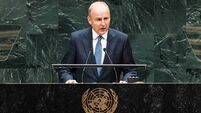
The conference, which heard from a variety of international speakers, was opened by the Minister for Foreign Affairs Micheál Martin who yesterday added his signature on the Government’s behalf to the international Say No To Violence Against Women campaign, sponsored by the United Nations Development Fund for Women (UNIFEM).
The UNIFEM campaign aims to collect one million signatures by November 25, the International Day for the Elimination of Violence Against Women. The Irish Government is the 35th government to have signed.
Mr Martin told the conference the Government was also committed to the principles of UN Security Council Resolution 1325, and says women must be adequately represented in all national and international negotiations on conflict prevention, conflict resolution and reconstruction in the aftermath of conflict.