Health service gets sick feeling as Halligan takes tonic away
HE accepted the challenge of overseeing the health service’s 96,000 staff yet issues raised by three teenage daughters proved “insurmountable”.
He would have handled an annual budget of €10 billion and overseen the biggest shake-up of the health service in the history of the State, but family life came first. To the more sceptical, the reasons put forward by Kevin Kelly, the executive chairman of the interim Health Service Executive (HSE), explaining why Professor Aidan Halligan will not take over as chief executive of the new Health Service Executive (HSE) are hard to stomach.
Back in September when he was appointed to lead the charge in the Government’s programme for health service reform, Prof Halligan declared it “a fantastic once-in-a-lifetime opportunity”, a chance to return to his Irish roots.
The Government billed him as the great white hope, the man most capable of delivering to the health service the tonic it desperately needed. Executive chairman of the interim HSE, Kevin Kelly, enthused that Prof Halligan’s acceptance of the post marked “the most tangible signal to date of the arrival of the HSE”.
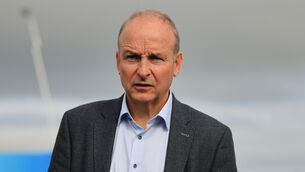
Prof Halligan’s colleagues in the NHS, where he is deputy chief medical officer, lamented his imminent departure. Erstwhile Health Minister Micheál Martin forecast that Prof Halligan would play “a critical role in achieving the Government’s ambitious programme of reform for the health service”.
The board of the interim HSE declared itself “delighted” by the appointment of Prof Halligan as the first CEO of the HSE. It applauded PriceWaterhouseCoopers, whom the board had retained as recruitment agents, “for having undertaken an executive search both nationally and internationally” to find the perfect man for the job. It paid PwC €36,000, excluding VAT, for its services, which included producing “a very high calibre list of candidates for the board to interview”.
Amazingly, considering the calibre of the candidates on its shortlist, it now seems none of these individuals will be called upon to fill the vacancy created by Prof Halligan’s decision to stay put. Instead, Kevin Kelly announced yesterday, it will be another six to nine months, and another bout of advertising nationally and internationally, before the health service will have its new chief. Prof Halligan did not, it turns out, sign his contract, because, Kevin Kelly said yesterday, it wasn’t “user-friendly” and he was working on redrafting it.
The position will be readvertised on the same terms. Nor had Aidan Halligan tendered his resignation as deputy chief medical officer in Britain. A spokesperson for the British Department of Health yesterday said he had not formally resigned because he was “waiting for all the (Irish) paperwork to be done”. The spokesman also said he believed the Irish media had “run away with the story” of Prof Halligan’s appointment “as if it was all done and dusted”. An examination of press releases on the Irish Department of Health website shows if the media did get carried away, it was as a result of what was drip-fed from the department.
Aidan Halligan has turned his back on a €330,000 salary, touted as the biggest-ever negotiated for an Irish public servant; a €40,000 relocation allowance, a €15,000 car allowance, a maximum bonus of 25% and a pension provision of 25%. A spokesperson for the NHS said yesterday that the band for his grade in Britain is £125,000 to £150,000. This translates to €178,000-€214,000, a hell of a lot less than what his Irish job offered.
The spokesperson also said there were no perks attached and no special package, scotching rumours that Prof Halligan was declining the Irish job because there was no financial incentive. So why has he changed his mind? Kevin Kelly protested yesterday that Prof Halligan’s decision was genuinely down to family concerns, which must not have been present last September when the interim HSE and then Health Minister Micheál Martin announced his appointment amid much fanfare. Neither must it have surfaced prior to Prof Halligan’s recent alleged participation in recruitment interviews for the second tier of HSE management, nor before he agreed a new start date - that he would take up his new post ahead of schedule on January 31, 2005, rather than April, to help handle the transition to a unitary health service. In fact, Aidan Halligan seemed so keen on meeting the challenge of reforming the Irish health service head-on that he was, according to the British Department of Health, sounding out loyal and interested colleagues in the NHS to tackle the challenge with him. So, it would seem, not only have we lost Aidan Halligan, we have lost a possible reforming team.
The Health Minister’s response? She “regrets his decision”, Tánaiste Mary Harney said yesterday, but she “respects it”.
The Taoiseach considers it “a pity”.
Fianna Fáil junior minister Batt O’Keeffe was less politically correct.
“Very awkward,” he said. “My own view is we are going to have to get on with it (health reform).”
Easier said then done. Even before he decided to step down, there were rumblings of discontent among unions whose members are affected by the proposed health reforms. IMPACT has already directed its 25,000 health sector members not to co-operate with HSE briefings in health boards and hospitals this week because of a lack of confidence in the way the health reform programme is being managed and a lack of consultation about changes. The result of a ballot on possible non-co-operation with the health reforms will be known on Friday.
The Irish Congress of Trade Unions has also sought clarification from the Department of Health on the level of consultation. Significant contractual and work practice issues have yet to be addressed. Yet, despite the reservations of staff on the ground, the Government is planning to publish the legislation to establish the new HSE on a statutory footing on Thursday. Yesterday the Taoiseach insisted Prof Halligan’s decision would not lead to delays in the Government plans for reform, but IMO industrial relations chief Fintan Hourihan was sceptical.
“I think it was significant that Kevin Kelly said they were working towards January 1 (as the start date for the new HSE), but with the qualification that it was subject to the legislation being approved. It wouldn’t be any surprise to me if that (legislation) was delayed.”
Irish Hospital Consultants Association secretary general Finbarr Fitzpatrick said the association was “very disappointed” given their understanding was Prof Halligan “had applied for the job first day”. At any rate consultants were not prepared to engage in reform until the indemnity row with the Government is resolved, Mr Fitzpatrick said, begging the question: In what direction exactly is the reform programme headed? It has no chief executive and no senior management team. It is without the backing of the consultants.
In the words of the Labour Party, the health service reform programme appears to be “in a shambles.”
THE health service reform programme involves:
Merging 10 health boards and the Eastern Regional Health Authority into one organisation, the Health Service Executive, creating the single biggest employer in the State.
The Government needs to legislate to allow the HSE take over the operation of the health system from January 1. That legislation is due for publication on Thursday.
The central corporate executive of the HSE will be based in Naas, Co Kildare. It will comprise nine directorates - including HR, primary, community and continuing care, population health, a national hospitals office, shared services, finance, change management and corporate affairs. The directors positions have not yet been filled but are expected to be by the end of this month.
There will be four administrative regions. The Western Region will have a regional health office in Galway City; the Southern Regional will have its office in Cork City; Kells in Co Meath will be the headquarters of the Dublin/North East Region and Tullamore, Co Offaly, the location of the Dublin/Mid-Leinster Region.
Each regional office will have 25-35 staff and co-ordinate on the ground with local health offices based in the 32 existing community care areas.
Hospital services will be delivered on an interim basis through 10 hospital networks.
A Cork-based Health Information and Quality Authority (HIQA) will ensure high quality of service across all aspects of service.
A National Hospitals Office (NHO) will oversee the re-organisation of acute hospitals, bringing all 52 statutory and non-statutory acute hospitals into a single unified structure.
The HSE will be responsible for the delivery, within budget, of publicly-funded health services and will manage the health service as a single entity. The Department of Health will still formulate policy.
CONNECT WITH US TODAY



Be the first to know the latest news and updates