Mercedes EQA review: An EV that delivers on its quoted range but that's about it
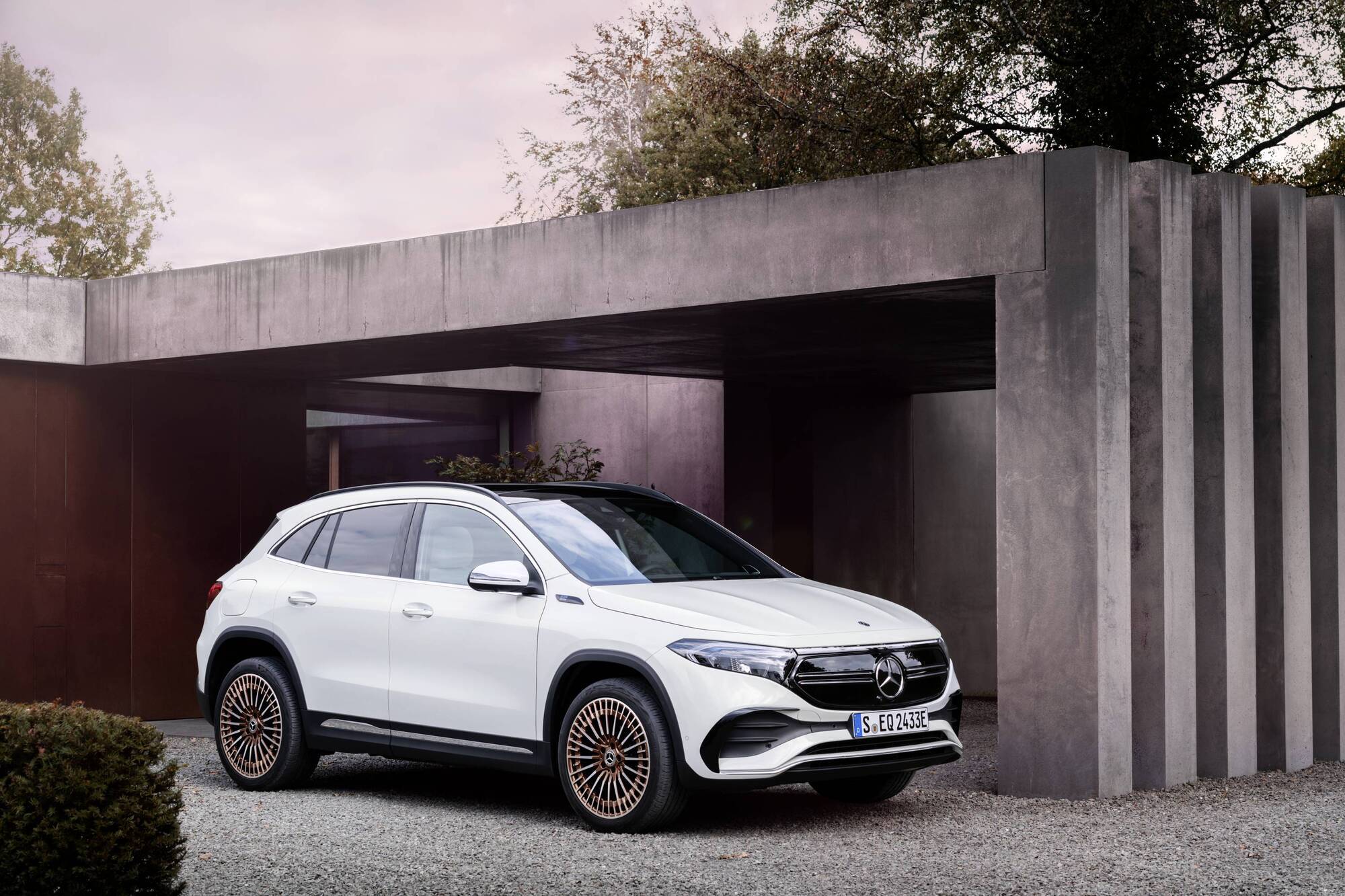
The Mercedes EQA is built on the same platform as the GLA — and looks very like it apart from a terrible-looking black plastic grille — but the high price tag is very unreasonable
|
Mercedes EQA |
|
|---|---|
|
|
★★★☆☆ |
|
|
from €56,120 - €57,546 as tested |
|
|
a 140-kW asynchronous electric motor powered by a 66.5 kWh lithium-ion battery |
|
|
well up to Mercedes standards |
|
|
not a fun car to drive, but it does what it says on the tin |

Over the last 18 months or so, we have not been exposed to the inner thinking of motor companies in the way motoring journalists regularly used to.
The Covid crisis has placed limitations on access to people at a high level in the industry, but at the recent Munich Motor Show, we were given an insight – via Zoom, it must be said – to Mercedes assessment on what’s coming down the tracks.
Now it must be said at the outset here that Mercedes has been rather behind the curve on the whole electrification process as pertaining to its future product, what with the likes of VW, BMW and Audi all racing ahead of the Stuttgart giant, but according to Marcus Schafer, Mercedes Benz Cars COO, that’s going to change rapidly soon.
He promised “a lot” of new electric product over the coming months, with five new EVs heading for a dealer near you in the very near future. There are currently just three electric Mercedes available right now, the EQC, the EQV and this week’s tester the EQA, but that’s about to change rapidly.
Indeed, Herr Schafer told us that Mercedes has now finished development of internal combustion engines, but were focusing on the development of hybrids which we will see in 2025/6 and also developing PHEVs with a range of up to 100 km electric-only driving.

He insisted that his company needed electric cars with an average range of 500 km because “range matters,” but it was intensifying development of ‘small’ batteries in order to address what he described as “the biggest transformation in the history of the auto industry as the car reinvents itself.”
With some 22,000 R+D engineers now deployed within the company and focused on the “electric era,” Herr Schafer was nevertheless ambivalent about the future of PHEVs in particular, saying only that Mercedes predicted a “decline in choices” for the customer in electric motivation in the coming years.
He stressed that PHEVs remained part of the plan – for now – but that Mercedes was keeping its’ options open on that one, depending on which way the regulatory authorities worldwide swing in the coming years, but warned petrolheads that “there will be no internal combustion engines after 2030 – that’s it.”
Asked about hydrogen power and hydrogen fuel cell technology, the COO said simply: “Green hydrogen is very expensive, so we at Mercedes think that battery is the way forward. We are all-in on battery.”
His colleague, Jorg Burzer, who is a member of the company’s Board of Management with responsibility for production and supply chain management, said Mercedes was not yet sure how the changing markets would evolve, but that it would develop strategy as things evolve. “It is a discussion we will be having constantly in coming years,” the Herr Dr. said.

Having spoken to these two very important men in the Mercedes hierarchy, it was clear were their priorities lie and that the ICE is dead as far as they are concerned; the company will make PHEVs as long as it is made to do so; and, battery development is top of their priority list right now.
We will see how those forward plans work out, but right now – in the here and now – the EQA is part of Mercedes’ initial electric-only prong and it is not a bad thing at all.
Based on the same platform as the GLA – which is unusual given that all major competitors have utilised completely new platforms for their initial electric forays – it also looks very like the GLA.
That said – and like so many other manufacturers – Mercedes has chosen to replace the striking grille design of the GLA with a plain black plastic strip and it looks terrible. As the necessity for added cooling for ICE cars led to interesting and eye-catching grille designs down the years, the electric era has only heralded uninteresting black plastic.
The rear end has been slightly rearranged too and there is now a light strip between the light clusters and this gives a hint of compatibility with the EQC. Overall, however, the design is flaccid by comparison with several of the concept EQA models we have seen heretofore.

Power comes from a 140-kW asynchronous electric motor which in turn is powered by a 66.5 kWh lithium-ion battery. This provides the equivalent of 190 bhp and 375 Nm of torque which, on paper, seems impressive for a small SUV, but in truth it’s not that great in reality.
Top speed is 160 km/h and the 0-100 km/h time is 8.9 seconds and if you think that electric offers you instant torque and light switch acceleration, think again. This is actually quite a ponderous beast and top end performance falls away quite rapidly.
The upside is that the quoted range is 428 km and the Mercedes – unlike so many other electrics we’ve tried – actually live up to the claim. And, not only will it deliver those kilometres on short and medium trips, but it will also do it while motorway driving.
Now highways are usually the rock upon which most electrics perish, chewing up vast amounts of juice in a ridiculously speedy timescale, but this one doesn’t.
If you’ve planned a 400km drive and most of it will be on motorway, you can feel comfortable that the car will deliver for you and not force you into unwanted and painful charging stops.

On the road the car is confident and sure-footed and while it might not be the best driving experience you’ll ever have, it is very capable over rougher B-roads and quite the sophisticate around town and on motorways.
The interior is – as ever – at the Mercedes end of the opulent scale. The excellent MBUX infotainment system is and object lesson in user-friendliness and the ‘digital plank’ twin screen system is state of the art. Décor is good, but don’t expect S-Class standards.
Boot space is poor and the rear legroom a bit tight and these are factors potential buyers are going to have to build into their purchasing decisions. Another thing to consider is that there is no spare wheel and for rural dwellers that is a serious no-no.
It has to be said too that the price tag is far from anything that could be considered reasonable for a small Mercedes. This is something that with such as the ID.4 on one side and the Audi Q4 e-tron in direct competition, Mercedes may well be forced to look at, because the EQA looks embarrassingly dear by comparison with either.

The EQA is a nice car to look at (apart from that terrible grille) and very nice to live with and in terms of where Mercedes is right now in their electrification programme, it is a timely and welcome addition to its range.
It’s biggest asset – aside from being a Mercedes – is that the range of the car is deliverable and trustworthy.
That fact alone makes it a very saleable contender in the growing electric ranks, but you’d have to expect – and especially so if you tend to believe the company big-wigs, as I do – that better stuff is coming down the line, rapidly.