Northern Exposure: How to drive from Cork to the Shetland Islands
In every sense, Shetland proves to be the ultimate highlight, writes Tom Breathnach 
Northern Exposure: How to drive from Cork to the Shetland Islands

On paper, the 1300km journey from Cork to Shetland seemed like quite the intrepid schlepp.

They say that sometimes, the journey is the destinaton, so surely, a road trip from Cork to the Shetland Islands would rank as one of the most epic escapades. Factor in the North Sea and Atlantic waters between Scotland, Norway and the Faroe Islands; Shetland’s remote location has traditionally left it off course for most travellers. But with a recent travel boost from Brits-on-lockdown, the growing appeal of nature-rich destinations and budding screen tourism due to BBC crime series Shetland, the islands are starting to emerge as an outdoors haven. All the more reason, then, I thought to load up the car boot and enjoy a winter escape to Scotland’s true north.


On paper, the 1300km journey from Cork to Shetland seemed like quite the intrepid schlepp. In practice, however, this ferry-drive adventure hopscotching through Antrim and Aberdeen would prove, pretty much, plain sailing. After setting off from Cork on a Sunday afternoon, by evening, my friend and co-pilot, Crona, and I were rolling aboard the P&O service from Larne to Cairnryan and following that two-hour crossing along the North Channel, we’re soon checking in to North West Castle Hotel in Stranraer, our budget overnight pitstop.

One could gladly anchor down to explore this region alone, but the next morning we motor on with our leisurely Scotland drive-thru. Brunch in Ayr on the west coast was followed by a scenic leg stretch at Turnberry Lighthouse, then after a scoot past Glasgow, Perth and Dundee until come evening, we’d reached the North Sea and our mainland terminus of Aberdeen.

Hjaltland sailing to Shetland. Picture: Nick McCaffrey

Aberdeen is the maritime gateway to the islands with NorthLink ferries, the only operator to the archipelago, shipping up to 600 passengers there each day. We were running at about one-third of that capacity according to the ground crewman as he flags us across the quay towards the ferry ramp. The MV Hrossey (meaning Horse Island in Old Norse) is our impressive vessel, offering all the bells and whistles of modern ferrying from a premium lounge and a cinema, to a Viking-themed play area and reclining sleep pods. We were anchoring down in an en suite cabin, a compact but perfect refuge for our 12-hour overnight crossing to Shetland.

Dining was delicious aboard too; we hit the ferry’s cafeteria-style Feast restaurant for an unexpectedly fine combo of tikka masala followed by delicious Orkney ice cream before retiring for an early night as the last lights of mainland Scotland twinkled portside. Our journey north was surprisingly calm (it’s worth noting that conditions can vary dramatically and on our return leg the seas would become so choppy, we were requested to deactivate our car alarms upon boarding) and the next morning, well-rested, I emerge on the deck to the sight of Bressay Lighthouse beaconing towards me. Shetland, ahoy!

Postcard scenes from historic Lerwick

Lerwick is Shetland’s diminutive but characterful capital and it centres around a postcard old town that yields to a greyish spawl of docklands, housing estates, municipal buildings and a Tesco.

The town and its hinterland is home to half of Shetland’s population of 23,000 (and counting) and it would offer a veritable downtown experience relative to the rest of the archipelago to come.

To gather our geographical and cultural bearings, Lerwick’s Shetland Museum is our first port of call. Set within a restored 19th-century dock, the centre offers an immersive time-lapse through Shetland’s history and heritage.

Crona and I trade facts, everything from the islands’ first settlers in the Mesolithic period to Shetland’s 500-year stint as part of the Kingdom of Norway until it was annexed by Scotland in 1469 following a dowry dispute. Along with exhibits on textiles, farming and fishing to Shetland’s more recent lucrative oil industry, the museum gifted us a rich story-telling tapestry of this most resilient and fiercely proud region.

Geographically, Shetland is made up of about 100 islands with 16 of them inhabited, from Fair Isle located a further 10-hour ferry southwest to our base of Muckle Roe, a small island 20 miles north of Lerwick and connected by bridge.

Our idyllic digs is Orwick Lodge, a two-bedroom cabin with windows framing a postcard loch where sheep graze along a shoreline dotted by terns and oystercatchers. Architecture on Shetland can sway from pebble-dashed bungalows and traditional croft farmhouses (not unlike a scene from West Cork, in fact) to increasingly popular modular buildings which give Shetland a strong Scandi aesthetic. Orwick is more the latter and with that scenic setting, cosy living spaces and all-you-can-eat mussels from our host’s shellfish farm, it makes a dreamy base to hunker down.

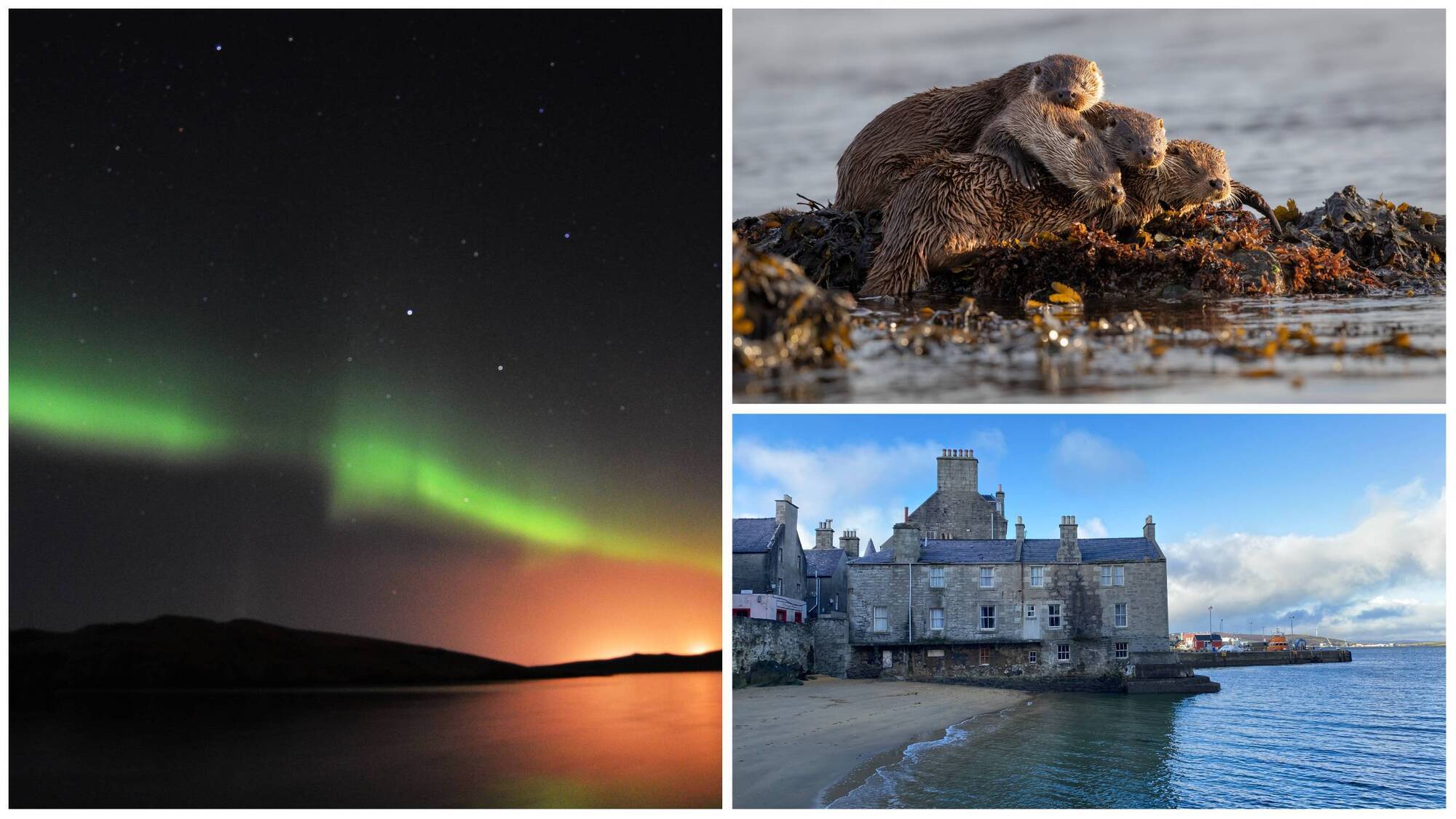
Shetland is perhaps best known for its wildlife (and of course those iconic ponies) and the next day, we ventured off in search of one the islands’ most endearing residents, the otter.

A romp of otters. Picture: James Rogerson

Shetland Nature offer bespoke tours across the island and come sunrise our guide, naturalist and skilled photographer, James Rogerson picks us up at our lodge for our grand excursion. Focussed on Shetland’s mainland island, James offers us a 360 degree insight into the habitats on the island from the spectacular cliffs of Eshaness to the raw wilds of Ronas Hill, the islands’ highest point where a tundra-like landscape offers refuge to the likes of snipe and snowy mountain hares. Main event, however, is otter spotting and James is equipped with a wealth of tips to track the animal, from spraint spotting, remaining downwind to keep our scent at bay and crucially, remaining utterly silent.

Bar one coughing fit, our commitment is rewarded and after army-crawling over headlands, rocks and shingle, we encounter about a dozen otters during the day, the highlight being a group of five (collectively known as a romp!) fishing through the kelp forests. It’s a total thrill and observing animals — without them even knowing you’re there —is how wildlife viewing should be.

Following our tour, we seek out those Shetland ponies, visiting the farm of Carole Laignel, a welcoming native Shetlander whose family have held a Shetland pony stud on the islands since the early 1800s. Today she considers herself more of a pony hobbyist and she (along with her Sheltie sheepdog, Rose) introduces us to her friendly heritage herd who graze in seriously scenic pastures.

Orwick Lodge on Muckle Roe Island 

Down the coast at Gulberwick beach, we also go in search of another one of Shetland’s blockbuster residents, the orca, basking in the November sun along the shoreline, hoping for a glimpse. Two pods of orcas frequent Shetland’s sheltered bays in search of food but luckily, at least for the seal, they’re biting up the coast.

For a final adventure, the next day we take an island-hopping road trip to Shetland’s northernmost island, Unst.

We get there via Shetland’s rather fantastic inter-island ferry service, first to the island of Yell and after driving to that island’s tip, onwards to Unst.

Shetland’s superb road infrastructure also makes for almost meditative touring where routes, void of any hedgerows or hairpins, wind gently through dramatic peatlands and coastlines, punctuated by the odd fishing hamlet. Few manmade attractions dot our route but there are few quirky sights in Unst; a replica Viking longship, the UK’s northernmost kirk (church) and the much-hyped construction of new SaxaVord space station which is set to become a significant economic boost to the island.

Aurora borealis in Scotland, Shetland Islands in winter

Hermaness is the northernmost nature reserve in the UK, famed for its towering cliffs, sweeping moors and birdlife, and sees us hitting the 1300km mark. And on this November morning, we’re the only migrants to the wilderness. We strike off on a three-hour loop of the reserve, first along a newly installed boardwalk across delicate boglands before reaching a dramatic crescendo at Hermaness Cliffs. They are gulp-inducing scenes: Muckle Flugga lighthouse, a dizzying waterfall cascading into the ocean and sheep nonchalantly grazing on the most dramatic of precipices. The rawest sense of solitude makes this one of the most spectacular hikes you could make.

Buoyed by Shetland’s wilderness highlights, that night back at the lodge we enjoy a final fish and chip supper (from the local gluten-free sustainable chipper in the middle of Shetland, no less) before reflecting on our epic trip. But one more peak performance awaits. Thanks to James’ Aurora app tips and Crona’s fastidious tracking we predict an evening showdown from Shetland’s most elusive visitors, the Mirrie Dancers aka the Northern Lights. And true to predictions at 10:06pm we hit the living room lights to reveal a green arc outside our window, arching over the loch like a fluorescent rainbow.

In every sense, Shetland proves to be the ultimate highlight.

How to do get from Ireland to Shetland 

Driving from Cork to Shetland is a surprisingly fluid process with, by lucky coincidence, ideal crossing times between the various ferry services.

Both P&O and Stena Line ferries connect Antrim with Scotland. We took the P&O ferry outbound, departing Larne at 9pm and arriving in Cairnryan, Scotland at 11pm (€170 one way for two adults + car). 

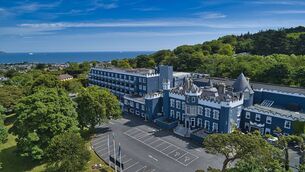
Tip: the Olderfleet gastropub, right at Larne harbour, made a great option for a dinner following the drive from Cork and before our evening crossing. We overnighted in the North West Castle Hotel in Stranraer, a ten-minute drive from Cairnryan and a good value base for the night at €70.

From Cairnryan, it’s a five-hour drive to Aberdeen however, with our night ferry to Shetland leaving at 7pm, the forgiving timeline takes the pressure off the road trip. North of Cairnryan, we grabbed brunch at The Tree House in Ayr before driving cross-country.

Our fare from Northlink Ferries from Aberdeen to Lerwick cost €460 return for two adults plus car and two sleeping pods though we were upgraded to cabins as a guest of Northlink Ferries. Cabins cost from an additional €145 return but are a sound option if you’re a passenger who may not sleep as readily in a pod.

On Shetland, our base of Orwick Lodge cost €270 for three nights but it can sleep up to four guests for that rate. For more on Shetland Nature’s excellent bespoke tours see www.shetlandnature.net while visits to Carole Laignel’s Shetland pony stud can be arranged via guestud.com.

Returning back from Lerwick, our night ferry arrived in Aberdeen at 7:30am, leaving plenty of time to catch the 3:30pm Stena Line ferry back from Cairnryan to Belfast (€188 one way for two adults + car).

All that totted, our total transport bill came to just shy of €1000 for ferries and petrol. Not a budget trip, but bear in mind that the journey was a great adventure, flights to Shetland don’t come cheap, plus we’d the convenience of loading up our car without any baggage fees. And of course, we also avoided the punchy expense of renting a car on Shetland.

More in this section

Lifestyle

Newsletter

The best food, health, entertainment and lifestyle content from the Irish Examiner, direct to your inbox.

Cookie Policy Privacy Policy Brand Safety FAQ Help Contact Us Terms and Conditions

© Examiner Echo Group Limited