Nantes is one of the most vibrant cities in France
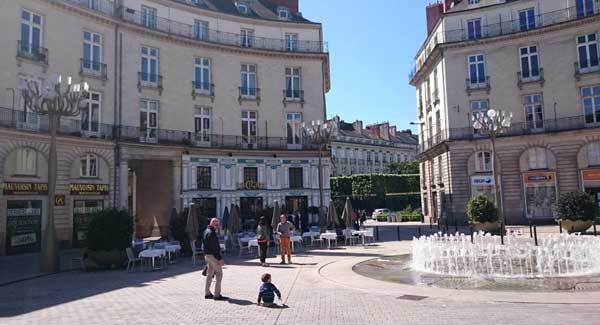
The midday sun was shining as I stared around the circular “square” of Place Graslin.
In the middle, a ground-level fountain bubbled sporadically.
A few small children were running over and back across it, trying to time their run and not get soaked.
Around the fountain was a ring of green art-deco-style street lights that looked like some kind of beautiful bionic trees.
“It’s all part of the gradual pedestrianisation of the city centre,” explained our guide Sandrine, as we stared around.
“The pace of change in Nantes is very dynamic.”
The ornate opera house Théâtre Graslin — open to the public to visit all through the day — dominated the northern side.
She went on to tell us how the first pedestrian street in Nantes city centre was met with fierce local opposition.
How will people get here? How will the deliveries arrive?
But since then, everyone has learned from experience the pedestrian streets are the ones where people want to be, where they can relax and where they will do most of their spending.
It’s good for business and it’s good for the psychological well-being of the city.
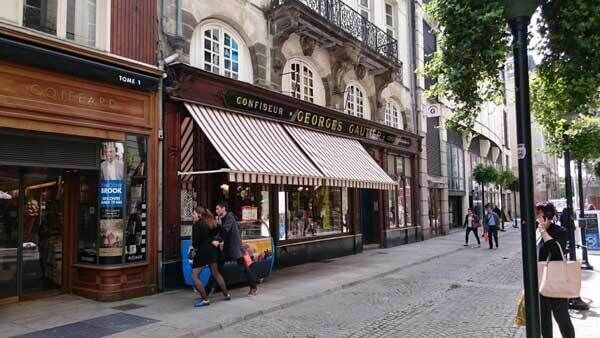
Welcome to one of the most vibrant cities in France, if not all of Europe and run by Socialists for almost 30 years. In the late 1980s, Nantes was on its knees.
The former capital of Brittany (it hasn’t been since the 1950s, but you still see graffiti telling you otherwise) was the centre of military ship-building for several decades and when the shipyards finally closed, it looked like the only future was a disastrous one.
They hadn’t counted on the spirit of the Nantais. Under the guidance of miracle-mayor Jean-Marc Ayrault, the city went about the business of transforming its millions of square feet of industrial wasteland into creative space.
This was no hippy dream, but a serious undertaking that has made the place profitable once more and which has turned Nantes into one of the most sought-after cities in France, regularly featuring on lists of the best places to live in the world.
You can see many examples of this creative and innovative spirit, such as the former LU biscuit factory overlooking what was once a branch of the River Erde and which is now a café and multiple-age-group fun hangout (have you ever played 3-D basketball?), or the Pizzeria down at the Hangar à Bananes which bills itself as the largest in the world.
The ultimate example, however, is the Ile des Machines.
Here, a team of creative (and maybe just a tad unhinged) people make moving mechanical creatures.
You can visit the workshop and try riding a mechanical ant or mount a mechanical worm or gaze at a mechanical pterodactyl.
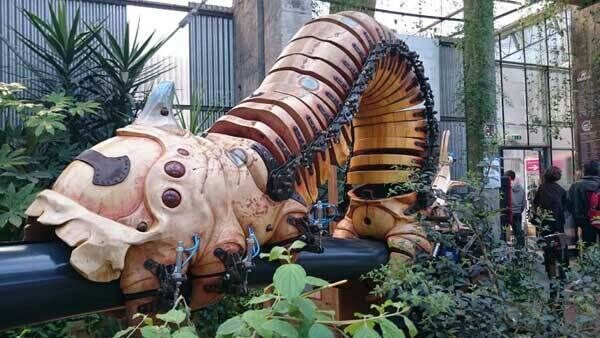
The pièce de resistance, however, is the over-sized mechanical elephant that stalks around the grounds of the place which once produced French warships.
He even squirts water at passers-by as he goes along.
The lively city centre is largely reconstructed since the war but it has a spacious buzzing core around the afore-mentioned Place Graslin, Place Royale and the wide oblong square at Place du Commerce.
The large terraces spill out onto an area where banks and offices used to be but now the grand buildings are filled with great shopping and gorgeous food.
There’s a strong vibe of Celtic-meets-Gallic culture, dominated by plenty of youthful citizens.
Culturally speaking, the city that gave the world Jules Verne fairly sparkles with creativity.
As part of the great push to get people to visit, the Voyage à Nantes (Journey to Nantes) project commissioned a whole series of astounding large-scale art projects to get people to appreciate their city and their estuary.
Between here and the Atlantic Ocean 45km away, there are several pieces of art set up along the length of the Loire.
The idea is to visit them all in a car. When you stop at each one, you look, think and appreciate a the beauty and history of where you’re standing.
One of my favourites was the one that looks like a house that has been swept away in a flood and run aground in the estuary.
There’s also a full-sized yacht bending over a pier trying to escape the boat graveyard and get back out to sea.
Back in Nantes, the Voyage à Nantes people came up with the clever notion of painting a green line on the ground that you follow to take you all around the city to the places and sites worth seeing.
It makes a circular route so you can’t get lost — just follow the line and it will take you past all the cool spots, best monuments and churches.
It also brings you past many of the newer attractions, such as the underground Memorial to the Abolition of Slavery.
Finally, for wandering around at night, the Bouffay district to the south and west of the Château des Ducs is the mediaeval centre that’s perfect for moseying from bar to restaurant and back to bar.
This part of town comes alive at night and is crammed with Mexican eateries, Breton creperies, Irish pubs and French mid-range dining… and if you can fit all that in over one weekend, you move faster than the pace of change in Nantes.
CityJet ( www.cityjet.com ) has a new direct weekly summer service from Cork starting on June 18 .
Aer Lingus ( www.aerlingus.com ) fly direct from Dublin during the summer.
For the longer way down, take the ferry from Cork to Roscoff ( www.brittanyferries.ie ).
The Okko Hôtel Nantes Château ( www.nanteschateau.okkohotels.com ) aims to upend the smart hotel experience for the better: No reception desk, no meeting room, no lobby — just a relaxed living space, including a kitchen area where guests can snack together in a kind-of high-end hostel experience conducive to conversation with fellow guests. I liked it.
It’s also right in the heartbeat of Nantes and only a stone’s throw from its impressive Château des Ducs.
For a splash-out, try the Radisson Blu ( www.radissonblu.com ).
Formerly the law courts, it’s a palatial space with enough quirk and avant-garde touches to keep you staring around all day.
It’s also very luxurious and close to all the action.
Take the lift to the top floor of Nante’s 32-storey La Tour de Bretagne, from where you can get a bird’s eye view of the city from Le Nid — a restaurant with a strong “nest” theme going on.
Try a trip out of town to see some of the vineyards in this revived wine region whose star wine is the highly glug-able Muscadet. For tours, check out www.levignobledenantes-tourisme.com
For shopping, browse the turn-of-the-century Passage Pomeray, a beautiful multi-level shopping centre based on the Parisian indoor arcades.
Delicatessens, chocolatiers, cake shops, and clothes shops abound around here.
If you really like the river, try the sunset cruise (www.bateaux-nantais.fr) with dinner that glides along Nantes’ other river (the Erde), past wildlife and chateaux nestled in the trees.
For eclectic good food at reasonable rates in a relaxed atmosphere in town, try the Irish-owned Beckett’s Canteen on 3 Rue Guépin (+33 2.40.48.76.46).
La Civelle ( www.lacivelle.com ) in the former fishing village of Trentemoult offers smashing seafood just minutes from central Nantes via the Navibus ferry.
In La Cigale (www.lacigale.com), the experience is more up-market, more for the exquisite belle-époque décor than for the food itself, but definitely a place not to miss in Nantes.
- Visit www.nantes-tourisme.com for more.
CONNECT WITH US TODAY



Be the first to know the latest news and updates