Luxembourg is a city with a mixture of ancient fortresses and cutting-edge architecture
When it comes to city breaks, Luxembourg is quite probably not on your wish list.
What could be interesting about a banking and business city, regarded as a tax haven, unless you’re minted?

Its glass-fronted buildings in the Kirchberg area are the headquarters of a number of European Union regional offices including the European Court of Justice.
Is there more to this small city than workaday matters?
Just what makes the Grand Duchy’s capital tick beneath the veneer of efficiency and affluence?
As I ambled along an elegant street having just checked in at the city centre four-star Hotel Simoncini ( www.hotelsimoncini.lu ), I said something very strange to one of my travelling companions, a travel writer whom I met for the first time, on the flight out of Dublin recently, with Luxair.
“I feel the need for a church,” I blurted.

What was that about? A reaction to the well-to-do young Eurocrats and financial types surrounding us? An approaching middle-aged conversion in a city of mammon?
And this was even before we saw designer stores such as Gucci and Louis Vuitton.
Soulless is a word that initially comes to mind when you first encounter the city of Luxembourg.
With a population of just 110,000, it is primarily made up of non-natives (about 67% of the population) who move here to work, constituting a largely transient population, on their career trajectories.
But once you get the lowdown on Luxembourg (founded in 963 by Siegfried, Count of the Ardennes) it’s not just a story of high finance, EU administration, and former Eurovision glory.
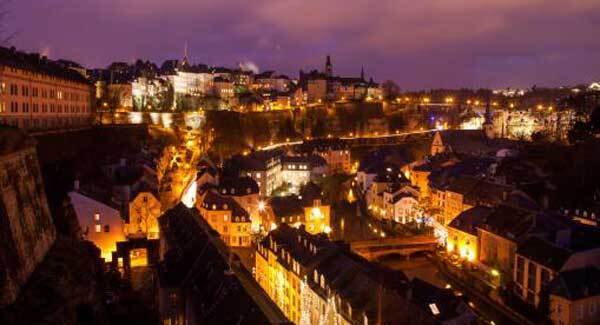
Luxembourg is an attractive city, a mixture of ancient fortresses and cutting-edge architecture.
It has a number of Unesco-listed World Heritage sites including the Old Town comprising fine old buildings and smart restaurants. (There are four Michelin star restaurants in the city; La Cristallerie, Mosconi, Clairefontaine, and Le Patin d’Or.)

The Grund area lies below the Old Town. Here, you can stroll along the pedestrian lanes and relax in one of the many cafes.
The Corniche is ‘Europe’s most beautiful balcony,’ from where you can see the city’s ramparts and the Neumunster Abbey which is now a cultural centre with a brasserie. (It has had a number of incarnations including a prison.)
Head down to the Casemates which is an extraordinary 14.2 mile-network of underground galleries.
Just 10% of the sand rock structures are visible today. It took 16 years to dismantle the rest of these subterranean caves.
During troubled times, they sheltered defenders and their horses.
They were also used as artillery workshops, kitchens, and bakeries. During WW1 and WW11, they were a refuge for 35,000 locals.
Luxembourg is a representative democracy with a constitutional monarch headed by Henri, Grand Duke.
The centre-city royal palace, built in 1573, houses the Grand Duke’s office with parliament using its 1859 annex.
Voting is compulsory for citizens between 18-75 years. Luxembourg’s prime minister, Xavier Bettel, married his same-sex partner in May.
The Grand Duke and his family don’t live in the palace.
The reason it is so central is because it used to be the City Hall.
The royal family lives 30km away. The palace is only open for guided tours during a brief period in the summer. It wasn’t open during our stay.
We wondered how the soldier on duty, armed with a rifle, puts up with the tedium of patrolling the building.
There is a changing of the guard every two hours.
On a livelier front, the city’s concert hall, Philharmonie ( www.philharmonie.lu ) is hugely popular.
This modernist building in Kirchberg hosts opera, jazz, and classical music events. It opened in 2005 and boasts 460 events annually.
The number of visitors to the venue comes in around 160,000 every year which is massive considering the population of the city.
When we called, the Orchestra Philharmonic Luxembourg was rehearsing Madam Butterfly. Seating in the main auditorium is for 1,450 people.
The building’s smaller chamber orchestra theatre seats 300.
Nearby is Mudam, the museum of modern art. Designed by Chinese American architect Ieoh Ming Pei, better known for the Louvre pyramid in Paris, the building combines stone and glass with sweeping staircases.
The museum, which exhibits modern and experiential art, houses a collection that includes photography, design, multi-media and fashion.
Dining out in Luxembourg is not cheap but doesn’t necessarily have to break the bank.
At Am Tiirmschen, on Rue de l’Eau, main courses cost between €20-€35.
Here, you can sample typical Luxembourg dishes but there are also French and fish options.
I had veal sausages with mustard sauce, mashed potatoes and salad. There’s a vegetarian option with dumplings. It’s tasty fare.
My companions enjoyed the national dish, Judd mat Gaardebounen, which is smoked collar of pork, beans in mustard sauce, and potatoes.
We also dined at Brasserie Guillaume where dishes range in price from €10 to €120.
Here, you can order seafood including lobster and oysters or steaks which veer towards rare, even if you ask for yours to be ‘well done’.
The Chocolate House, which faces onto the palace, does a good line in quiche lorraine and cream-laden desserts.
Sitting on the terrace for lunch, we enjoyed the warm weather. Here, you can buy sellophane-wrapped hotchocspoons or any amount of beautifully presented chocolates as gifts at reasonable prices.
We went for drinks in the Grand Ducal Palace area.
At Urban Bar, a popular after work spot, where we sat outside, a glass of Pinot Grigio cost €5.60 while a pint of beer was €5. (Cremant, a sparkling wine from the Moselle district, is a popular local drink.)
Not sated enough to go back to our funky hotel with its contemporary art gallery and free wifi, we headed to King Wilma, a karaoke club in Rives de Clausen.
There was no admission fee, just a willingness to get up on stage and sing — at least for the more extroverted warblers among us.
A stunning creature, who looked like a model, tried to chat up one of our party. The stunner turned out to be a lady boy.
We made our excuses and left — and headed to the swanky White House ‘exclusive lounge’ on Rue des Bains.
It was a Wednesday night and the club was open until 3am. (It’s open on Fridays and Saturdays until 6am.)
The revellers comprised young suited men and glamorous young women teetering in stilettos.
While we were not charged at the door, the price of drink was saucy. A round of four drinks, including a bottle of water, came in around €44.
As for my need for a church, I forgot all about it until we entered the dark Notre Dame Cathedral. The architecture is late Gothic with a Renaissance element.
The church has a small revered Madonna and child statue.
The Virgin Mary is the patron saint of Luxembourg.
This ‘comforter of the afflicted’ is an antidote to the moneyed people on the streets.
I saw just one beggar on the streets of Luxembourg city and one homeless man over a two-night stay.
It’s certainly a wealthy place, not exactly soulful, although the ‘urban pianos’ scattered outdoors around the city, inviting the public to play them, are a lovely touch.
The city is a delight for history buffs interested in what was once one of Europe’s greatest fortified sites.
There is plenty of contemporary culture as well and a lively midweek social scene.
The language of business is French while German is the media language. Natives speak Luxembourgish among themselves. English is spoken by most people.
While Luxembourg is expensive, you can purchase a Luxembourg Card in tourist offices, hotels, train stations, and on www.visitluxembourg.com for €13 for one day per person, going up to €28 for three days. (There are also family cards.)
The card gives free access to trains and buses and over 70 tourist attractions.
Luxair ( www.luxair.lu ) serves Dublin every day except Saturday. Flight duration is one hour and 45 minutes.
Return fares start at €130.60 including tax.