When the tourists are in the ascendancy, it’s paradise lost
Holidaymakers will be familiar with the town. I have known it since the 1980s, but it becomes less familiar on every visit. New streets turn old streets into alleyways. The church and town square have been dwarfed to toy-town proportions under high-rise apartment blocks.
When I first set foot there in 1981, Cristianos was still a small Canarian fishing village. Development was just beginning on the coast a few kilometres away, at what is now the huge resort of Playa Las Americas. A shortcut between them led across badlands where derelict saltpans held numerous seabirds. Within a few years, the salt ponds and the nearby desert were concreted over with motorways, apartment blocks and hotels.
Did the few locals mind? Why would they? Beyond the village, the coast and hinterland were arid and hilly, a few block-walled banana plantations and run-down tomato beds alone breaking the monotony of the sunbaked plains. There was no water, but there was sunshine galore and, since the 1960s, sunshine could be sold. Wilderness was traded for pesetas. Naturalist might complain, but the land was the people’s to sell.
Fifty kilometres away, across the water, La Gomera, last of the chain of Spanish sunspots stretching south from the French border, was saved a similar fate when, in 1982, the local council, seeing the disasters of unfettered development in the northern islands, consulted the great Canarian architect, Cesar Manrique. He advised low-rise, red-roofed dwellings and small apartment houses on the green, gardened terraces of Gomera’s great valleys. Gomera remains unspoiled, its development low-key and sensitive. However, too often, such considerations are secondary to providing bed-nights.
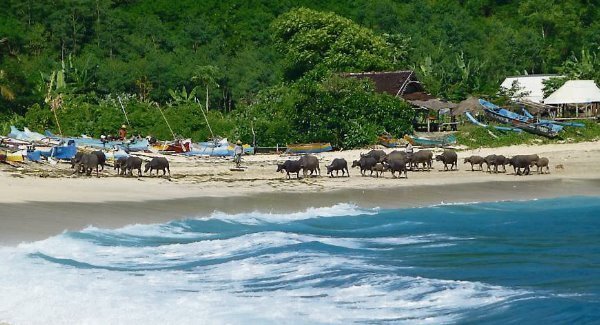
The three paradise Gili islands off the coast of Lombok in Indonesia offer an escape from the exhaust-fume belching, farting motorbikes and scooters that pollute the air and blight the ambience of every Indonesian conurbation. Amongst the islands’ many charms is the absence of motorised transport. One walks, rents a bike or climbs aboard the much-recommended cidomos, gaily-painted, canopied little pony traps.
I was surprised, therefore, when I noticed a queue of cidomos on tiny Gili Air carrying not visitors but building blocks and cement. Australian auctioneers’ billboards marked out sites for sale. In jungle clearings, lunghi-skirted labourers fed concrete mixers.
The island is three sq km in area. I was witnessing another paradise with cement dust in the air.
I couldn’t but lament its passing — but, then, what is a paradise, anyway? Sunbeds on the beach with tourist razzmatazz alongside brought paradise to Spanish peasants. But those fortunate enough to have options will say paradise is an uncrowded, scenic place with freedom from razzmatazz and traffic, friendly people, interesting local culture and unspoiled nature, sun and sea.
I was fortunate in that I travelled early and travelled often. I got the best of paradise unblemished on Ibiza and Formentera, the Turkish coast, Rhodes and various Greek islands in the 1960s, in Phuket, Thailand and in Goa in the1970s. Where towering hotels now stand above once-pristine beaches, my family and our friends were often the first to lay foreign footprints on the sand.
Now, as then, the less one has to spend and the more independently one travels, the more likely one is to stumble upon such places. Indeed, many of those with mobility and a pension find it costs less to travel in winter than to stay at home.
Unspoiled places are still there to be found — Baracoa in Cuba, the Thai islands off Burma, south Lombok — but resort development has delivered much of joy to both givers and receivers. As mentioned above, in Spain and the Canaries near-useless land has been transformed into sun-beds for Europe.
Once, the coast from Tossa del Mar in the north to Tarifa on the Atlantic was a string of small fishing villages reached by bockety roads. Their development has brought affluence to the locals, who often don’t give a fig for the sunsets and never used the beaches anyway.
“You can’t ate the scenery”, they say, echoing the small farmers on the spectacular but rock-rent peninsulas of our own south-west.
Some years ago, at sunset one evening, I stood looking south over the Mediterranean near Estepona. The sun burnished the cliffs as far as the eye could see. “I never knew there were such cliffs!” I told my wife. “Cliffs?” she answered, “They’re twenty storey-high apartment blocks! Keep up, Damien, for goodness sake!”
DISCOVER MORE CONTENT LIKE THIS
CONNECT WITH US TODAY



Be the first to know the latest news and updates