Cornwall: An Anglo-Irish family holiday
A sojourn to London, yes that’s perfectly acceptable. A weekend in Brighton, maybe even faintly hip. But to suggest that you might want to spend your annual summer holiday in Limeyland and that you may even find it quite lovely and vaguely interesting and you get a reactions like a near aggressive ‘why don’t you just go to West Cork, Kerry, Connemara?’ But Anglo-Irish relations and mild climate aside, there we went. It was the first O’Sullivan holiday en famille in nearly 20 years and so Husband politely declined as he was suddenly Very Busy In Work and Could Not Possibly Take Time Off.
My two sisters live in the south west and had been trying to get us all to the UK for years. Taking the ferry from Rosslare to Pembroke made the most financial sense when there was Grandma, Grandad, two kids, their uncle and myself travelling and a car is a must-have as much of the joy of the south west is in navigating the country lanes taking in the unspoiled ‘unbungalow-blissed’ English countryside. Also, my eldest son, aged 11, was delighted at the prospect of driving our car into a ferry while the younger, aged 6, was more mute, as he wrestled with why exactly the Titanic had sank. However, at 8.30am as we sat in the car waiting to board the 182.5 metre Isle of Inishmore, the excitement was palpable. Kids and ferries just work. They loved it.
They loved racing up the stairs down the stairs, the novelty and fear of going out on deck, the gaming area and the shop. For myself, my brother and Dad, it was sit back and order a coffee as began a week of endless anecdotes from mum about family holidays aboard the ferry when we were kids.
The 67-mile crossing took four hours and between being dragged here and there by a six-year-old, eating, having a quick snooze and a read, the time zipped by.
So then began the 4-5 hour drive down the motorway to Cornwall. You know what? It wasn’t that bad. We stopped halfway to eat a mega picnic we’d packed up the night before and reached our gorgeous Cornish cottage that evening “at the foot of the hill as you enter Herodsfoot”. The last stretch was a bit of a nightmare, one of those raging half hours when you’re suddenly aware you’ve been travelling for 12 hours and all in the vehicle are moaning and shouting, adamant the landlord’s directions are actually wrong.
The heart of our weeklong holiday was “the Cottage”.
Tressaran is set in a copse in the middle of Herodsfoot wood, an abundance of oak, silver birch, hawthorn and woodland flowers. The cottages were part of the silver and lead mine and date back to the 18th century. Stone steps are built into slopes and a river meanders through the grounds.
It’s the slow pace of a holiday in Cornwall that will bewitch you — and infuriated my Dad. He being of the “out the door at 9am so we don’t waste the day” variety, he was driven to distraction by daughters and son who were happy to make breakfast into an hour long somewhat misty al fresco affair as we listened to the river.
He was right of course. There is so much to see in the south-west. The star attraction for the us was the Eden Project, the awe-inspiring botanical and environmental project that is a temple to “dreams really do come true if you believe in them and refuse to let anything get in your way”.
The brain child of Tim Smit who has just finished restoring the nearby 19th century “Lost Gardens of Heligan”, he wanted to build a showcase for the world’s most important plants.
When he suggested developing the site of a working china clay pit that was nearing the end of its life, people thought he had finally lost the plot. Thankfully, he ignored them and instead created what is routinely described as the eighth wonder of the world.
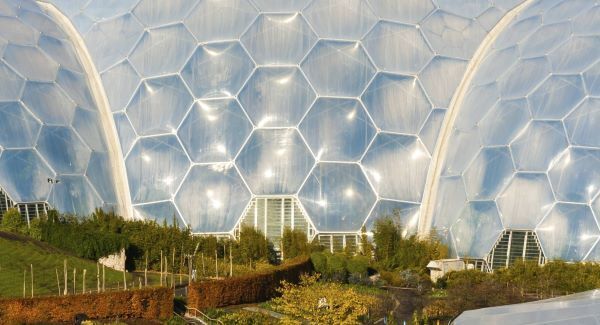
Due to our predilection for late breakfasts, we didn’t get there until near lunchtime. Big mistake. Ideally you should spend at least a day and a half at the Eden as a one-day pass can be used all year long. The Eden Project is most readily recognised by its two 50 foot tall biomes (which look like hemispherical transparent golf balls) containing two different eco climates: rainforest and Mediterranean. The land surrounding the biomes is then described as “Wild Cornwall” and is a conservatory for its native flora.
The kids were blown away by sheer scale of the project: by the powerful Amazonian waterfall, the mangrove swamps, the rubber plants, the cocoa plants and the real life hot air balloon that is used by researchers at the project and worldwide to move around the canopy of trees.
With sweat pouring off us, we climbed up to the top of the biome to look down over this wonderland and ponder how an area of rainforest this size is destroyed every 10 seconds in real life. But the Eden Project is about far more than just looking at plants and getting angry about climate change. It’s a day trip that takes you on a physical, social and educational journey where you are unwittingly confronted with the utter selfishness and myopia of man.
The main Core area contains the expansive Eden Deli which serves the best of local Cornish produce and includes an enormous artisan bakery where you can watch up to 20 bakers make bread as they listen to classical music.
By night, it’s renowned as a cultural centre.
The majestic Tamar Bridge interlinks Cornwall and Devon and the capital of Devon is Plymouth. Plymouth, has undergone major urban regeneration around the Royal William Yard area and is a great place to wander around shopping after a city lunch. It is also home to the UK’s National Marine Aquarium.
We had some fantastic dinners and lunches at cozy British pubs and restaurants at spots like the seaside smuggler villages of Looe and Polperro but our standout lunch really was Plymouth city. We couldn’t resist visiting Hugh Fearnley-Whittingstal’s Canteen and Deli at the Royal William Yard. It’s an old stone warehouse filled with big oak tables. Entirely unpretentious, the locally sourced and seasonal food is reasonably priced.
I cannot talk about our southwestern break without mentioning Crealys. These are local adventure parks run by the Crealy family that are dotted around Cornwall and Devon. They’re the parks where time stood still, sometime back in the early ’80s, possibly even before. Crealys is no Alton Towers. It’s all donkey rides, ballpits, decrepit haunted houses, climbing frames, pet paddocks looping plastic slides, wooden pirate ships where you can do battle with guns and an indoor playhouse. The adults wept that this could be pawned off on hi-tech noughties children but the children thought endless racing up and down a slide in a dusty sack was heaven. Not for the first time on this holiday, I was suddenly plonked in an Enid Blyton novel. Old school or not, this was “jolly good fun”.
Irish Ferries offer up to 12 daily ferry crossings to the UK from Ireland sailing from Rosslare to Pembroke and Dublin to Holyhead. Tickets start from €89 one way.
There is a raft of cottages to rent in the south west so get googling. We stayed at www.tresarran-cottages-cornwall.co.uk where the three-bedroom cottage cost from £200 to £600 per week depending on the time of the year.
The winding streets of St Ives, Padstow, Looe, and Polperro are full of great funky little clothes, surfing and lifestyle shops where your money will just evaporate.
The Eden Project, the National Marine Aquarium, the Lost Gardens of Heligan, the Tate St Ives, the Minack Theatre, an open air theatre set in the cliffs, St Michael’s Mount. You won’t be able to do it all in a week.
Hugh Fearnley-Whittingstall, Rick Stein and Jamie Oliver all love Cornwall and have restaurants in the region. There’s great fish, and of course the ubiquitous pasty or Devon cream tea, to be found everywhere, and you can buy bass and snapper off fishing boats as they dock each night. You also have to try local ciders, which can be bought from the farmhouse. In this neck of the woods, they treat cider like wine.
CONNECT WITH US TODAY



Be the first to know the latest news and updates