Reserva time for Rioja
THE FLIGHT from Dublin to Bilbao in Spain’s Basque region was surprisingly full for a Tuesday morning in April and it was buzzing with anticipation and goodwill.

Reserva time for Rioja

It transpired that most of the passengers were bound for the Camino de Santiago, the legendary pilgrims’ route through northern Spain.

My pilgrimage was of a somewhat more decadent and less arduous nature — I was heading to Rioja in north-central Spain to see how one of the world’s most famous wines is produced.


Much like the Champagne region in France, Rioja’s identity has become subsumed by its famous alcoholic product. This is hardly surprising in the case of Rioja, which is exceptionally suited to wine production. It’s aided by its location and climate, which is influenced by both the Atlantic and Mediterranean, providing the ideal levels of temperature, humidity and sunshine. Also, the area is protected by the Cantabrian mountains from cold, wet weather from the North.

The climate has an impact on the landscape you roll through as you come south from Bilbao. It’s dramatic — lush in some areas, stony and arid in others — and it reminded me occasionally of Connemara, though a Connemara blessed with more sunshine.

You know you’re entering wine country when the bodegas start appearing by the roadside. In recent decades, these traditional wineries have been joined by avant-garde structures, making the area a draw for architecture buffs as well as wine lovers. One of the most famous of these structures is the Marques de Riscal winery, designed by Frank Gehry, probably the world’s best-known living architect. After the phenomenal success of his dramatic design for the Guggenheim Museum in Bilbao, which transformed the city in 1997, everyone wanted some of the Gehry magic.

Legend has it that the Marques de Riscal showed an elegant sense of flattery when enticing Gehry on board: they reportedly persuaded him to undertake their project after they treated him to a bottle of wine from the year of his birth.

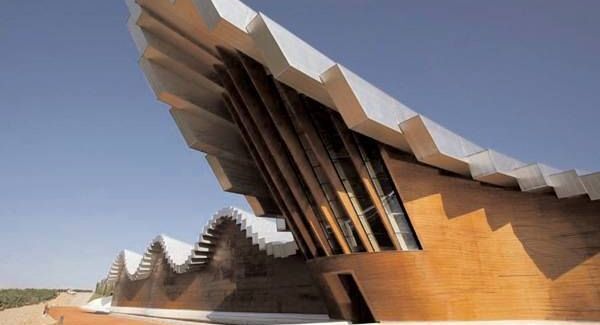
Another example of Spain’s modern architectural renaissance can be seen at the Ysios winery, designed by homegrown star Santiago Calatrava. The undulating waves of the low-slung building’s roof echo the shape of the barrels it produces, as well as the line of the surrounding mountains. The eye-catching building was designed as a temple to wine and its name is a combination of the Egyptian gods Isis and Osiris; again, this homage has a visual parallel in the shimmering canals of water which flank the entrance, referencing the Nile.

Such reverence and attention to detail also extend to the winery’s production methods. The grapes are hand-picked and sorted and kept in vats particular to the ‘terroir’ where they are grown. The wine is aged in barrels made from French and American oak, according to the characteristics of each grape variety.

As we entered the warehouse where thousands of bottles of wine are left to ‘rest’ , the lights automatically dimmed and our guide lowered her voice to a whisper. The wines do not react well to loud noises, vibrations or sudden changes in temperature, she explained. A bit like babies, I joked. I interpreted her stern look as suggesting they’re handled just as carefully.

Providing a fascinating contrast to the almost boutique style of winemaking at Ysios is the larger scale operation at the Campo Viejo winery, though the winemakers’ passion for their craft is just as evident. The winery was created with sustainability in mind: most of it is underground, keeping the impact on the landscape to a minimum while creating the perfect winemaking conditions — consistent temperature and humidity.

It’s a high-tech operation, but one which retains traditional standards of quality. The cellars are impressive, with the wine ageing in 70,000 barrels before bottling and left to rest in the ‘library’, which has the capacity for six million bottles.

After viewing the process at such close quarters, tasting the results was the next task. Though I usually prefer white wine, I was won over by the Campo Viejo Reserva, a round, well-balanced Rioja, aged for 18 months in oak barrels and another 18 months in the bottle.

Naturally, all that wine tasting is not best done on an empty stomach. In Spain, tapas are the natural accompaniment to a chilled glass of cava or a rich glass of red. The main urban centre in Rioja is Logrono, a compact and pleasant city with a bustling old town and more than its fair share of tapas bars. We visited one which was doing a roaring trade in its signature (and only) dish of local mushrooms, three huge ceps atop a small slice of bread, soaking up all the garlic-infused juices. All bars follow roughly the same blueprint: a long counter on one side and rudimentary seating arrangements which are usually ignored in favour of the hubbub at the counter. After a couple of days observing the alchemy of winemaking, what could be better than savouring the fruits of Rioja in these most convivial of surroundings — and right in its own backyard.

* Visits to the Campo Viejo winery can be made by appointment at www.campoviejo.com. Visits to the Ysios winery, also by appointment at www.domecqbodegas.com.

* The Campo Viejo tapas trail takes place in Cork from May 8 to June 5 and in Dublin from June 9 to July 17. See www.campoviejotapastrail.ie for more.

* How to get there: Aer Lingus flies from Dublin to Bilbao. Logrono is two hours and 45 minutes by train from Bilbao airport. There are regular buses to Logrono from the Termibus station in Bilbao. The journey takes two hours. See www.termibus.es for timetable.

Accommodation: The Hotel NH Herencia in Logrono is a reasonably-priced, four-star hotel.

x

More in this section

Lifestyle

Newsletter

The best food, health, entertainment and lifestyle content from the Irish Examiner, direct to your inbox.

Cookie Policy Privacy Policy Brand Safety FAQ Help Contact Us Terms and Conditions

© Examiner Echo Group Limited