Best in show
Five or six years ago, this image might have conjured up an overblown breakfast in a boutique hotel. Or a stroll down the aisles of a organic deli, perhaps — where a souvenir-sized pot of Manuka honey would pull a price in the double digits.
Today, it’s different. The honey I’m looking at sits in a modest little pot, and it’s not for sale — it’s displayed in a glass case in the Little Museum of Dublin.
What’s going on? Like everything in this unusual museum, an ordinary object turns out to have an extraordinary story behind it. ‘Abbeville Honey’, as it’s labelled, was collected from the mansion of Charles J Haughey in Kinsealy. The former Taoiseach was a furtive beekeeper, it transpires, and enjoyed gifting honey to family and friends “to keep them sweet”.
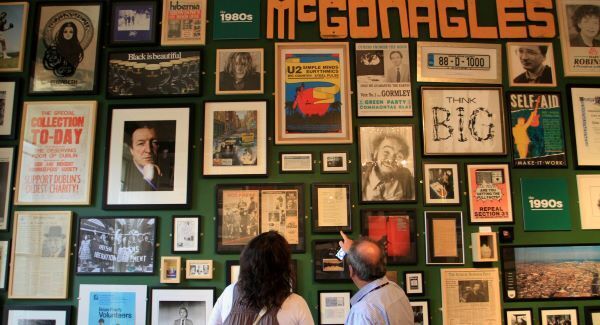
It’s the perfect juxtaposition of Dublin past and present. The Little Museum of Dublin is a relatively new arrival, but its eccentric trove of exhibits — a signed U2 album, an old bus ticket machine, a menu from Jammet’s, a facsimilie of James Joyce’s death mask — are like wisps, beckoning you back into the nooks and crannies of the 20th century.
In what it does, and says — and the understated way in which it says it — this brilliant quirky museum is everything Dublin should have been during the Celtic Tiger, but was not. It’s cool, and clever. It’s modest, and big-hearted. It’s small, but perfectly formed.
I also love that its basement houses Hatch & Sons, a modern take on a traditional Irish kitchen, complete with rock buns, cheese boards and floury Waterford blaas.
Dublin is bubbling. Ideas are in the air. The hot-shots about town are no longer bent on transforming the cityscape into a generic fudge of apartments and superpubs. They’re mining the spaces between restaurants and nightclubs, coming up with funky, affordable dinner and cocktail joints like Bite and 777. They are running the Dublin Flea Market, the Irish design collective Project 51, or the website DublinTown.ie.
Walking down South William Street, I feel the same energy and excitement that fizzled in Temple Bar back before it became a theme park. Shops like Indigo & Cloth and De La Punc are a stone’s throw from Grogan’s, the evergreen old man’s pub for the kids, or the 18th century Powerscourt Townhouse, the city’s slickest shopping mall.
I love that the hottest property on Wellington Quay is no longer Bono and The Edge’s Clarence Hotel. It is the Workman’s Club, a warren of Georgian-grunge where you might wander into a comedy gig, a literary death match or a thumping club of an evening.
Don’t fancy a traditional city sightseeing tour? Try a walkabout with a difference in the Le Cool Experience. No two outings are the same — on mine, the stops included Dublin Ink, a tattoo parlour, an exhibition in The Front Lounge bar, and alternative video shop, Laser, where novelist Belinda McKeon read a scene from her novel, Solace.
Strangely for a city that has spent years in recession, Dublin’s restaurant scene is thriving. Along with Hatch & Sons, places like Rock Lobster, the Damsen Street Diner and Fumbally Café have all opened in the past year. Michael Viljanen, one of the most exciting chefs in the country, was lured from Co Clare to cook at The Greenhouse.
What these places have in common is that they’re not taking the proverbial. Many of them serve cocktails. They stay late. You can eat an entire dinner for what a developer might have paid (or expensed) for a glass of claret in 2005. And it feels good.
Dublin still ain’t cheap. But the Worldwide Cost of Living Ceremony, published by the Economist Intelligence Unit, suggests it’s becoming cheaper. In the space of a year, Dublin has dropped from the 30th to 37th most expensive city to live in on earth.
Big openings are happening, too — the kind we haven’t seen for years. The Morrison Hotel just re-opened as a Doubletree by Hilton. After years lying idle, the Manuel Aires Mateus-designed five-star in Grand Canal Dock will finally open this April. Amongst the features we are promised? A rooftop garden inspired by... the Burren.
Watch out for the Dubline too — a new interactive discovery trail set to link College Green to Kilmainham along one of the city’s most ancient thoroughfares.
Behind all of this forward momentum, you still have the big hits and seductive surprises. Did you know that, beneath Dublin’s Chapel Royal, there is a Revenue Museum? That the remains of St. Valentine are kept in Whitefriar Street Church? Or that there is a ‘museum flat’ hidden within the Iveagh Trust complex, preserved in its 19th century state? Of course complications remain. Dublin’s public transport system never quite seems to be joined-up. Late Friday and Saturday nights, Mr Hyde boots Dr Jeckyll out of this UNESCO City of Literature, unleashing a Bacchanalian barf-fest. You can still find yourself paying over a fiver for a pint, and quays traffic still cuts the Liffey off from passers-by.
Still, I haven’t been this stoked about the city in years.
“The advice I like to give young artists, or really anybody who’ll listen to me, is not to wait around for inspiration,” as artist Chuck Close, who was quoted recently by Le Cool Dublin, once said. “Inspiration is for amateurs; the rest of us just show up and get to work. If you wait around for the clouds to part and a bolt of lightning to strike you in the brain, you are not going to make an awful lot of work.”
Well, Dublin is working. It has learned that a spoonful of honey catches more flies than a gallon of vinegar. And it’s a breathtakingly exciting time to visit.
CONNECT WITH US TODAY



Be the first to know the latest news and updates