Adam Richardson: 'We've been sold a dream that, for our generation, is not the case'
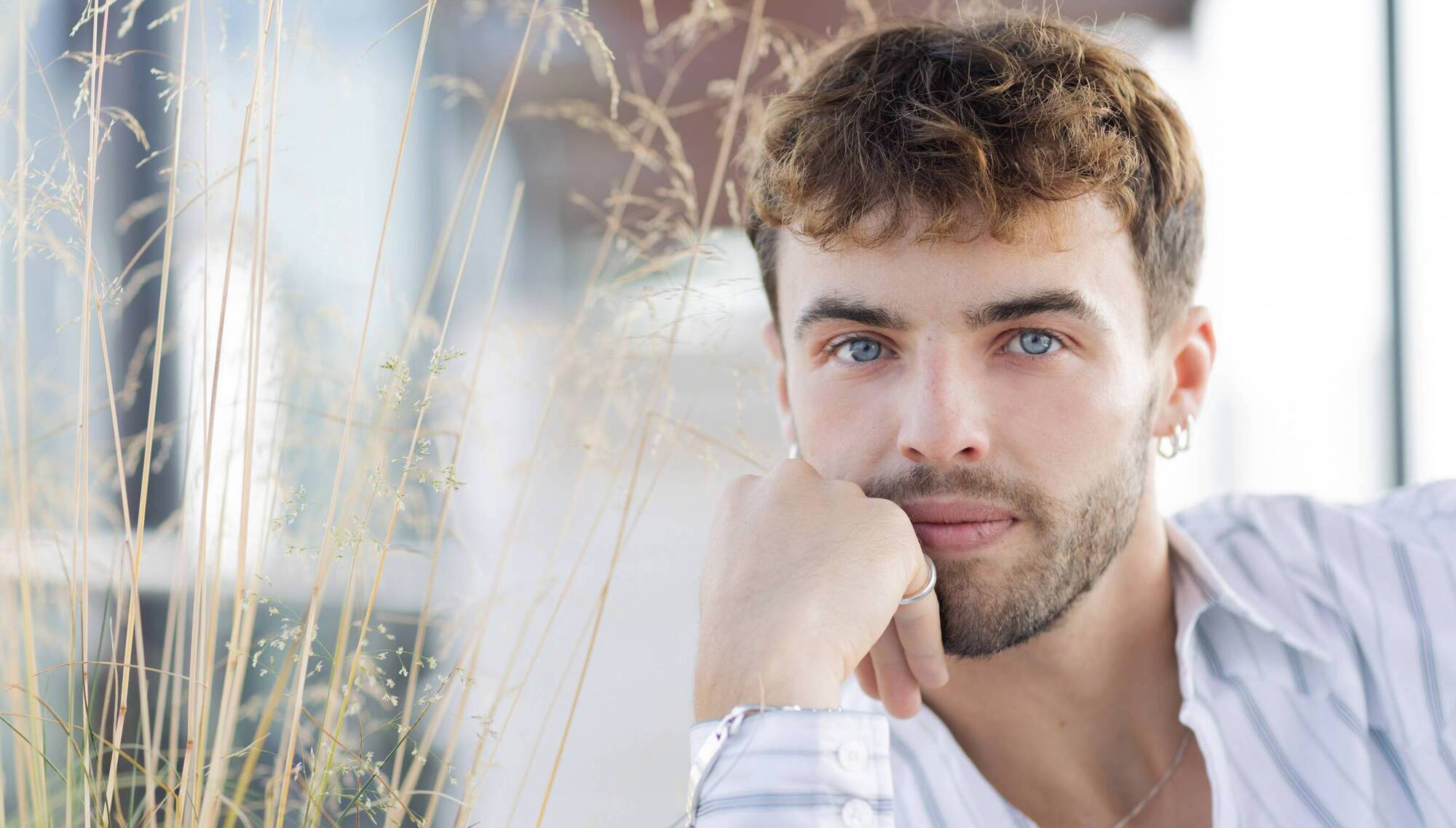
Adam Richardson of The Dry. Picture: Emily Quinn
It is the day after Paddy’s Day when I speak to Adam Richardson on Zoom. He’s in London while I join from Dublin, both cities basking in sunshine — albeit fleeting. He’s just moved flat and apologises for the mess, though I see none. If anything, his backdrop is clean and professional. A happy coincidence, he assures me.
“It’s a bit of an in-betweeny moment right now,” he says.
We do the usual back and forth about the weather before pivoting to more exciting things: Namely, the third and final season of The Dry. Created by Bafta-nominated playwright Nancy Harris and directed by acclaimed filmmaker Paddy Breathnach, the series follows the Sheridans as they deal with everything from dysfunctional family dynamics to generational trauma and addiction.
Richardson plays the youngest sibling, Ant, a character who struggles to leave his party days behind him and find stability.
In season one, he lives in the converted shed at the back of his parents’ house, often distracting himself from his problems with alcohol, men, and drugs. He’s indulged by his mother, who enables him in subtle ways. While his sister Shiv tries to embrace her sobriety, he resists it.

“With family, you can be in someone’s corner until you feel threatened by them, and then, unfortunately, you might want to bring them back down to reality,” says Richardson. “It’s very potent in the Sheridan family.”
In many ways, Ant is a microcosm of the frustrations facing young people in Ireland today.
“It’s my reality and a lot of my friends’ realities also,” he says of the housing crisis and Ant’s struggle to establish himself.
“That’s why we’re living in London, because we can actually afford housing here. I’m quite happy and grateful to be able to portray that kind of story, of our current generation growing up in a hard place.”
“We’ve been sold this dream, and our parents have raised us on this [idea] that if you work hard, you’ll get what you deserve. Unfortunately, for our generation, that’s not the case,” he continues, later adding, “Ant’s situation is the perfect synopsis of that version of growing up in Ireland.
“It’s so disheartening, but I suppose on the flip side of that, we’re lucky to have parents who will put us up, so it’s hard to be angry sometimes. But it’s equally frustrating. I think that’s what the young people who watch The Dry resonate with most — Ant’s version of the world versus his sisters’ or even his parents’.”
The first actor and the first openly gay person in his family, Richardson got his start in The Lir Academy in Dublin, assuaging his parents’ concerns about an unstable line of work with a third-level degree.
“I never thought I’d do this as a career,” he admits, saying that, like his parents, he is “quite sensible in most aspects of life”.
Thankfully for him, roles have been plentiful.
“I think I made the right choice,” he smiles.
“That said, I don’t know if I’d let someone I love do it, to be honest — knowing the turmoil, the ins and outs, the highs and lows. It’s only ever feast or famine.”
Despite being “the black sheep of the family”, as he puts it — is the only creative carving out his own path — Richardson is thriving.
“I always knew I was a bit different. I couldn’t really put my finger on it for so many years, but once I did, it allowed me to navigate this surplus of empathy I held in lots of social interactions, this kind of appeasing nature I grew up with. Once I came to terms with that, I was like: ‘Oh, I can be fully myself now. No more masks.’”
“I learned to read the room from an early age. Maybe I grew up a little bit faster than my peers, knowing I had something to protect.
“Being able to 100% immerse yourself in someone else’s shoes, and being able to gain that insight of how it might feel from their perspective, that really helps [me as an actor].
“More than likely, you’ll have something in common with your character; however, what you need to lean into is the differences and illuminate them to find how they think differently, how they act differently, how they move through space,” he says of his process for getting into character.
“I’m a bit of a nerd. Nancy and Paddy laugh because I like to do animal studies and Stanislavsky lists, actions, hunches, facts … It’s a bit extra.”
The Stanislavsky system, developed by Konstantin Stanislavsky, refers to a systematic approach to training actors to “live” a role rather than merely “perform” it, while animal work involves reimaging a character as a creature, enabling actors to act and react in new ways.
“For example, Ant was a fox in season one,” says Richardson. “In season two, he was a deer. And in season three, he’s a bear.”

The series has very much been building up to a reckoning for Ant. Is season three an opportunity for growth, or will the consequences of his actions deepen? Going to therapy is “the gateway drug”, jokes Richardson.
“He dips his toes in without committing … it can go one of two ways with people his age. They can wise up, grow up, have a bit of a call to sense, sort their problems out, and re-approach life entering their 30s. Or they commit to the party girl era and maybe get too attached to that until it’s a little too late.”
He’s fairly tight-lipped on spoilers, but does hint at a big family secret that throws everyone off kilter.
“The family tends to escape accountability and responsibility by blaming each other a lot,” he says.
“I think there’s comfort in that — being able to point to someone else and say they’re the problem.
“In the first two seasons, Ant is super guilty of that, but I think a lot of viewers may be pleasantly surprised to see him grow up.”
With discussions around masculinity and identity gaining momentum online, I ask Richardson where he sees Ant fitting into that conversation.
“Being the alpha is what’s to be celebrated as a man; it’s what [we’re taught to] strive for all the time,” he tells me.
“Ant is quite intellectually and emotionally aware, so he knows he won’t live up to that. He has to extract himself from that world. I think that’s why we don’t really see Ant have many friends. In Ireland, in Dublin, from my experience anyway, if you don’t ‘man up’, be part of the crew, and ‘grow a pair,’ you’ll be ridiculed, unfortunately. So for young men growing up, they need to decide whether they’re going to engage with it or extract themselves.”
Unlike Ant, Richardson has “never been a big drinker” and typically errs more on the side of caution.
“Ant and I are very different in that regard. I’m actually taking a leaf out of his book to lean into fun a bit more.”

Outside of his work on The Dry, Richardson spent much of last year filming for on location in Tenerife. In the series, he plays an openly gay character who is also a practising Catholic.
“[That juxtaposition] hasn’t been portrayed before, and I think that’s the only reason why people don’t think it should exist — because it hasn’t had the chance to exist before,” he notes.
“I have quite a religious family, and not that I was ever devout — I’m agnostic, so I do believe in something — but [as a gay man] I felt quite pressured to give up my faith. I’m not going to say specifically by my family, I’m sure it was through growing up in Ireland and the State being the Church and the Church being the State and all that muddled in between land for so long.
“Growing up gay, I knew I wouldn’t be accepted into the religious circles my families were in … Accepting the role and reading the script really hit home,” says Richardson of the project, which also stars Tom Vaughan-Lawlor and India Mullen.
Having already dabbled in theatre and TV, film is his last medium to conquer. And if that so happened to coincide with working alongside Academy Award winner Cillian Murphy, then he’d only be thrilled.
The third and final series of The Dry airs on RTÉ One on Thursday, April 23 at 10:15pm. All eight episodes will drop on RTÉ Player on the same night.