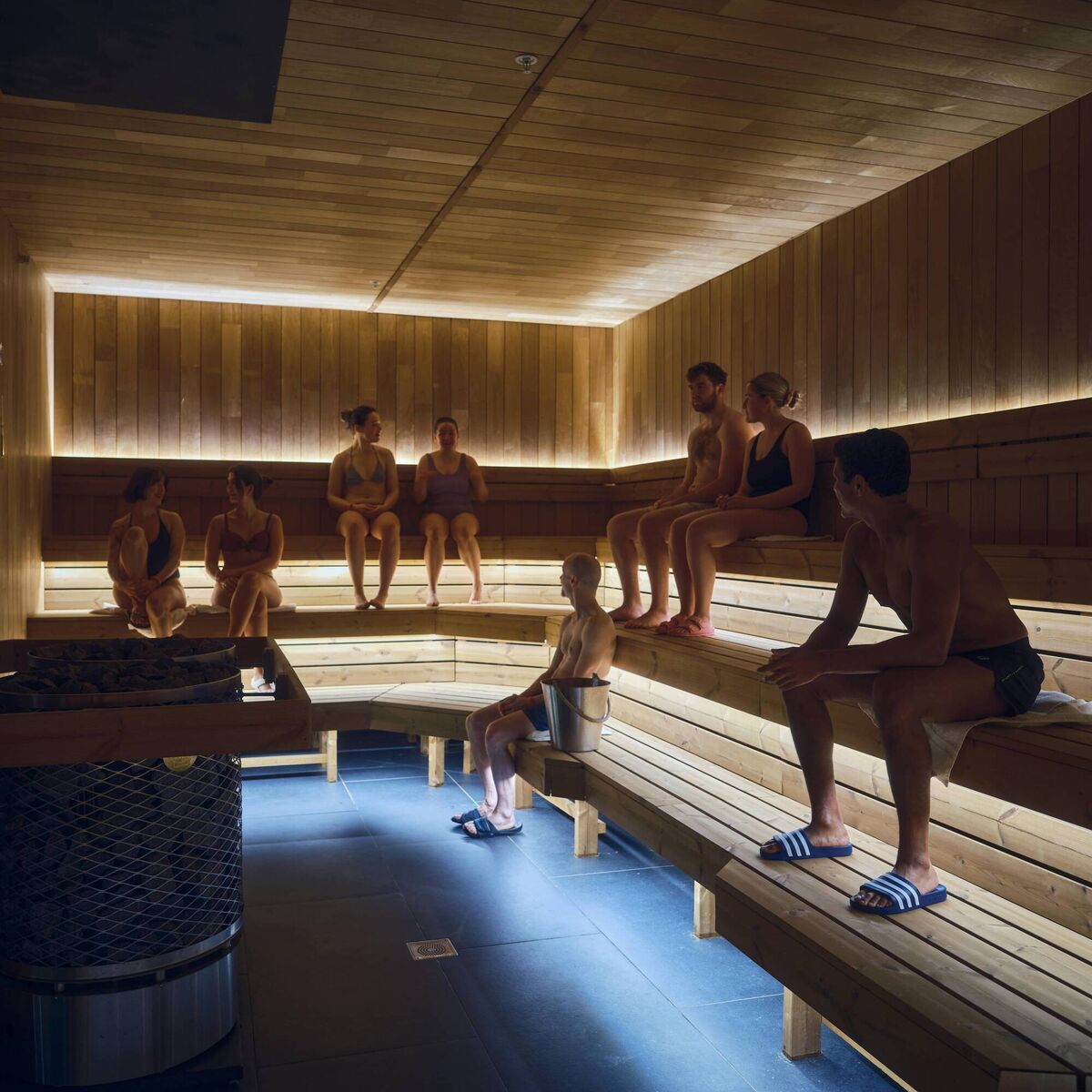
Exploring the science behind the power of heat as saunas grow in popularity across Ireland

âSweating is magical. Sweating helped us go from the middle of the food chain to the top,â Gifford says, explaining that the evolution of humansâ ability to regulate body heat through sweat helped us segue from prey to predator, enabling us to thrive as a species.

It was a bitterly cold winter in Salt Lake City, Utah, when Bill Gifford first began using the âcrapâ sauna in his gym. The journalist and writer had been going through a tough time and craved â15 minutes a day of peace and comfortâ, which the saunaâs warm, dark, quiet interior provided.
âIt felt like an embrace,â says Gifford, who âfelt like a new manâ after the daily quarter-hour of heat, followed by a 15-second blast under the cold shower. That mood boost set him on a deep dive into the health benefits of heat, which heâs documented in Hotwired: How the Hidden Power of Heat Makes Us Stronger.
Heat gets a bad rap these days, most often appearing in the same sentence as âdeadlyâ (as in heatwaves), âextremeâ (as in climate change), and ârisingâ (as in temperatures). Weâre bombarded with ways in which heat is destroying our planet and killing us in the process. Humans and heat donât mix, right? Wrong.
âHeat,âGifford says, âis not just the devil, it also has some angel to it.â Not only is heat good for us, itâs an environment in which we were designed to thrive. Modern life, with its air conditioning and office jobs, has dulled our resilience and our ability to adapt to heat â but by reintroducing targeted heat stress and periods of sweating, we can reclaim it.
âSweating is magical. Sweating helped us go from the middle of the food chain to the top,â Gifford says, explaining that the evolution of humansâ ability to regulate body heat through sweat helped us segue from prey to predator, enabling us to thrive as a species.

Sweating and heat go hand in hand. âHeat can be a powerful tool if itâs used safely and wisely for a specific reason,â Gifford says. The idea that heat could be healing was the jumping-off point for his journey of discovery, and he began it with where he had found solace: the sauna.

Sauna culture has exploded in Ireland since the pandemic, possibly because during those dark days people were craving the same things Gifford sought: peace and comfort. In Finland, where sauna is deeply embedded in the culture, the sauna is known as âthe poor manâs pharmacyâ.
âIt was interesting going from the United States, which very much has an influencer-driven culture thatâs all about the health benefits of sauna, to Finland, where itâs just a part of life,â Gifford says. âThat was really eye-opening.â
Finnish saunas have etiquette and customs but no âhard and fast rulesâ, he says. âItâs much more free-form.â
You can stay in as long, or as little, as you like, cold plunging is optional, people are nude, and thereâs often alcohol and always lots of chat. That laissez-faire philosophy of sauna-ing is one to which Dan OâConnor subscribes. OâConnor is the co-founder of The Hot Box, which had its genesis in a DIY sauna he helped his friend Liam Irwin build in his parentsâ garden during the pandemic. Like Gifford, OâConnorâs experience of saunas had been limited to the gym variety but a visit to Shirley Fitzpatrickâs Bosca Beatha wild sauna in Wicklow opened his eyes to what a true sauna experience could be.
âMyself and Liam left feeling euphoric,â he recalls. â[We walked] away absolutely elated⊠they call it sauna-high.â They launched The Hot Box in Bective, by the River Boyne, with a mobile sauna built on a cattle trailer. They then brought a third friend, Luke Williams, on board, went to Finland, Latvia, Lithuania, and Estonia to get inspiration for expansion, and havenât looked back since.

âOur purpose is to give ordinary people an extraordinary feeling,â OâConnor says. âItâs like, âJust come, take a load off for a little while; I guarantee you it will work.â The benefits are great but we donât want to go down the rabbit hole of becoming too specific of how long you should stay in a sauna, how long you should stay in a plunge pool. Staying as long as you want or as little as you want, thatâs entirely up to you.â Itâs a very Finnish approach.
While thereâs no denying the beatific buzz that comes from a sauna session, is there actual science behind the steam? âThe most surprising thing to me was the fact that targeted heat therapy has an effect on depression,â says Gifford. He volunteered for a clinical trial in Colorado during which he was heated to fever temperature, followed by a cold plunge. The aim was to reset his âinner thermometerâ â a 20,000-person study found that severely depressed people ârun hotterâ (and also tend not to sweat very much) â and, by doing so, banish his depression (and help him survive the HotterâN Hell Hundred, a Texas bike race thatâs as insane, and blisteringly hot, as it sounds).
Gifford says he was âmoderately depressedâ before the âhorribleâ experimental treatment but âat the end of it, it felt like it was a new dayâ.
He was still feeling the benefits three weeks later. (He also aced the bike race.) Most of the participants had significant improvement in their depressive symptoms after a single session, with effects lasting up to six weeks. The trial is ongoing.
You donât have to cook yourself like a rotisserie chicken to get the mood-boosting benefits of heat therapy, though. In fact, you donât even need to go to the sauna. A hot bath will do just as nicely.

âHot-water bathing is just as healthy as sauna use, maybe even more so, because you get more of a direct heat transfer, so your core temperature increases,â Gifford explains. âA lot of the health benefits are related to a slight increase in your core body temperature.â
The heat gives your heart the equivalent of a cardio workout, improves circulation, and lowers blood pressure, while at a 38.5C body temperature, stress-resistant heat shock proteins are activated, which âkeep your DNA from decaying and clear out waste products and all that kind of stuffâ.
Gifford adds: âIn fact, there was a study in Japan that found that people who take hot baths regularly had a similar reduction in heart attacks, all-cause mortality, and heart disease as people who used Finnish saunas regularly.â
Hot water is good but Gifford discovered that cold isnât the holy grail of wellness people think it is.
âThe science around heat, and heat as a therapeutic tool, is much stronger than the science around cold,â he says, adding that the studies to date on cold-water immersion have been small scale and, he says, often shaped by researchers hoping to find a positive effect.
âI think the benefits are a bit oversold,â he continues. âEspecially if youâre talking about using [cold immersion] as a tool for athletes for recovery. If you do a strength workout and then hop in a cold plunge, youâve just stopped any muscle adaptation, any muscle growth that you mightâve hoped for from your strength workout.â
A large study in the Netherlands that had a percentage of participants run a cold blast at the end of their shower found that âthe benefits werenât hugeâ, although those people did miss fewer days at work. Interestingly, Gifford says, the cohort who were assigned the cold blast kept doing it after the experiment concluded. âSo some people really find it compelling and I think it gives you a mental charge. It can boost your mood if youâre coming into it in the right frame of mind.â
The jury is out, especially for women, he says, and that applies to heat as well as cold. A Finnish study that looked at hormone changes in women before and after sauna sessions found that a particular stress pathway was activated much more in women than in men. Is that a bad thing? âI think it depends,â says Gifford, reiterating: âItâs more stressful.â
Itâs not one size fits all, is what heâs saying. When it comes to heat or cold, you need to listen to your body and do what feels right for you. Itâs worth mentioning that Finnish saunas are much hotter than the average Irish sauna. Finnish saunas are all about the löyly: steam, and clouds of it.
âOld-time Finns thought the steam carried spirits,â Gifford says, âand if you see the way the steam comes up off the rocks, travels around the room, itâs almost like a living thing.â
That transfer of heat to skin in the sauna is, Gifford thinks, the âsensation that the Finns craveâ. He adds: âAnd I think thatâs the sensation that is cool about sauna. Thatâs the drug.â
Itâs a drug that Irish people canât get enough of. âWhat surprised us is how mad people are for saunas and cold plunges,â OâConnor says. âIt just blew up. Now, a lot of people are substituting going out on a Friday or Saturday night for going to the sauna. Itâs become an absolute place of socialising and meeting new people.â
Gifford doesnât go to his sad gym sauna anymore; heâs got a neighbourhood place that is âbasic but greatâ. Heâs gone from a self-confessed âwinter guyâ to one who has âno problemâ riding his bike on a sweltering summer day in Utah. Sweating has given him superpowers. His biggest takeaway from his heat odyssey?Â
âIf you lean into some discomfort, you learn that you can do a lot more than you think you can. You can exceed your own self-imposed limits.â
- âHotwired: How the Hidden Power of Heat Makes Us Strongerâ, by Bill Gifford is published by Harper WaveÂ
- The HotBox, see thehotboxsauna.ie

Cancel anytime
CONNECT WITH US TODAY
Be the first to know the latest news and updates