How improving my literacy and numeracy skills as an adult changed my life

Girl reads a book, close-up.
Linda Waldron and her 20-year-old niece, Chloe, have always been close. When they were both a little younger, they spent hours in each other’s company. “Her mother worked in St. James’s Hospital,” says Linda. “So I’d look after her. I remember going to the doctor’s surgery with her once, picking up leaflets and not being able to read them. She’d ask me, ‘Linda, what's that word?’ and I’d have to tell her I didn’t know. You’d be embarrassed. She’d come home from school and I couldn’t help her. I could write and read but I didn’t know a lot of words.”
As a child, Linda was “never bold in school” and “never got into trouble”. If anything, Linda was something of a go-getter. When the Liffey Valley Shopping Centre first opened near her childhood home in Clondalkin, she got work there, starting at 4.30 am and finishing four hours later so she could get to school on time.
“There was a lot of bullying back then in school,” says the 41-year-old. “So if you were asked to read, you’d be afraid to do it. If you said the wrong word, there’d be awful laughs. It was hard to get the confidence. If they had got me now, they might have pulled me aside and asked if I needed extra help. You kind of felt embarrassed to ask for help back then. I was so young and I didn’t know how to put it into words.”
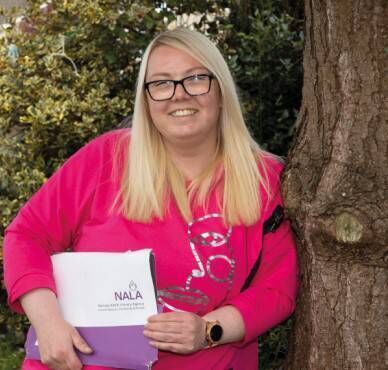
Linda soldiered on. She completed her Leaving Certificate and got on with life. But at the back of her mind, she knew she could do more. “I felt like I missed out on my education,” she says. “So I wanted to go back and see if I could improve. I wanted to do it for myself and my future.” When COVID hit in 2020, Linda, like the rest of us, had a little more time on her hands. Encouraged by colleagues and friends, she contacted the National Adult Literacy Agency (NALA) to see if they could help.
“I was petrified ringing NALA,” she recalls. “But I’m so glad I did. It has changed my life.” For the next year, Linda worked with her tutor, Fiona, to improve her literacy and numeracy skills. At five o’clock every evening, she took a call and Fiona guided her through exercises and weekly challenges - gap-fill exercises, reading assignments, as well as spelling and reading through novels.
“It helped me with my mental health too,” says Linda. “I had something to look forward to. I had that call every day at five o’clock and it was something interesting. I had a longing each evening for that phone call. If it wasn’t for NALA I wouldn’t be where I am today.”
NALA gives people with unmet literacy and numeracy needs access to learning opportunities so they can fully take part in society. That they are required on the island of saints and scholars might come as a surprise, but according to the latest statistics, 18% of adults (16 to 65) struggle with reading and understanding everyday text. For that cohort, apparently simple things like reading a bus timetable or understanding instructions for medicine, are more than challenging. Twenty-five percent of us have difficulties using maths in everyday life such as working out a bill or calculating percentages.
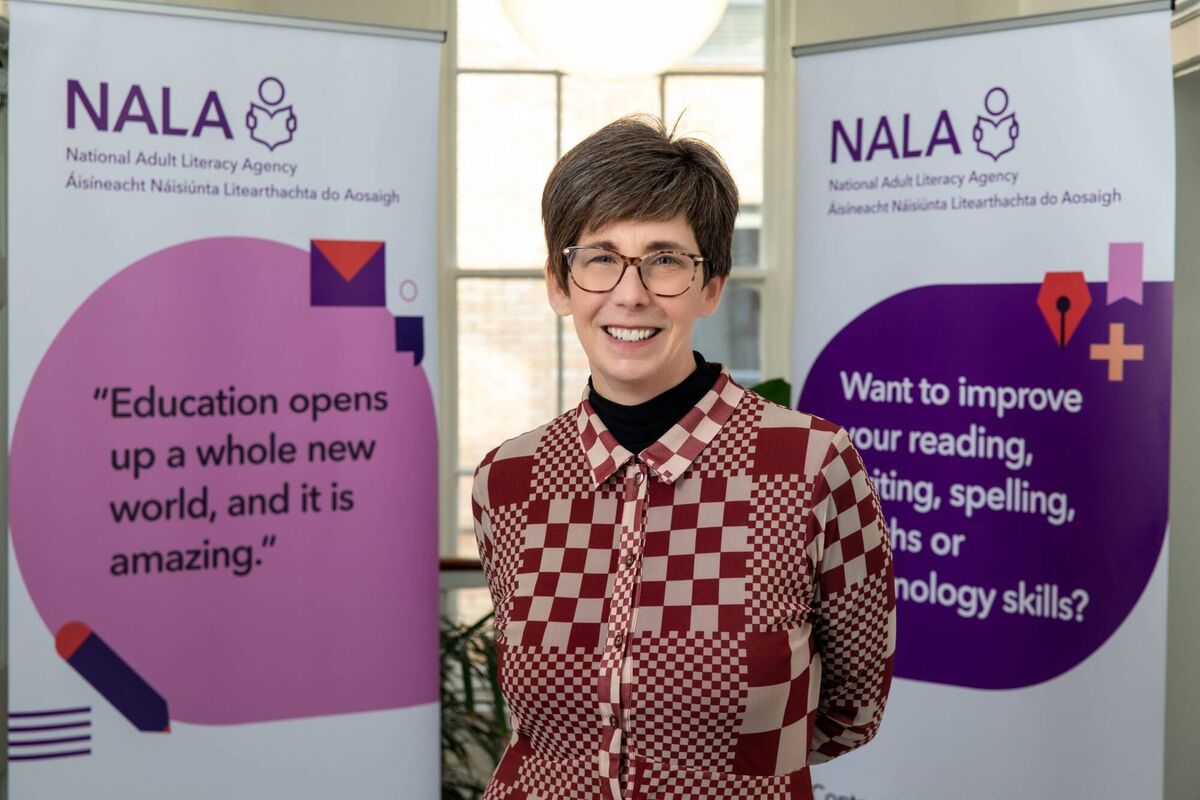
“Ireland does have one of the highest levels of third-level progression in the world,” says Colleen Dube, Chief Executive Officer of NALA. “Despite those achievements, we have a situation where close to one in four adults have unmet literacy needs. About 11% of the population still have lower than Leaving Cert qualifications so there are pockets of people who don’t have the basic skills they need to engage fully in daily tasks.”
Of course, the challenge becomes even more acute when you consider that the nature of literacy itself has changed significantly since NALA’s foundation in 1980. Much of the focus is still on basic reading, writing and numeracy skills but digital literacy is a newer and sometimes more daunting frontier. In Ireland, only 38% of the population have the requisite digital skills to engage properly in work. This is a staggering statistic for a country that sees itself as the Silicon Valley of Europe.
“Ireland has lots of digital strategies,” says Colleen. “But we haven’t adopted an agreed curriculum for digital learning skills. We do have technology-enhanced learning but it’s not the same as teaching an agreed curriculum on digital. There is a framework that sits within the European Commission called the Digital Competency Framework and we are one of the few countries that have not adopted it. We think this needs to be adopted and embedded in primary, secondary and third-level education.”
While NALA is waiting for new international reports and statistics to be published, anecdotal evidence suggests we are, broadly speaking, moving in the right direction. One area of concern is the adults of tomorrow. In 2022, the OECD’s Programme for International Student Assessment (PISA) report found that Ireland’s 15-year-olds were performing well in relation to other countries. However, the percentage of students who are not achieving Level 2 (“the baseline level of proficiency that students need to participate fully in society”) has risen since 2015, in both reading and mathematics. Reading has risen from 10.2% in 2015 to 11.4% in 2022 while mathematics has risen from 15.0% in 2015 to 19% in 2022. The report concluded that “Ireland now has significantly more lower-achieving students in mathematics”.
“There is a new government strategy, the Adult Literacy for Life Strategy, that looked at all of this evidence and identified 12 target groups that have unmet literacy needs,” says Colleen. “But the one group that didn’t get picked up, but has emerged, are young adults, who have left school early or were school refusing and that’s a timebomb for the Government if it's not addressed. We’d like to see the National Training Fund used for people qualified at lower levels. At the moment, the Government is obsessed with higher level qualifications in the likes of data analytics, construction skills, green transition and they’re taking their eye off the ball in terms of that timebomb.”
Linda was one of those from her generation who slipped through the net. Luckily, she had the determination and humility to ask for help. By the end of her NALA programme, her confidence and capabilities had developed to such an extent that she is now in third-level education, studying Level 5 Healthcare Assistant near her home in Mountmellick, Co Laois.
“I didn’t know what an assignment was or what a module was but once I got through those doors, I loved it,” she says. “I ended up getting three merits and three passes in college this year. I have another year to do but I’m getting a certificate for the modules we’ve already done in September. So I have to wear a hat and gown for that. I’m looking forward to the day out.”
“I really enjoy reading now,” she continues. “My partner can’t believe how much I’ve improved. I read little books with my nieces now and that fulfills me. I try to encourage them to stay in school, work hard and enjoy it. The future is very bright for me and I have NALA to thank for that.”

CONNECT WITH US TODAY



Be the first to know the latest news and updates