Elaine Harris: My guide to help you make sense of your journey into midlife

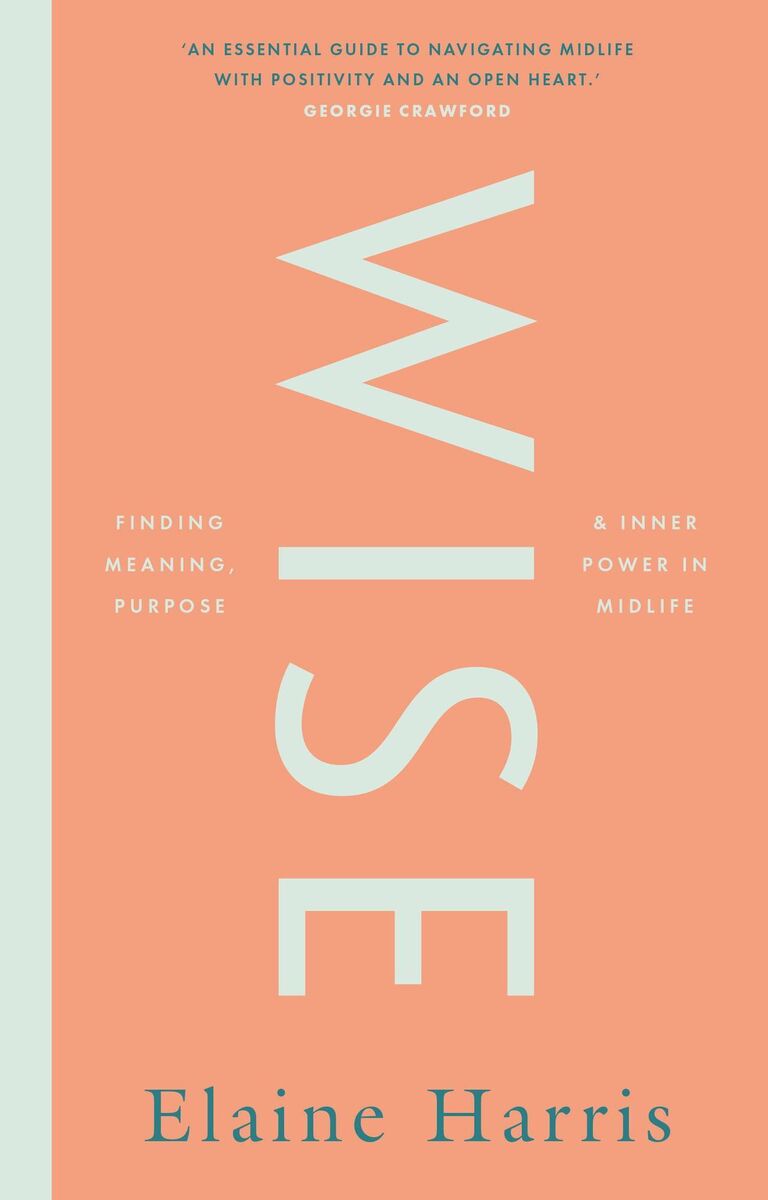
Elaine Harris: Wise is her manifesto to women everywhere on finding meaning, purpose and inner power in midlife.
The following is an extract from my book. The inner work that we do as we move into midlife, and our commitment to this work, facilitates us stepping into our birth right to become wise women. This is what nudged me to create this book – a guide to help you make sense of your own journey into midlife. This passage requires that we contemplate those things that might be stopping us from carrying our wisdom forward and sharing it with those coming behind us for the greater good. This is how we become the fullest expression of ourselves.
Since I was young, I have always been intrigued by stories of people who seemed to discover their gifts later in life – like Vera Wang, who started designing wedding dresses at 40 years of age, or Julia Child, who published her first cookbook at 49 years of age. And just recently, Angela Álvarez started her recording career at 90 years of age, winning best new Latin artist award at the Grammy Awards when she was 95 years old.
In a youth-obsessed culture, these women are not only inspiring, but serve to remind us that it is okay not to have everything figured out yet. There is time to get to know ourselves and bring something to the world later in life. Western culture, however, doesn’t always encourage us to think this way. Our society does not see the value of ageing as a time to assimilate and embody wisdom, and so we don’t honour the wisdom of our elders.
Many of us have been conditioned through aggressive marketing campaigns to try to prevent the natural ageing process. Our propensity for fear and shame at the visible signs of ageing is worth a lot of money to the companies that sell us a promise of eternal youth – the global anti-ageing market is worth over $45 billion. Our rejection of ageing appears to stem from a deeply ingrained fear of death in our psyche. We try to resist death by clinging to youth and going to war against the physical signs of ageing. Youthfulness is applauded as beautiful and worthy, with the result that those of us who dare to age find our self-worth diminishing in a world that tells us we should remain young. The passage into midlife sees our inner maiden flourish into a wilder, wiser woman. If we embrace the energies of these archetypes, we will see a great shift in the world.
But sadly, many women feel the desire to hide these qualities in an anti-ageing culture. We suppress our inner wise woman to try to fit in and conform.
The anti-ageing narrative is anti-life and anti-growth. When we start to accept impermanence and death as inescapable parts of the cycle of life, we gain immense freedom, clarity and perspective to truly live.
To age is to grow, and everything that is living must age. Ageing gives us the opportunity to learn, change, evolve and gain the perspective, clarity and wisdom that only comes with a life fully lived.
This is something to be celebrated, embraced and honoured. And as we know, the age of wisdom it is a privilege denied to many people who died before they reached this stage of life.
Despite what the marketeers want us to believe, the truth is that we cannot beat ageing or escape death. Denying the natural stages of life is futile. Moreover, it is damaging to ourselves.
We lose connection with our natural rhythms and damage our well-being. We are exhausted and experience epidemic levels of illness and burnout trying to conform to a system not designed with our wholeness in mind. But we have the power to shift our reality. We can create a radical new paradigm that values personal growth and the balance of yin and yang, and that ritualises the cycles of life.
This transformation begins with us. It can only happen when each of us realises that we have something wise and sacred to contribute. Midlife often gives us the opportunity to fully embrace all that we are and all that we can be. If we can intentionally lean into the flow of this liminal time, we can find more fulfilment. But if we push against the rhythm of this rite of passage, then we will suffer.
The term ‘midlife crisis’ was coined by Jung to describe the journey we pursue to find purpose and meaning in the second half of life. Jung believed that people experience a crisis when they have not been true to themselves or when they live in an inauthentic way that is out of alignment with who they really are. He suggested that the quest of midlife is to reconnect with our uniqueness and individuality and to follow the path intended for us by nature.
Jung’s treatment for a midlife crisis involved asking patients to tune into their imagination and creativity and to rediscover hidden parts of themselves, such as the passions and interests they had in adolescence.
From the Jungian perspective, midlife is a chance to return to ourselves, getting to know ourselves in a deeper way and unearthing meaning in our lives. Interestingly, the word ‘crisis’ has its origins in the Greek krisis, which means ‘a critical turning point or decision’. Similarly, the word crisis is interpreted in Chinese as a ‘change point’.
Midlife is a significant turning point in our lives. Up until this time, typically we have been in striving mode – focused on the pursuit of educational achievements, meeting a partner, building our families and following a hierarchical career path to accumulate material goods.
As strivers, we allow our value and worth to be measured by our accomplishments and financial success. But Professor Arthur Brooks of Harvard says that this linear path leaves us unfulfilled, as we suffer the ‘striver’s curse’, finding that attaining our material desires and achievements does not provide the meaning that we need in our lives. Thinking back to Maslow’s work, we can see that although material things make life more comfortable, they only help us to fulfil our lower level in the hierarchy of needs. Focusing solely on our material desires, and ignoring our higher-level needs for safety, love, the age of wisdom self-actualisation, transcendence and spiritual connection, does not give us more contentment. In fact, the law of diminishing returns sets in, and no matter how much more personal wealth and material goods we accumulate, our lives will lack meaning and purpose until we begin to address our desire for love, connection and the highest human potential.
The principles of Ayurveda, the Indian science of life, can help us to understand ourselves better and make sense of the shifts and changes during midlife. In Sanskrit, ayur means life and veda means knowledge. Yoga is one well-known practice that is derived from Ayurveda. According to Ayurveda, the universe is made up of five elements: ether (or space), air, earth, fire and water. Crucially, each element is needed to give us life and sustain us. Just like the universe, each of us is made up of a combination of these elements, and some of us will have more of one element than others. The unique combination of elements that we have will form our natural constitution and influence the qualities of our mind, body and spirit. Jennifer Freed, a psychologist and astrologer, says that when we know our personal map of these elements we can take care of ourselves better and design our best life, which is one that allows us to fully express our unique gifts.
- Elaine Harris is a social scientist, yoga therapist, reiki practitioner, blogger and mother. She is living and experiencing the rite of passage to midlife at the time of writing this book.
- Elaine has two children and lives in Wicklow with her husband, Damien Duff. 'Wise' by Elaine Harris is published by Gill Books on June 8.
CONNECT WITH US TODAY



Be the first to know the latest news and updates