Burping after meals and clipping nails in public: Why 'polite society' has always been a myth
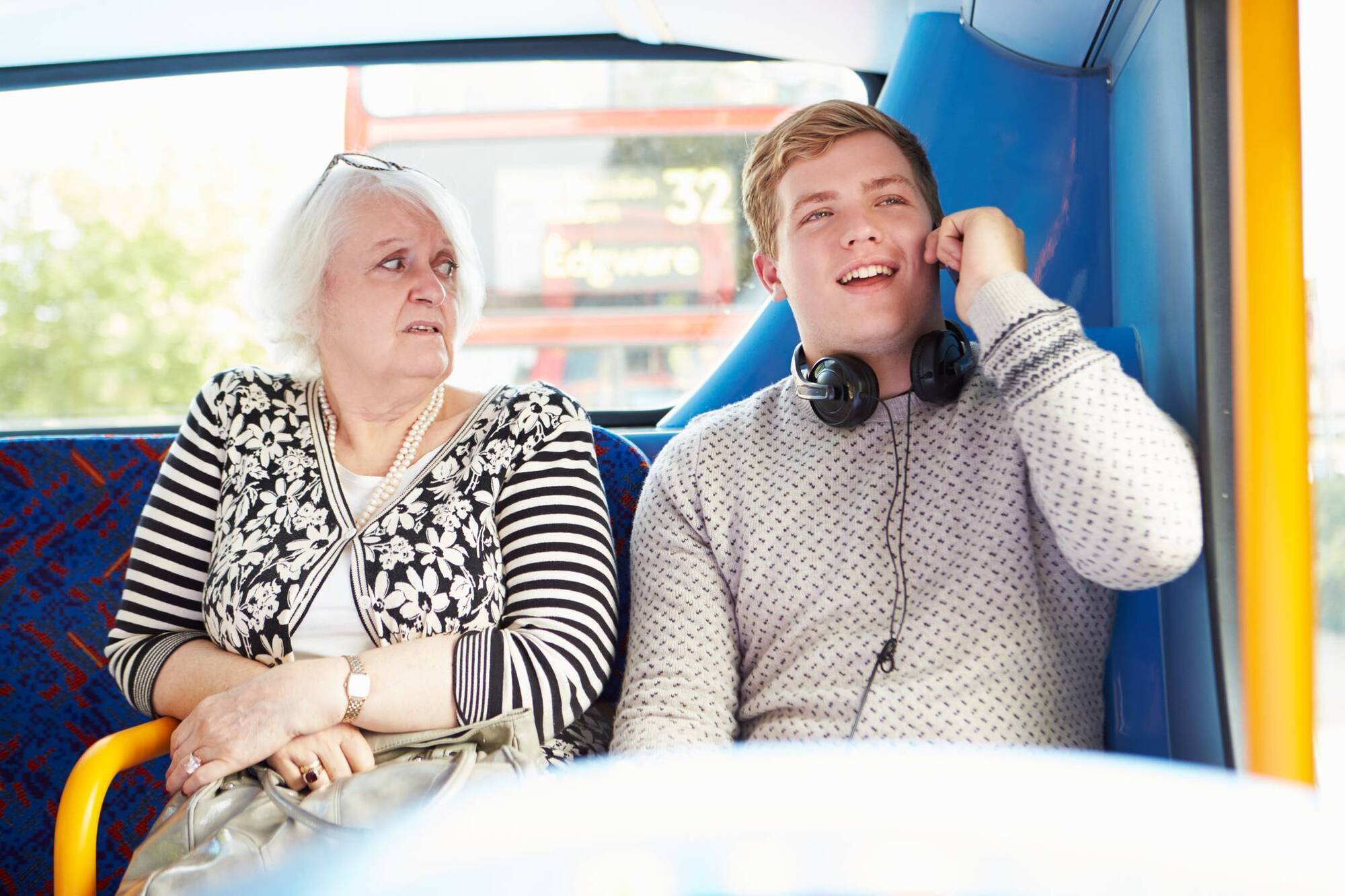
Disturbing other passengers with your loud phone calls may be rude now but the past was not as polite as you may think.
Walking five abreast along the pavement, forcing on-comers into the road; spitting, and dropping litter in the street; queue jumping and pushing in; taking up a bus seat with your bag; picking over vegetables in the supermarket and discarding those you don’t like; letting your dog — or child — annoy others; making fellow passengers endure your loud personal phone calls; putting your feet up on train seats; continually interrupting a conversation to text your mates; shouting your opponent down instead of arguing logically; and finding it outrageous if a ‘proper’ bacon and egg breakfast isn’t available when you’re abroad. It’s a rude world out there all right!
Yet the past wasn’t a polite place either.
Instead of “sitting up straight” at the table, Ancient Romans reclined on couches and ate with their paws. If they enjoyed their food, they’d give a hearty belch and, when full, tickle the back of their throat with a feather to vomit.
Should they need the toilet, they’d do their business on a pan in front of other guests. “Apollinaris, the doctor to Emperor Titus, had a good crap here,” reads an inscription on a house in Pompeii.
Unlike the Romans, who at least had public baths, medieval people were a pretty pongy lot. “There are some women who have sweat that stinks beyond measure,” recorded 12th-century physician Trota of Salerno.
“He must be a king... he hasn’t got shit all over him!” says one grimy serf to another on spotting King Arthur in Monty Python and the Holy Grail (1975).
Even some royals smelled bad. Queen Isabella of Castile reportedly boasted she had bathed only twice in her life: on the day she was born, and when she married Ferdinand of Aragon. King James I supposedly wet himself while out hunting.
Table manners remained a perennial gripe. Sixteenth-century Dutch philosopher Erasmus noted how some people stick their hands into food dishes “in the manner of wolves”. Good manners, he wrote, “distinguish us from beasts or crude people”.
In Galateo: The Rules of Polite Behaviour (1558), Florentine scholar Giovanni Della Casa deplored the practice of clipping nails in public and looking into the handkerchief after blowing your nose.
The lower orders received the most flack. One writer complained they did not comb their hair, farted at will, laughed too loudly, winked and snorted, and made unannounced visits to people’s homes.
Travellers were particularly shocked by toilet habits, not least by the “young wenches” in Leiden during the 1590s, who “performed in the open street”; while an Englishman visiting Turkey in 1615 was astonished that locals didn’t “piss against the nearest wall” but, strangely, withdrew to urinate.
Back home, King Charles II’s courtiers left excrement “in every corner”, and Samuel Pepys admitted he once defecated in the hearth. University men were no better: When Josiah Pullen, late 17th-century vice-principal of Magdalen, Oxford, got caught short while escorting a lady around the college, he “turned his face to a wall [and] performed the discharge, still holding the lady fast by the hand”.
Societies for the Reformation of Manners sprang up in the 1690s, but were often derided as groups of middle-class do-gooders, and ignored.
Eighteenth-century novelist Richard Graves was horrified to witness an eminent doctor spit on the carpet and a country gentleman borrow someone else’s toothpick, use it, and return it with thanks.
“Were I to yawn extremely, snore, or break wind in your company, I should think that I have behaved myself to you like a beast,” the Earl of Chesterfield advised his son in 1774. Doubtless, he’d have something harsh to say about today’s mobile phone blabbermouths, since he thought: “One cannot keep one’s own private affairs too secret.”
During Victorian times, appropriateness was taken to new heights. An 1860 manual stipulated: “Never be seen in the street without gloves,” and a gentleman accompanying a lady “should carry her parcels”. Bad breath must be “carefully remedied”, while the slightest burp threatened social ruin!
In the US, the decay of manners scandalised socialite Emily Post, who singled out dozens of discourtesies in her book Etiquette (1902). “It is unforgivably rude to refuse a proffered hand,” she commented. While at the theatre: “Nothing shows less consideration for others than to whisper and rattle programmes and giggle.”
But little changed. In 1988, New York mayor Rudolph Giuliani lambasted a “rude culture of self-indulgence, selfishness and vulgarity” when launching a campaign to improve the manners of pedestrians and motorists, taxi drivers and deliverymen.
Recently, our behaviour patterns have been turned upside down by Covid-19. When will we next dare to shake “a proffered hand”? For two years we’ve freely mouthed all sorts of things behind our masks, been required to keep an ‘anti-social’ distance, swerve instead of greeting others in the street, and refuse invitations from those outside our social bubble. In the ‘new normal’, who’s going to ask someone to remove their bag from a bus seat so you can sit next to them?
There might never have been a golden age of politeness, since rudeness has been moaned about ever since the Middle Ages. Today, we live in a less hierarchical society, where deference is scorned and ways of speaking and dressing are less formal. Should that also mean less consideration for others?

CONNECT WITH US TODAY



Be the first to know the latest news and updates