Phoebe Bridgers floats above her sinking feelings in Punisher
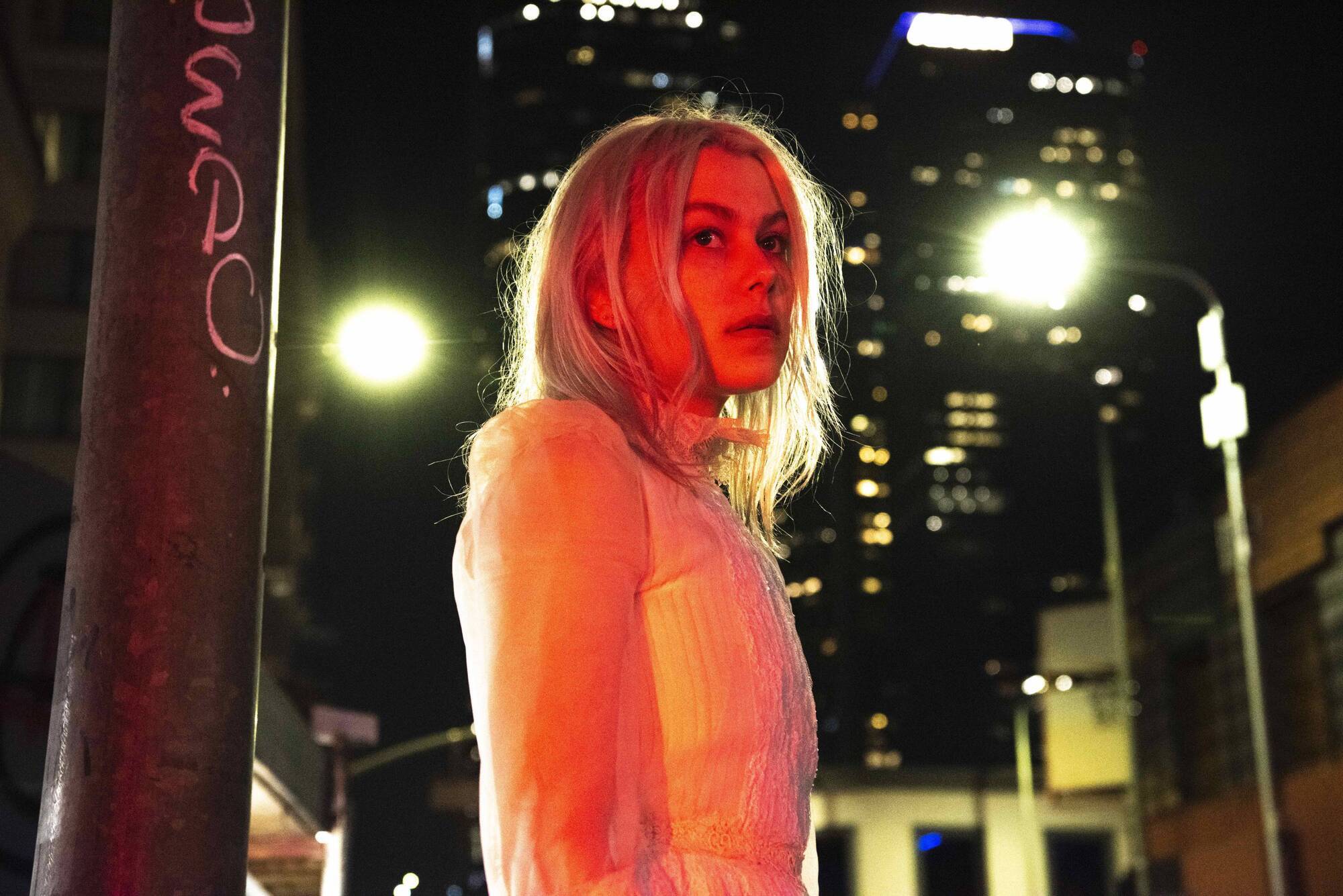
Phoebe Bridgers mines her life for her music. Photo: Frank Ockenfels
Phoebe Bridgers’s is a song that sounds airborne — and not just because the lyrics refer to planes. It begins with a synthesiser wafting a gentle melodic line. Drums stir accents on the two and four.
Bridgers floats in, singing the simple verse melody. The mood is wistful, drifting. A few bars pass before a revving electric guitar and bass enter.
The drums grow bolder. Then comes the chorus, and starts to soar: Bridgers rises in register, singing in high harmony with herself. A trumpet rings out atop chiming guitar and keyboard. We’re flying. (And so is Bridgers in the song’s trippy video.) But listen to what the singer is telling you. She’s on tour in Japan, too unsettled to take in the singularly beautiful city after which the song is named. Instead she’s stuck on someone.
She sings about a phone call she got — he said he was getting sober. Her little brother got a call, too, to wish him a happy birthday — 10 days off, but points for trying. The lyrics pull down while the music crests and crests. As “Kyoto” closes, Bridgers is belting, “I’m a liar.” Though you might think you heard, as I initially did, “I’m alive.” Then again, it’s never a mistake to hear life in Bridgers’s music, melancholy as it may be.
Is it any wonder that , the album from which comes and that helped Bridgers earn four Grammy nominations, was such a comfort to so many during these awful last 12 months? Haven’t we all, in our own way, been desperately trying to make our sinking feelings float?
“There’s this stamp that I can put on bad things,” says Bridgers, a 26-year-old Angeleno.
“Got a song out of it. It’s weird, but, wow, that’s my job.”

You’ve said elsewhere that one of your difficulties in life is feeling unable to experience things in the moment. That seems connected to your lyrical sensibility, which has this striking specificity but also a sense of remove. I’m wondering if you worry about the source of your gift also being what prevents your happiness.
You’ve tapped into the thing that I think about every day. I spend hundreds of dollars on therapy a week so that I can fix that problem. I’ve also monetized it by using it to write songs, so it’s a complex thing. I’d love to inch closer to feeling good things and bad things more in the moment, but when I sit down to write, I just can’t be super emotionally activated. It takes me years to write about something.
So how did you arrive at ?
Word vomit. I do this thing when I feel frustrated where I just say what’s on the top of my head or rhyme random stuff. The first couple lyrics of the song came out like that. Then I was like, I can’t just talk about addiction issues. It has to be more interesting than that. I should tell you more context about my relationship with my dad. Marshall Vore wrote the song with me because I was struggling with this thing we call 'dumpster dads'. He and I have a lot of shared experiences, whether it’s abandonment or gaslighting. And Marshall was like, everybody’s dumpster dad gets them to drive way too early. I thought: That’s funny. I’ll put that in there. So the truck bit in the song was, I thought, made up. Then I was driving in Pasadena and had a recovered memory of driving my dad’s truck when I was a child — this was after we finished the song. So the emotional distance goes even further than a mind-set that I need to get into to write. It’s natural for me.
The detail in your lyrics and even your openness on Twitter and in interviews encourages the idea that there’s a one-to-one relationship between you and the persona in your songs. Is there any space between the two?
No. I can only really write from my perspective. That was one of the things that was mind-blowing about seeing the way that Conor Oberst wrote when we were working on our record [ , from 2019]. He’d go, What would it be like to be this person? What would you think about and do? I’m not that creative. I only have my experience to go on. But there are little bends in the truth: I wrote a song called on my first record [ , from 2017] about my brother and domestic violence and when my house caught on fire when I was 19. My mother was hurt in the fire, and everyone was psychologically freaked out. One of the cops wondered if my brother had done it, but he had no part in it. In the song I say that he would prefer to drown than go up in flames. Then a couple of years ago my brother said, “I definitely prefer fire, so I don’t know why you said that.” [Laughs.] He’s hilarious.
It seems like such an emotional minefield to write about your family.
Sometimes I think, Why did I open that up? I also have this tendency interpersonally — I’m the anxious-avoidant attachment type. I’ll talk to my therapist or my mom about how upset I am about something somebody did, and the logical conclusion is, Well, you should tell that person. Then I’d have to resolve it, when what I want is to exile them from my life. But it’s common to not have black-and-white feelings about your family, and it’s nice to talk to people who’ve had similar experiences. It makes me feel less alone, and I get more of those experiences from sharing my own. But I don’t like when my family hears it.

I know that your mom has started doing stand-up. Have you seen her perform?
Oh, yeah. When she told me she was taking a comedy class — concerning. Then she invited me to go see her — so concerning. I don’t drink that much, but I ordered five drinks and was shwasted by the time she came onstage. And she crushed it. Went to see her the next time, totally dry, she was still funny as [expletive]. It was a relief. Like if you’re dating someone and they start writing poetry, you have to be like, “Oh, cool.” But this was my mom. She’s always been hilarious, but I was nervous.
Did she tell jokes about you?
Yeah. There was one involving my sending her a picture when I thought I had an STD when I was a teenager.
You got a little of your own medicine.
Totally. I gave her permission to joke about me, too. I was like, I’ve definitely subjected you to a weird spotlight.
Speaking of: There was a Spotify billboard in LA featuring you that had a tagline about hitting the road with a guitar — what’d it say?
“Hitting the road with six strings and a UTI”
Right. It made me wonder, if that line got approved, what got rejected?
They all came from my tweets. But there was one that was, “I was sexually active before I stopped wetting the bed.” Which, if you flip it, sounds like I was assaulted when I was a kid. But the truth is that the last time I wet the bed I was like 20. It runs in my family. What I loved is that the person I was dating at the time — I did it, and I thought, Are you kidding me?
I woke them up and was like, “I’m really sorry but I totally wet the bed.”
And they were like: “I’m tired. I’m going to just scoot over.”
Then I never did it again. It was like a magical fairy-tale solution. All I needed was acceptance and someone who didn’t give a [expletive] and the problem was solved. You look back at what you obsessed about when you were younger, the stuff that made you go, “I would evaporate if anybody ever knew,” and then you turn into an adult and realise no one cares. Your world is biggest to you. Which is good to remember.

After the allegations of Marilyn Manson’s abuse came out, you tweeted about a weird experience you had with him. Can you fill in that story?
How was it that you wound up at his house? He was trying out for a TV show that my friend’s dad was working on, and my friend’s dad was like, “I know you’re a big fan, come with us to meet him.” So I went with two of my best friends. One of them is my guitar player, Harrison. I think I was 18. I am not a victim of his, so I’m not trying to take up space, but I did want to say I witnessed him at his best, and he made tons of rape jokes, used the N-word, joked about swastikas. There was a beanbag chair that he had for me to sit on, and he was like, “I’ve [expletive] so many people in that beanbag chair.” I hated all the comments that were like, “What did you expect from Marilyn Manson?” I expect the world. But yeah, as much as you read about this kind of stuff, somehow it still shocks me.
Do you feel an expectation that you must be active on social media?
Well, it’s easy to romanticise people with depression or even romanticise yourself and think, The darkest parts of me are what make me an artist, when you don’t have to be abusive or depressed or addicted to make great art. I like using social media to strip back that idea of the depressed artist. But I do get self-conscious of my whole Twitter being Phoebe Bridgers jokes. I want to have a healthier relationship with social media than [expletive]-posting all day about myself.
What you might do differently?
I have a fantasy of eventually deleting it.
Don’t we all.
Yeah. But my connection with fans — I have a friend, Austin, whom I met because he was a yellow-haired kid in the crowd at my shows. I recognised his face on Twitter: He DM'd me asking if I wanted to get lunch at a vegan zombie-themed burger restaurant, and I was like, Absolutely I do. The real thing about social media is the direct contact with fans. That can be scary when someone has no boundaries, but I’ve met so many friends through it.
(This interview has been edited and condensed for clarity from two conversations.)