Jimmy Durham: A modest but important mark made on history 
August marks the 110th anniversary of the death of Jimmy Durham, dubbed the only Black soldier in Victoria’s Army. Donal O’Keeffe visits his grave in Fermoy.
Jimmy Durham: A modest but important mark made on history 
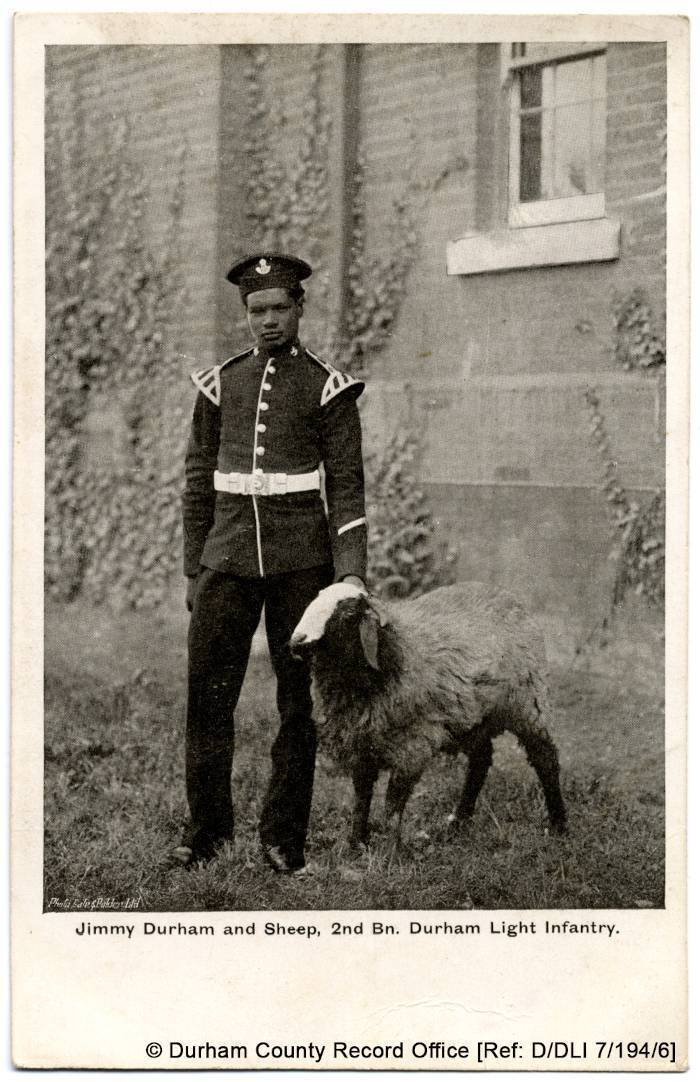
Jimmy Durham, 2nd Batallion, Durham Light Infantry. Reproduced by permission of Durham County Record Office. File picture. 

In Fermoy’s old military cemetery, a white marble cross marks the final resting place of a historic figure who died in 1910, aged 25, 5,500 miles from his birthplace.

Jimmy Durham’s story begins on New Year’s Day, 1886, after the Battle of Ginnis, when Lieutenant Henry de Beauvoir de Lisle found a baby on the banks of the Nile. Soldiers of the Durham Light Infantry had defeated Mahdist Sudanese warriors of the Dervish State aboard a barge. The Sudanese were massacred by British boat-mounted Gardner guns, and the few survivors fled.


De Lisle later recalled “We ran up to the boat and … and there, standing on the bank of the stream alone, was a small curly-haired child under two years of age, dressed in the full war paint of a Sudanese warrior. As he held up his arms for me to take him up, I did so and threw him to Sergeant Stuart.”

Stuart, a kindly Scotsman, nicknamed the infant “Jimmy Dervish”. Deciding the baby would make “a good infantry pet”, de Lisle was told by an injured man that the child’s name was Mustapha and that his father — a Sheikh — had been killed, and his mother had fled. 

In 1939, the then-General Sir Henry de Beauvoir de Lisle recalled the traumatised child “pointing his finger at me repeating ‘Bung- morto ’, imitating the sound of the rifle and the result [death].”

“He was a very smart lad. He quickly learned to speak English and, when only two-and-a-half, could act as interpreter for the men with the hawkers in camp.”

Private James Birley and Sergeant Joseph Francies decided to raise Mustapha between them. With their names, and a surname from their regiment, Mustapha became James Francis Durham. He would soon be Jimmy to the men of the Durham Light Infantry (DLI).

On the long marches, Jimmy sat on the pommel of Sergeant Stuart’s saddle, endearing himself to the men with his singing and dancing. According to de Lisle’s memoirs, the plan was that when the regiment reached Cairo, Jimmy would be left at a mission home. However, when they got there, the DLI sergeants begged that Jimmy be allowed stay with them, and they each pledged a rupee (a day’s pay) a month toward his education.

Jimmy travelled to India in 1897, where he learned to play the bugle. In 1898, it was on to Mandalay, where, a year later, Jimmy would make history. When he was about 14 — his exact birthday being a mystery — Jimmy and the sergeants felt he was old enough to enlist.

The British Army had employed Black musicians since the 18th century — and colonial regiments were often Black — but no African had been allowed to join the regular Army on equal terms with white recruits. Jimmy’s application went all the way to Victoria herself. Swayed by strong endorsements from the DLI, the Queen approved his enlistment. 

On May 23, 1889, James Francis Durham — Boy Soldier Number 6758 — became almost certainly the first Black person to be enlisted to the British Army.

In 1902, the DLI was brought home, and Jimmy found himself first in Aldershot and then in the English North-East. The cold, wet climate was daunting for a teenager who had known only warm environments, but Jimmy was welcomed by an extended family of former and serving sergeants, and he lived in and around Darlington, Bishop Auckland, and Tyneside. He was partially brought up with the family of Sergeant Robson, whose daughter, Stella, he came to regard as a sister. To Jimmy’s delight, Stella would name him godfather of her baby.

In Bishop Auckland, Jimmy met Jane Green, daughter of a local blacksmith, and sister to a quartermaster sergeant in the DLI. Jimmy and Jane fell in love and were married in a Newcastle registry office on July 25, 1908.

Stationed to Victoria Barracks in Cork, Jimmy played clarinet and violin in the regimental band, and while running the Army Temperance Association for the 2nd Battalion of the DLI, he won an award in 1908 for achieving the highest membership percentage in the Army.

A teetotaller, Jimmy rented rooms for temperance meetings over a public house across from the barracks. Some of his colleagues soon realised that attending those meetings gave them a perfect excuse to go to the pub.

As 1910 began, Jane discovered she was pregnant. Joy turned to tragedy when the Irish climate finally bested Jimmy. He contracted pneumonia and died in the Fermoy Military Hospital (now the Aldi carpark) on August 8, 1910. He was perhaps 25. There was a huge turn-out for his funeral, with many floral tributes left at the graveside.

Three weeks after Jimmy’s death, Jane gave birth to their daughter, Frances. Jane would later re-marry and have four more children with her second husband, Thomas Cleasby of Bishop Auckland, Co Durham. Frances would live her whole life in Bishop Auckland, marrying a Mr Jubb. They had no children. Frances died in 1998.

In Fermoy's old military cemetery, with its gentle views of Fermoy's spires and steeples and, away to the south, Corrin Hill, Jimmy Durham — Mustapha — having made his modest mark upon history, lies at peace these past 110 years, half-a-world from his birthplace.

x

More in this section

Lifestyle

Newsletter

The best food, health, entertainment and lifestyle content from the Irish Examiner, direct to your inbox.

Cookie Policy Privacy Policy Brand Safety FAQ Help Contact Us Terms and Conditions

© Examiner Echo Group Limited