Is your child experiencing social isolation at school? Here's what you can do

Social exclusion can make young people feel as if something is wrong with them, and presents a difficult challenge for parents to overcome
Is your child experiencing social isolation at school? Here's what you can do

As children move into their teenage years, social issues become more complex. Picture: iStock

Lunchtime at school was the worst, says 20-year-old Sheila*, recalling being excluded by friends when she was in fifth year at a West of Ireland co-ed school.

“They’d make plans in front of me where I wasn’t invited. One lunchtime, they were giggling and whispering, and I glanced at the phone of the person beside me, and saw ‘can she just go away, she’s so annoying’.
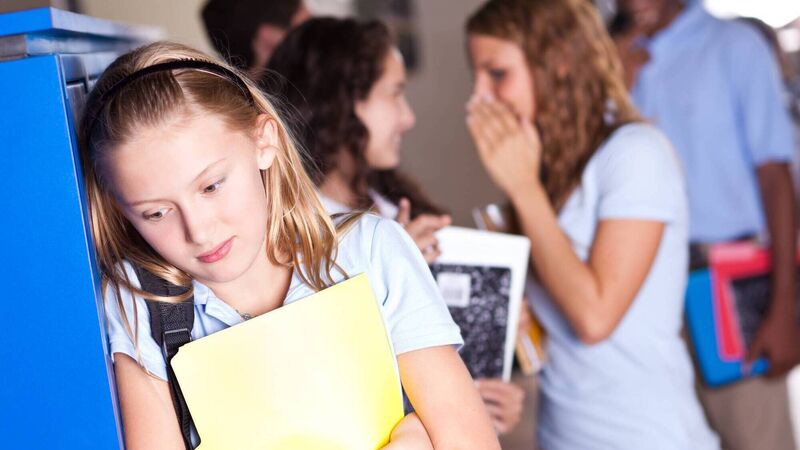
“The worst part was being in a very cliquey school. You had your group, and that was it. I hung around by myself for a lot of it, or I sat in with people who weren’t really my friends, just so I wasn’t alone.

“I felt sick to my stomach all the time, a heaviness, and definitely self-conscious. I wasn’t focusing in class. I felt very isolated and lost interest in things I loved — I quit football, which I’d played since I was 10.”

Sheila is not alone.

Of 5,079 teenagers, aged 15 and 16, across 90 schools and centres in Galway, Mayo, and Roscommon who participated in the November 2024 Planet Youth survey, 38% had experienced rejection by friends — 45% of girls reported it versus 28% of boys.

Emmet Major: 'Being rejected by friends has a big impact on mental health.'

“This means around 2,000 young people, which is a lot,” says Planet Youth coordinator Emmet Major.

Digging further into the data showed a correlation between teen social exclusion and various aspects of mental health. Major explains that 58% of teenagers with a low self-esteem score had experienced rejection by friends. Some 22% of those who reported engaging in regular self-harm had suffered this type of rejection.

Being rejected by friends has a big impact on mental health, says Major, adding that it has a knock-on effect on issues such as school refusal. “There’s only so many times a child can go into school and eat their lunch in the toilets before stopping [attendance].”

Clinical psychologist and author Malie Coyne says belonging is a fundamental human need, wired into our biology for survival and emotional safety — and this need really intensifies for teenagers: “They’re forming their identity — and their brains are very sensitive to peer approval and peer rejection.

“Teens are very focused on their peers — it becomes all-important whether they do or don’t feel they belong in the group.”

As a consequence, being excluded by peers feels catastrophic, says Coyne: “Teens process it almost like physical pain.”

Malie Coyne: 'Teens are very focused on their peers — it becomes all-important whether they do or don’t feel they belong in the group.'

Explaining the difference between peer exclusion and bullying, Coyne says bullying is repeated, targeted behaviour where there is intention to harm, a power imbalance, and the affected person is enduring ongoing fear and distress. Peer exclusion, by contrast, is about being left out, not being invited; you feel ignored and that your group doesn’t want to interact with you.

Coyne says: “It can be short-term and can repair. You can feel excluded, and that may not be the other person’s intention. It could be linked to changing interests or group dynamics. It’s a serious feeling but a situational one that can improve with time.”

Feeling powerless

It can be difficult for parents to tell whether their child is experiencing exclusion or bullying.

“A child will present it as a catastrophic thing and the parent might presume it’s bullying,” says Coyne.

Sheila’s mum, Maria*, felt “so helpless”, hearing her usually outgoing daughter talking about getting the silent treatment and dirty looks: “I was trying to advise her to keep the head down, ‘this will pass, they’ll move onto someone new, you’ll be OK’. That didn’t happen. I felt so helpless — these were 17-year-olds, not eight-year-olds, where you could go in [to the school] and the teacher would put manners on them.

“She’d go into the toilets at lunchtime and it was like I was in there with her because she’d be texting me, often 30 texts a day. And I’d be trying to support her, telling her ‘you’re amazing, these people aren’t worth your time’ — which isn’t really any practical help.

“The biggest challenge, it was all so vague, nothing you could get a grip on. If they’d trashed her stuff, you could do something about it. But this talking about her behind her back, texting [about her] while she was there… It created a feeling of worthlessness in her, and helplessness in me.”

It helped Maria somewhat to meet with the school, though she felt they were powerless too: “The year head and counsellor tried their best. They said they could send her off to do messages along with another girl who she might become friendly with, but that’s not going to cut it with a 17-year-old. A teacher intervening would weaken her position even more in that group.”

Emer*, a 16-year-old TY student at an all-girls’ school, says her mum was a big support when she went through months of being excluded by friends last year.

Emer said: 

They just stopped talking to me, they stopped texting and inviting me to places. There was this awkwardness between us. 

"I’d walk by them in the hallway, and we’d say ‘Hi’ but in such an awkward way. They’d talk to me weirdly and purposely act like I wasn’t there.

“One time, they invited me into town. When I got to where we were to meet, they stopped answering my texts and didn’t show up. That was the hardest, I felt dumb. My mum picked me up right away and brought me for coffee. Anytime I was sad, she’d be there for me to talk to.”

The SAFE approach

Naturally, parents seeing their child in pain want to go straight into action mode and rescue the child. Coyne warns against this: “Your child needs you to surf this wave with them. You can’t stop the wave but you can learn to surf it. Because feeling rejected is a universal human feeling, we all feel it from time to time.”

Coyne advocates the SAFE approach:
Self-care for parent: First regulate your own emotions so you become calm. “Keeping calm, we give our children safety to feel their emotions, and strength to face hard things.”
Anchoring: Help your child feel calm in themselves. “They need you to be their anchor, a calm, safe place, someone to talk to.”
Feeling felt: Validate their feelings. “Take your lead from your child. Say, ‘That’s really hard. I’m sorry you feel that way. It’s really hard when we feel excluded or aren’t invited to something we’d like’. Stay with your child’s emotions, without minimising or distracting.”
Empowerment: But only after anchoring and validating their feelings. Help them with zooming out and perspective-taking. Map with your child whose opinion really matters. “Remind them that not everyone’s opinion carries the same weight. Maybe these girls who repeatedly exclude them aren’t really all that important.”

  • Help them identify black and white thoughts that are not necessarily true. ‘It’s hurtful to you that you weren’t invited. It could be in that moment they didn’t deliberately want to exclude you, just you weren’t in their minds for that moment.’
  • Build their sense of community. “Seeing friends from other environments can help. Are there activities they could enjoy, where they wouldn’t be fully reliant on school friends? Remind them, ‘You don’t have to be liked by everyone to belong somewhere’.”
  • Encourage them to find a mantra — a little sentence that helps them feel safe. “I’ve got this”, “I’m safe”, “my voice matters”, “I have people who care for me”.

For Sheila, moving school in sixth year was the turning point. A law student now, she has really good friends: “And I cherish them. I know my self-worth a lot more.”

Emer discovered that an untruth told about her by one of the group was at the root of her exclusion. She and her best friend in the group have since repaired their relationship and she is doing great now: “I do think I’m stronger.”

It proves that belonging can be rebuilt.

“With understanding, empathy, and guidance, teenagers can learn that rejection doesn’t define them,” says Coyne.

“And with compassionate support, it can even become a moment of growth and resilience.”

‘Supporting your teen when they’re feeling socially excluded’, see a webinar exa.mn/teen-social-exclusion

* Names changed

More in this section

Cookie Policy Privacy Policy Brand Safety FAQ Help Contact Us Terms and Conditions

© Examiner Echo Group Limited