Paul O'Connell: Sport allows children and parents to connect, to make friends
Rugby legend Paul O’Connell tells Helen O’Callaghan why he is supporting Barnardos Big Active, a school-based initiative raising funds for vulnerable children and families
Paul O'Connell: Sport allows children and parents to connect, to make friends

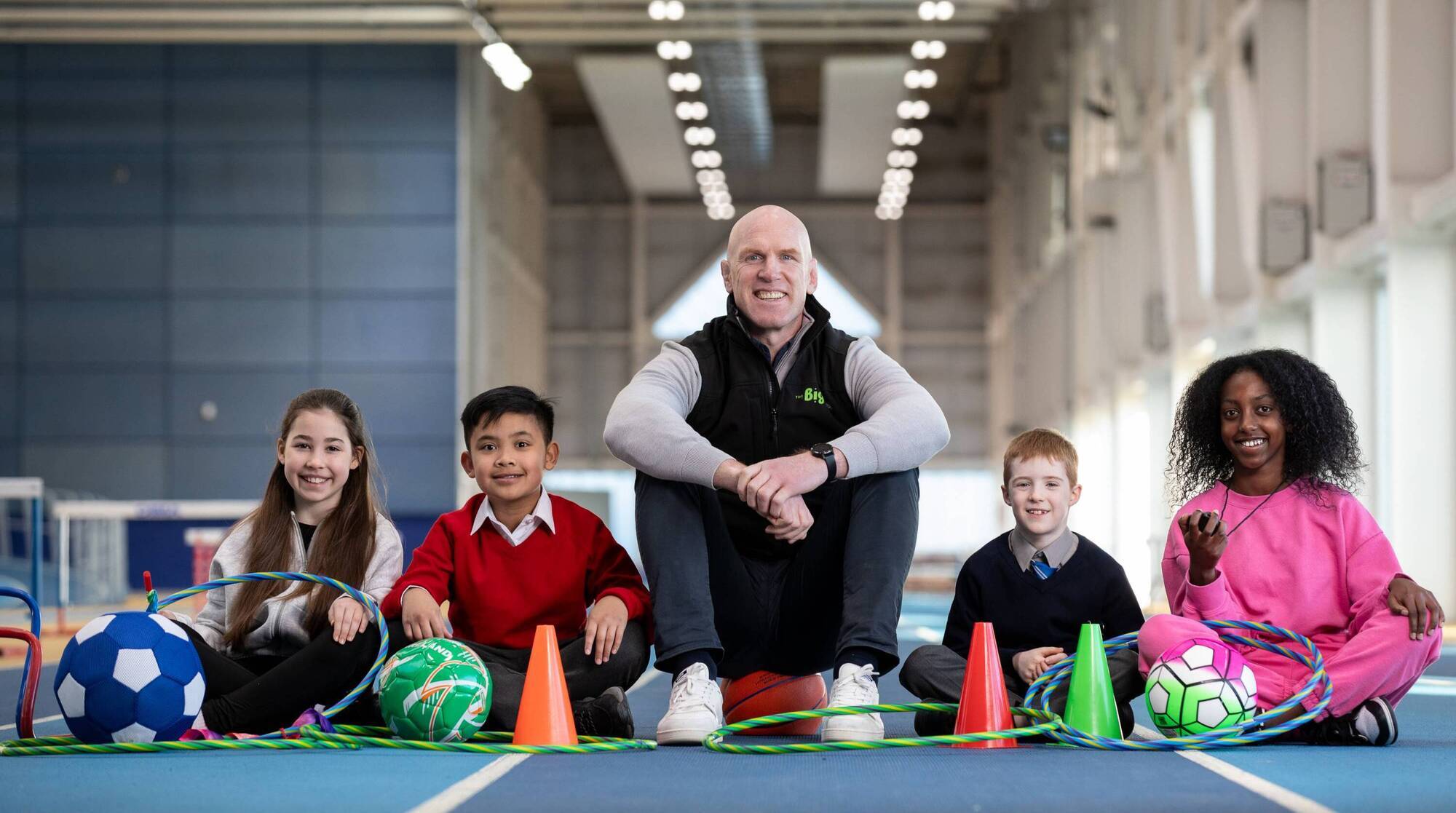
Paul O’Connell joins Amy Lydon, RJ Ragpala, Keagan Heatherington, and Ayana O’Callaghan as they invite schools to choose from a range of activities based on the body, mind, and heart, as part of the Barnardos Big Active campaign. Picture: Patrick Bolger

Paul O’Connell just has to think about how he feels when he hasn’t eaten for a while to get a sense of the great work Barnardos does for children and families nationwide.

The Ireland and Munster rugby legend is championing Barnardos Big Active, a school-based initiative that helps students of all ages and abilities focus on their health and wellbeing while helping others.

Involved with the children’s charity for about 15 years, after its former CEO Fergus Finlay invited him to visit a Barnardos centre, O’Connell has always been “blown away” by its work.

“Imagine a child coming from a difficult background arriving at school without breakfast, no dinner the night before, and no lunch in his bag.

“The breakfast club feeds these children breakfast and gives them a lunch going off [to school].”

Recalling his own childhood in Limerick, O’Connell says: “I had a really nice childhood — two parents at home, breakfast in the morning, out the door to school, help with homework, brought to training in whatever sport we wanted, a lovely dinner, then a story and a kiss goodnight. You’re lucky if that’s your childhood — a lot don’t have it. Some parents didn’t have a good experience from childhood on how to parent.

“Barnardos tries to fill those gaps, to help children have a better life and parents do a better job. For example, for a lot of children, their home environment isn’t suitable for doing homework, so Barnardos has homework clubs.”

Now in its third year, Barnardos Big Active promotes a range of activities based on the body, mind and heart:

  • Body — physical challenges that take care of the body and have knock-on benefits for mental health;
  • Mind — mindfulness exercises to support positive mental health and wellbeing;
  • And heart — promoting the importance of charity by helping others around you.

Pointing out that Barnardos “sends out journals and classes that teachers can do on mindfulness and coping mechanisms”, O’Connell says: “I’ve been involved in professional rugby for over 20 years.

“I couldn’t imagine players not having a sports psychologist to talk to, to give them coping mechanisms to deal with the pressures. Why not provide [something of] that support for children?”

The dad-of-three is a big fan of educating children about “how there are other children not as well off” as them, and “they have a duty to help”, he says, in reference to the philanthropic aim of Barnardos Big Active.

“It’s great for children and schools to help raise money for Barnardos to deliver services.”

Get them off their phones

With just 20% of primary schoolchildren and 10% of secondary students meeting WHO guidelines of 60 minutes of physical activity daily, O’Connell believes sport can play a bigger role in children’s lives today than ever before.

“It can get them off their phones. They can immerse themselves in something where they won’t be distracted by devices.”

When it comes to problem-solving, we’re in the habit of Googling everything, he says.

“We look up the answers to anything on the internet. With sport, you have to problem-solve in a different way — when you want to score a point, score a try, pass a ball to a friend. You’re always problem-solving. You might get picked or dropped for a team, you might win or lose — there are all these emotions.

“You learn to be part of a team [or] the challenge of an individual sport. Sport allows children and parents to connect, to make friends.”

O’Connell’s children are into all sorts of sport and physical activity.

Paddy, who turns 14 this month, plays rugby and golf and is a big fan of Formula 1.

Lola, nine, recently started horse riding and loves it. “She does everything — gymnastics, dancing, a bit of golf, camogie. She recently took up indoor hockey. She’s going to have to pick a few things – she can’t do it all.”

Soccer is six-year-old Felix’s main game, though he also loves Gaelic football.

What is O’Connell’s advice for parents wanting to get their children active — or keep them that way?

“If you love it [physical activity, sport], if you’re engaged, they’ll end up having an interest. 

It’s all very well, wanting your child to play sport, but if you don’t have sports on TV, or go to sports yourself, or play a little bit, how can you expect your child to be interested?

“Sometimes you get lucky and they end up in a friend group at school where they’re all playing sport, but it’s important for parents to show the way.”

What about the competitive element? Doesn’t that put some children off? O’Connell believes that in primary school — and in the first year of secondary — it should be all about enjoyment, about participating and having the craic.

“If by keeping the competitive side out of it for a while, you build interest and get them over that block at 12 or 13 years of age when some drop off sport, that’s massive.

“No matter what you do, kids keep score anyway. They get competitive. And all sorts of kids develop in all sorts of ways and at different times.”

What’s a must for parents, he says, is to “use every method to keep kids connected to something — whether music, sports, drama…”

He knows that overusing technology will only lead to disconnected children. His eldest got a smartphone at Confirmation time, and he and his wife Emily have “tight rules” about when Paddy uses it.

“He’s not too bothered about it yet anyway. Our younger two don’t have anything — we don’t have a PlayStation. It’s hard to put the genie back in the bottle. [Phones] are part of life for kids today — whey they get to a certain age they have it. But as long as [parents] don’t wobble on the rules, that’s what’s important.”

Emotional wellbeing

The co-chairpersons of the Irish Primary PE Association ( www.irishprimarype.com), Jason Byrne and Pete Lavin, recommend that parents give their children access to as many different activities as they can to increase the likelihood of the child finding one they enjoy.

In a joint email, they say children who spend significant amounts of time on screens are more likely to suffer declines in emotional wellbeing.

They point to research from Trinity College Dublin ( exa.mn/Emerging-Digital-Generations) that found spending more than three hours daily on digital activities was associated with significant declines in child socio-emotional wellbeing.

They also note that children who limit screen time to smaller sessions, and who use it in productive and creative ways rather than simply consuming video content, will be better off.

Sleep is essential for young people’s wellbeing, stress Byrne and Lavin. A 2022 Planet Youth survey ( exa.mn/Children-Sleep) found 53% of teens are not getting the recommended amount of sleep, and teens not getting this are twice as likely to report poor mental health.

They recommend a consistent sleep routine, and urge children and teens to eat a colour-rich diet with regular water — not sports drinks.

O’Connell, whose self-care includes going for long walks, says Lola recently cajoled him into letting her accompany him.

“I thought this was my time to be alone, to clear my head, but we ended up having a great walk, a great chat — she was knackered by the end.

“I don’t know why she wanted to go — maybe to try and prolong the time ‘til she had to go to bed. We ended up having [90 minutes] where we weren’t looking at each other, but facing forwards and we chatted about everything.”

  • Barnardos Big Active, supported by Aldi, is up-and-running in some schools nationwide. With students all over Ireland back to school next week, O’Connell is encouraging primary and secondary schools not already signed up to do so. Register at www.barnardos.ie to help raise funds for vulnerable children and families across Ireland.

x

More in this section

Cookie Policy Privacy Policy Brand Safety FAQ Help Contact Us Terms and Conditions

© Examiner Echo Group Limited