Unfurling the changing fate of octopuses in Irish waters
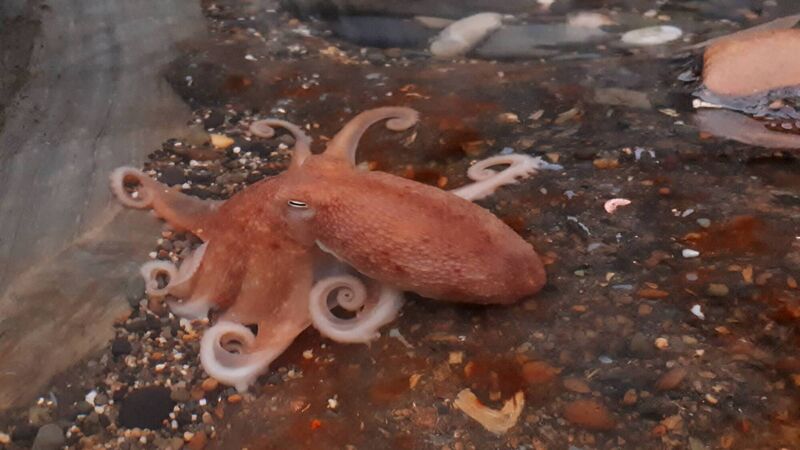
The octopus commonly encountered in Irish waters is a small species - the curled octopus, also known as the lesser octopus. All around our coastline, the curled octopus grows to around 50cm, whereas the Mediterranean species grows up to 130cm in length. Picture: iStock
Octopuses are perplexing creatures, popular characters in books, films and cartoons because of their intriguing physical abilities and impressive intelligence. Now, with warming waters around Ireland and Britain, it seems that octopus are getting more common here.
The common octopus, ( ) occurs in tropical and temperate seas around the world, from Japan to South Africa, the mediterranean, and the East coast of North America. Here in Irish waters, however, it’s a little too cold for this species to thrive, and records for their occurrence are only occasional.
The octopus more commonly encountered in Irish waters is a much smaller species - the curled octopus, ( ) also known as lesser octopus. At home all around our coastline, curled octopus grow to around 50 cm, whereas the Mediterranean species grows up to 130 cm in length. For both, colour varies, as they famously adapt for camouflage but also in response to emotion, changing colour when in fear, when curios, or when wishing to attract a mate. The curled octopus tends toward an orange body, and when at rest their arms fall into perfect tapering ringlets. The key characteristic to distinguish between the two species is that he common octopus (the rare one here) has two rows of suckers on each arm, while the curled octopus has only one row per arm.
As spring unfurls, octopuses are mating and minding eggs. Females lay hundreds of thousands of eggs in long clusters like braids, hanging from the roof of her den, sheltered in underwater crevices or rocky hollows. For the following months, she devotes herself entirely to guarding these eggs, fanning the water around them to keep them oxygenated until they hatch. During this time, she is so completely dedicated to the task of minding her eggs that she does not eat. The eggs can take months to mature, so most females die shortly after the tiny baby octopuses emerge.
The hatchlings are perfectly formed miniature octopuses, fodder for countless marine animals. Of the thousands that hatch, only one or two will survive to adulthood. When lots survive, sporadic population explosions occur. In 2025, for example, common octopus, normally a rare occurrence, became abundant off the south coast of England. Divers reported frequent sightings and fishers encountered them often in trawls and in lobster pots — which octopus find particularly irresistible. They slip inside with ease, anaesthetise the lobster before eating it, and leave again unharmed. It’s a level of compassion we humans rarely extend to the lobster, which we still boil alive in most places. (England has recently banned the practice on animal-welfare grounds.) In recent years, however, the common octopus seems to have been showing up more in Irish waters too. Octopuses are among the most highly evolved invertebrates on Earth, so it is no surprise that they are adaptable. They have similar quantity of neurons as a dog or cat, but unlike mammals, their neural system is distributed throughout their bodies. Around 60% of their neurons are in their arms, meaning each arm can quite literally think for itself. This decentralised intelligence allows octopus to solve puzzles, use tools, and explore new environments and opportunities.
Their intelligence, when combined with a population boom, means little is left of lobster fisheries. Octopus are also keen on scallops and crabs. Because they don’t have a rigid skeleton, an octopus can pour itself through the narrowest crevice, extracting prey as they hunt by night. We have little information about the curled octopus and its population dynamics, and now the potential influx of their larger cousins may spell further changes in Ireland’s marine areas and the fisheries that depend on healthy marine areas.
Octopuses are eaten by dolphins, blue sharks, and grey seals, among others. Catching them can’t be easy, considering their ability to change shape and colour in seconds, mimicking a rock, a clump of seaweed or the mottled sandy seabed. When all else fails, they are able to jet-propel away at astonishing speed, leaving behind a splash of ink to confuse prospecting predators.
After centuries of hunting and industrial fishing at sea, we are only beginning to understand the nuanced workings of marine ecosystems. Much of the devastation caused by industrial whaling, which drove several species to the brink of extinction, is still echoing through the seas around us.
More recent overfishing has left once common fish populations now tethering on the edge of survival. The impacts on their predators and their prey are still unfolding. Destruction of eelgrass beds and other benthic habitats from bottom trawling have eviscerated nursery grounds for many species. Some scavengers such as crabs and lobsters have done well from the changes. The octopus may also have benefited from the reduction of their predators. Now with changing currents, warming oceans and acidification, the population dynamics of marine animals becomes even harder to predict.
Marine Protected Areas (MPA’s) offer reprieve to all manner of marine animals and give ocean ecosystems a chance to recover from destruction. Ireland has a binding target to protect at least 30% of the Irish maritime area by 2030, along with implementing evidence-based restoration strategies.
However, government has been inexplicably delaying the long overdue action for Marine Protected Areas (MPA’s), even dismantling previous efforts to meet the legal requirements to do so. When Taoiseach, Micheál Martin specifically committed, in writing, to ensure that the next Government will implement the MPA Bill as soon as possible, yet progress seems to be going backward. For coastal communities, for resilience in the face of changing climate, and for the future of ocean ecosystems, MPAs are now urgently needed.


CONNECT WITH US TODAY



Be the first to know the latest news and updates