Ants — the tiny architects of a healthy planet
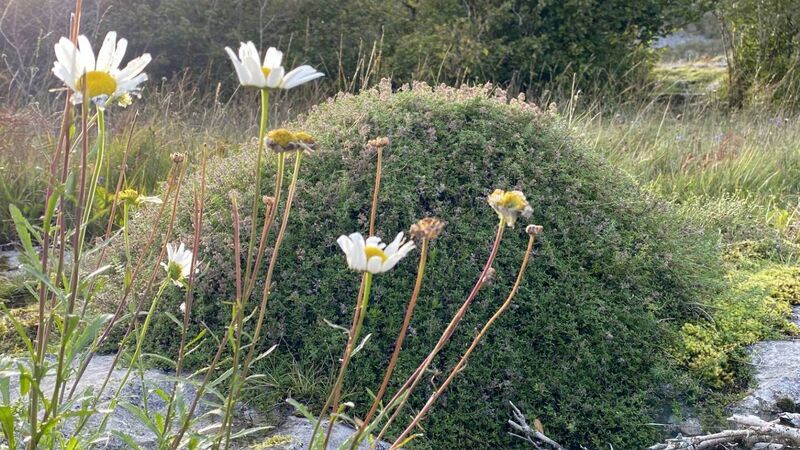
An anthill in the Burren in County Clare, with wild thyme growing through it. Picture: Anja Murray
Old fields, long grazed by sheep or cattle, untouched by ploughs or fertilisers, are rich in life. Small broadleaved herbs nestle among the grassy sward, flowering through the spring and summer, mingling with mosses and maintaining a dense cover of roots, shoots, and leave. Flowering plants sustain, and are sustained by, an array of pollinators — from burrowing bees to hoverflies, moths, grasshoppers, beetles and butterflies. But one among the creatures of old meadows are now recognised as ecosystem engineers — ants.
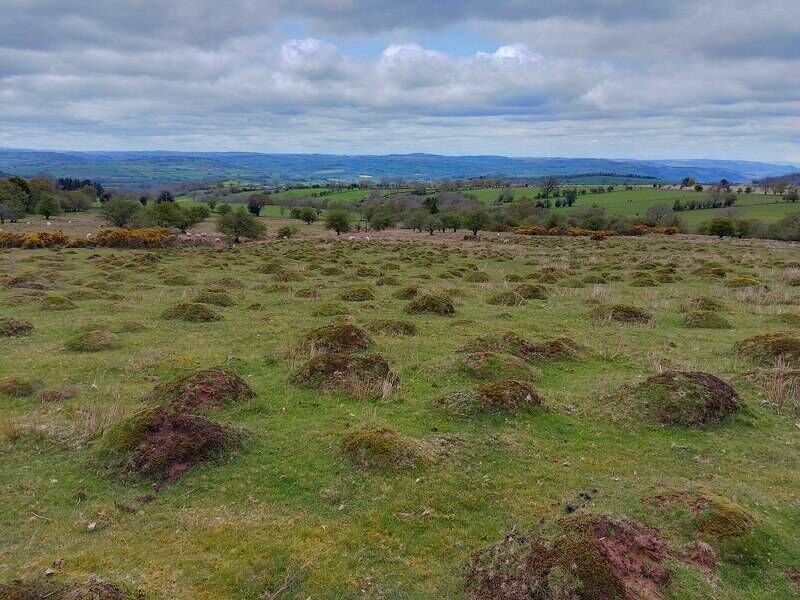
There are more than 20 different native species of ant in Ireland. Some build anthills. Where there are round hummocks in old fields, these may be active anthills, containing a busy community of tens of thousands of ants. These anthills are distinguished by different plant community to the surrounding grassland. In the species-rich grasslands in the Burren in County Clare, for example, I’ve often noticed the gorgeous little purple flowers of wild thyme blossoming profusely from the rounded mounds of anthills.
Thanks to @naturelark.bsky.social for posting up #anthills I’d like to see more pics but I’m particularly interested in the plant communities (also fungi) that can occur on these mounds of ant magic! Ecologically, anthills in grasslands = diversity. They are also reliant on grazing. Much to say✔️
— Sean Cooch (@waxcapscooch.bsky.social) 2025-04-28T21:29:57.349Z
One species in particular, the yellow meadow ant, is the chief architect of these earthy anthills. Each mound is home to complex communities containing drones, queens and workers. They coordinate their behaviour as a collective and communicate with each other through singing, squeaking, and tapping their bodies rhythmically, as well as by exchanging chemical messages carried on the air through which key messages can be transmitted to the wider colony. With each aspect of their lives closely coordinated, scientists consider each colony of ants to be more like a superorganism than a collection of individual, separate beings.
Once spring has warmed the soil and fresh-born workers become active, their main activity is farming groups of underground aphids. In winter, the worker ants keep aphid eggs in separate galleries within the ant mounds, licking them clean to keep fungal infections at bay, and protecting them from predatory beetles. In spring, the ants pick up the overwintering aphids and their eggs and deposit them on suitable plant roots, away from the anthill.
Foraging worker ants then fan out along underground runways feeding on groups of aphids that gather around plant roots. The foraging ant tickles the aphid's abdomen to induce it to produce a droplet of liquid honeydew, much as we might milk a cow. Ants, however, have been living this way for 20 million years, whereas we humans have only been farming for 12,000 years! The foraging ant brings this droplet back to the colony, gives it to a domestic worker, who then feeds the larva on the honeydew.
Yellow meadow ants are specific to grassland habitats — they do not survive ploughing, hard mowing, reseeding, fertiliser applications, or afforestation. Low intensity grazing of cattle and sheep keeps the sward low and generally helps to maintain the diversity of plant and animal species.
Incredibly, the dry mass of ants living beneath the soil can be equivalent to the dry mass of our domesticated cattle and sheep grazing above ground, with as many 165 kilogrammes of dry mass of ants per hectare of grassland. Anthills can be in continual use for decades or in some cases, for hundreds of years, and as such, are indicators of ancient grassland habitats.
Their subterranean avenues aerate the soil, helping maintain soil texter that is more effective at attenuate flooding in the catchment, for example. Their activity maintains soil fertility and creates crucial niches for a plethora of other unseen creatures. Grasshoppers and blue butterflies are some of the species that depend on anthills for key stages in their lifecycle. Ants also transport and sow seeds of many plants.
Today, species-rich grasslands are among the most threatened habitats in Ireland. Many are being replaced with more intensively managed ryegrass fields to feed the dairy industry, or converted to other uses such as plantation forest. Surveys undertaken by the National Parks & Wildlife Service in the past 15 years, and just six years apart, have shown losses of approximately 30% in the area of some types of such grasslands... with very little attention from the public or policy makers.
A more common and familiar ant is the black garden ant, which also lives in colonies that can contain tens of thousands of workers, drones and queens. Garden ants, however, are content to live in domes of sand or in nests under stones. Queens are produced throughout the year, with each colony producing more than 100 queens each summer. In the case of the black garden ant, they take flight all on the same day in July, in what is known as a nuptial flight — a mass mating event.
Yellow meadow ants have their nuptial flight at the end of the summer. All the winged males and all the queens take to the air simultaneously, providing perfect sustenance for the swifts, swallows and house martens who need to feed up well before departing on their epic southward migration.
Ants are intriguing creatures. We might resent them their tendency to nest beneath the slabs of our patio, in the case of black garden ants. Some ants can inflict a tiny but painful sting. But do not reach for the ant spray. In the grand scheme of things, their ecological benefits are invaluable, often in ways we can barely comprehend. David Attenborough once famously said that “if we and the rest of the back-boned animals were to disappear overnight, the rest of the world would get on pretty well. But if invertebrates were to disappear, the world's ecosystems would collapse”.
CONNECT WITH US TODAY



Be the first to know the latest news and updates

![<p> The International Union for the Conservation of Nature says that “an ecosystem is collapsed when it is virtually certain that its defining biotic [living] or abiotic [non-living] features are lost from all occurrences, and the characteristic native biota are no longer sustained”.</p>](/cms_media/module_img/9930/4965053_12_augmentedSearch_iStock-1405109268.jpg "<p> The International Union for the Conservation of Nature says that “an ecosystem is collapsed when it is virtually certain that its defining biotic [living] or abiotic [non-living] features are lost from all occurrences, and the characteristic native biota are no longer sustained”.</p>")
