An unsettling natural hazard: Here's everything you need to know about sinkholes 
Sinkholes are surprisingly selective. They require the right rock, the right water chemistry, the right underground space and just enough time...
An unsettling natural hazard: Here's everything you need to know about sinkholes 

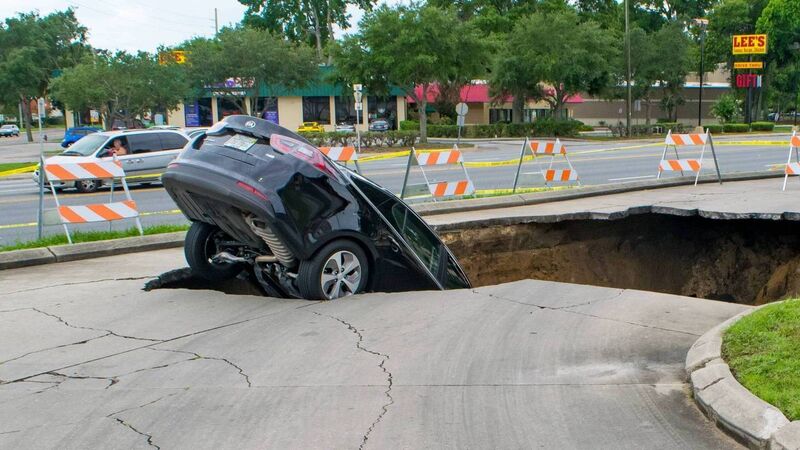
A large sinkhole opens in a parking area in Ocala, Florida, and swallows a car that teeters on the edge. File picture: June 11, 2017

The ground is not supposed to vanish. Yet every year there are reports of roads splitting open without warning, cars tilting nose-first into the Earth, and perfectly ordinary streets suddenly developing bottomless holes. One moment the landscape appears stable; the next, it is quite literally gone.

Sinkholes are among the most unsettling natural hazards because they offer no drama beforehand. No shaking, no rumbling, no obvious countdown. They seem random. Unfair. Almost targeted...


But sinkholes are not acts of geological spite, nor are they freak accidents. They occur only where very specific conditions align beneath the surface.

In fact, sinkholes are surprisingly selective. They require the right rock, the right water chemistry, the right underground space and just enough time. Get one element wrong and nothing happens. Get them all 'right', and the land above can collapse suddenly, revealing processes that may have been quietly unfolding for thousands of years.

Why is Florida the sinkhole capital?


A van remains in a sinkhole, Monday, Sept. 11, 2017, that opened up at the Astor Park apartment complex in Winter Springs, Florida, during Hurricane Irma's passing through central Florida. The glass on the ground (left) is the window that the driver punched out to extract himself after driving into the sinkhole. Picture: Joe Burbank/Orlando Sentinel via AP


Florida doesn’t just experience sinkholes; it specialises in them. The entire state sits on limestone bedrock, a rock type that dissolves slowly when exposed to weakly acidic groundwater. Rainwater absorbs carbon dioxide from the atmosphere and soil, forming a mild carbonic acid that seeps downward through fractures in the rock. Over time, those fractures widen into cavities, chambers and underground voids.

In many parts of Florida, this limestone lies tens of metres below the surface, allowing these cavities to grow quietly for centuries. Above it sits loose, sandy soil, which can be light, porous and easily collapsed once its support disappears.

The ground may appear stable, but beneath it lies an increasingly hollowed foundation. Add heavy rainfall, hurricanes and widespread groundwater abstraction, and the system becomes dangerously unstable.

This recipe results in thousands of sinkholes every year, most small and unnoticed, but some catastrophic:

In 2013, a collapse beneath a suburban home near Tampa formed a hole more than 18 metres deep, killing a resident as they slept. Investigations later revealed that a large underground cavity had existed long before the collapse. The final failure triggered not by a single storm, but by decades of slow weathering.

China’s sinkholes have become landscapes


Sinkhole in Guangxi, China


In southern China, sinkholes operate on an entirely different scale. Known as tiankengs, these features can exceed 600 metres in width and plunge hundreds of metres deep. Some are so vast they contain forests, rivers, waterfalls and ecosystems entirely isolated from the surrounding environment.

Their extraordinary size reflects the region’s geology. Thick limestone formations extend deep underground and are intersected by powerful subterranean rivers. Over hundreds of thousands of years, flowing water dissolves immense cave networks beneath the surface. When collapse finally occurs, it is not sudden geological failure, but the dramatic end point of extremely long-term erosion.

Spain’s fast-forming sinkholes


Asphalt road with a crack caused by landslides, in Jaén, Andalusia, Spain in 2014


In parts of northeastern Spain, sinkholes develop for a very different reason. Here, the dominant bedrock is gypsum, which dissolves far more rapidly than limestone. While limestone caves may take millennia to form, gypsum can dissolve in decades.

Cavities appear quickly, often with little warning, leading to frequent ground subsidence. Rather than dramatic collapses, the land slowly sinks and fractures. Roads buckle, rail lines deform and buildings require repeated stabilisation. Entire neighbourhoods may experience ongoing settlement problems.

Although individual sinkholes are often smaller than those seen in China or Florida, their high frequency creates persistent engineering and planning challenges that can last generations.

Why Ireland is different


A 60 X 30 by 20 feet deep sinkhole or depression was found in a landscaped area in front of houses in Castleisland, County Kerry in 2014. Picture: Domnick Walsh


Ireland has extensive limestone geology, particularly across the west and midlands. Yet sinkholes here are typically smaller and far less frequent than those seen elsewhere.

The reason lies beneath our feet. Irish limestone is relatively shallow, limiting the size of underground cavities that can develop. The country also lacks widespread gypsum or salt deposits, which can dissolve far more rapidly and dramatically increase collapse risk.

Groundwater abstraction remains minimal and much of Ireland’s landscape allows water to disperse naturally. As a result, most Irish sinkholes occur as localised collapses in agricultural land, along roads or near drainage systems rather than as large urban failures. They are disruptive, but rarely catastrophic.

Common factors behind sinkhole formation

Despite regional differences, sinkholes share a familiar recipe. They require soluble rock, enough depth for cavities to grow, soils capable of collapse and active groundwater movement. Where all four conditions overlap, sinkhole risk increases significantly. Where even one is missing, the threat drops sharply.

Some reports suggest sinkholes are increasing worldwide, but this is not universally the case. Instead, they are being observed and reported more often due to expanding development, ageing infrastructure, satellite monitoring and greater public awareness.

In many places, sinkholes are not becoming more common, they are simply becoming more visible.

Managing risk

While predicting the precise moment of collapse is impossible, identifying vulnerable areas is not. Geological mapping, ground-penetrating surveys and satellite monitoring can reveal zones where cavities are likely to exist.

In many countries, planning controls, infrastructure maintenance and responsible groundwater management have significantly reduced damage.

Waterways engineers inspect an area where two boats remain within a large 'sinkhole' which breached a canal in the Chemistry area of Whitchurch, Shropshire in December. Picture: Tuesday January 13, 2026: Jacob King/PA Wire

Sinkholes are not random disasters. They are the predictable outcome of very specific geological conditions. Understanding where those conditions exist remains the most effective form of prevention, and the clearest reminder that the most dramatic changes to the landscape often begin quietly beneath our feet.

More in this section

Revoiced

Newsletter

Sign up to the best reads of the week from irishexaminer.com selected just for you.

Cookie Policy Privacy Policy Brand Safety FAQ Help Contact Us Terms and Conditions

© Examiner Echo Group Limited