Iridescent kingfishers need clear rivers — can we help?
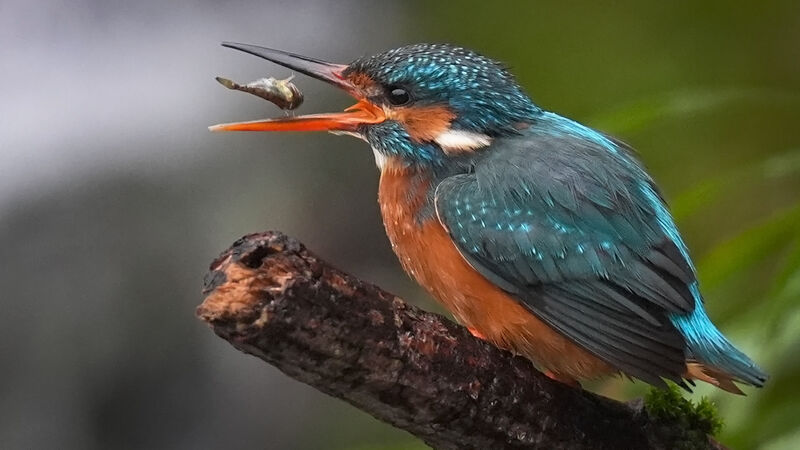
When light falls upon the kingfishers’ blue feathers, blue wavelengths are scattered more than other wavelengths, giving an ‘electric’ hue to the blues — a phenomenon known as the Tyndall effect. Picture: Gareth Fuller/PA Wire
Turquoise, cobalt blue, and flaming orange are not the colours we expect to see in our native birdlife. Such flamboyant, almost irridescent plumage is more typical among tropical birds. But kingfishers are native and widespread — even if catching a glimpse of them is rare for most of us.
This morning, though, I was lucky enough to get to watch one for ages, perched on a branch by Dublin's River Dodder, where the resident kingfishers are well known and much admired.
Here, the kingfisher characteristically perches on a branch overhanging the river, keeping still... though far from incognito.
The breathtaking brightness of turquoise feathers is hard to believe. The contrast with the orange feathers of their underside makes the colours pop even more. Several stunning shades of blue shimmer alongside each other, a visual effect produced by pigments as well as engineering.
When light falls upon the kingfishers’ blue feathers, blue wavelengths are scattered more than other wavelengths, giving an ‘electric’ hue to the blues — a phenomenon known as the Tyndall effect.

For such a small bird — most are only 16 centimetres from tip of tail to pointy tip of their bill — kingfishers manage to stand out, even if only as a fleeting bright blue flash along the riverbank.
In Irish, kingfishers are called cruidín, which means ‘hunchback’. Rather than evoking the beauty of their colouring, cruidín seems a more playful name, referencing the hunched-over look of a kingfisher when perching.
Perching is what they do a lot of, sometimes resting or digesting a meal, other times watching the water intently for the right fish to catch. As master waterside hunters, kingfishers pluck fish from flowing water with precision and phenomenal speed. Once they spot a fish worth catching, a kingfisher can alight from the branch where it is perched, dive in to the water, grab hold of their prey, and return to perch, all within 1.2 seconds.
The next step is to dispatch the prey, normally fish of less than 8 centimetres, by banging it off the branch. But this kingfisher, perched patiently over the Dodder on this cold January day, was not fishing nor watching the water. Assumedly having already caught a decent-sized fish, it takes a while to digest the meal, during which time they tend to sit still. Like owls, kingfishers regurgitate pellets made up of all the undigestible bits of their prey, mostly fish bones.
During January, kingfishers remain in ‘their’ stretch of river. Through the winter, males and females live separately, though often in adjacent feeding territory. Only in spring do couples reunite. From February onwards, unattached kingfishers begin looking for a partner. Males get busy with aerial courtship displays, gliding up to the treetops where typically they have no need to go, and whistling loudly to woo. Once courtship progresses between a potential pair, the male brings offerings of freshly-caught fish, several times a day, which she will eagerly eat up. Thus, the pair bond is confirmed. Most kingfisher couples remain monogamous, at least for the remainder of the breeding season.

Together, they excavate a burrow in the river bank, which can be as much as a metre long. Some pairs will seek to re-use an existing burrow, a second-hand home. Others will get to work on a ‘new-build’ and excavate from scratch. At the end of the tunnel, they carve out a rounded chamber. And when all of this is done, and only then, mating takes place, after their burrow is completed. Common kingfishers are evidently a patient and practical species. Eggs are laid from March and April and successive broods will be reared by both parents through the summer months.
The kingfisher in Ireland is classified as an Amber-listed species of conservation concern. Flooding is a growing threat, as the rising level of floodwaters can inundate their nest burrows. When we drain away the wetlands and bogs that help to slow the flow of water throughout any given catchment, heavy rainfall events mean more water travelling rapidly to the river, and a greater propensity for the level of river water to rise rapidly. Fewer deciduous trees and wetlands, combined with more compacted soils from agricultural intensification, and other land use changes result in greater susceptibility to flooding. More extreme weather events caused by climate change exacerbate such risks.
Dredging rivers is also a disaster, as it removes bankside cover for kingfishers as well as destroying spawning beds for the freshwater fish that these waterside hunters survive on.
But perhaps the biggest threat right now is nutrient pollution. Nitrates and other agri-nutrients seeping into waterways deplete oxygen from living waters, eradicating the most sensitive creatures and reducing the abundance of many other species, including the fish that Kingfishers depend on.
Currently, nutrient pollution from intensive agriculture continues to be the main driver of declines in water quality in Ireland, with almost half of rivers containing too much nitrogen for healthy ecosystems to exist. The problem is most severe in the South and Southwest of the county, as the dairy industry is concentrated in these areas.
For kingfishers to endure in the future, we have much to do. I’m thinking especially of those that live on the Nore, Suir, Barrow, Shannon, Lee, Laune, and the Feale — some of the rivers in which water quality has deteriorated significantly in recent years, according to the latest data from the EPA. Come spring and summer, kingfisher parents feeding hungry broods need clear water to see the fish they’re aiming for.
Kingfishers are one more reason to clean up our act, to finally grasp the nettle of nitrate pollution, to rethink our disregard for water quality, and to get busy restoring Ireland’s rivers to good health.