Michelle McKeown: The weather tug-of-war that shapes our winters
Understanding the North Atlantic Oscillation won’t stop Irish winters being chaotic, but it helps explain why they sometimes fall into familiar rhythms. And it reminds us that, while climate change is gradually reshaping global systems, natural variability still has plenty to say
Michelle McKeown: The weather tug-of-war that shapes our winters

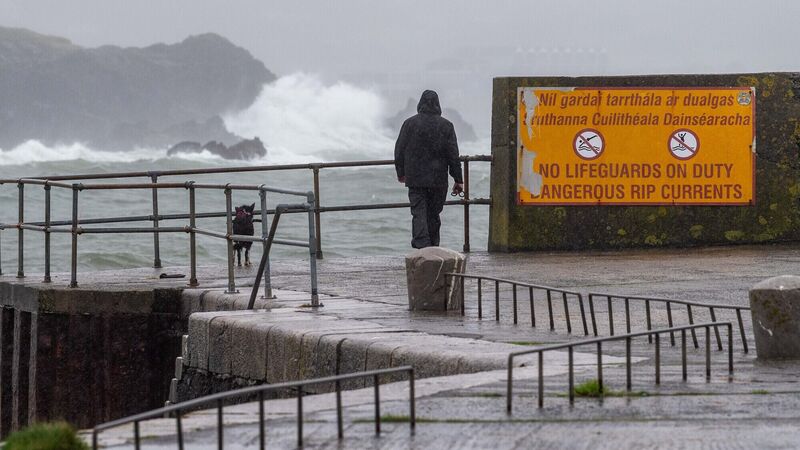
Waves lash the pier at Rosscarbery, West Cork. Picture: Andy Gibson.

If the atmosphere over the North Atlantic had a personality, it would be that friend who can never quite decide what they want, swinging between moods with dramatic consequences for Ireland’s winter weather. This grand atmospheric seesaw is known as the North Atlantic Oscillation, or NAO, and while it may sound like something straight out of an atmospheric science lecture, it has a habit of creeping into everyday life. Whether we get storm-lashed evenings, crisp frosts or mild, soggy Christmases often depends on what phase this mighty oscillation is in.

At its heart, the NAO describes the pressure difference between two big atmospheric players: a low-pressure system over Iceland and a high-pressure system over the Azores. When the contrast between these two regions changes, it shifts the strength and position of the winds that sweep across the Atlantic. This, in turn, shapes the weather we experience here on dry (or not so dry) land. Think of it as the atmospheric equivalent of tightening or loosening a giant rubber band.


The positive phase: storm conveyor belt activated

When the NAO swings into its positive phase, the Azores High strengthens, and the Icelandic Low deepens. This creates a large pressure difference across the Atlantic, whipping up strong westerly winds. Ireland, sitting squarely in the firing line, usually ends up with mild, wet and often stormy winters. In this phase, the Atlantic seems to toss weather systems at us like a conveyor belt on fast-forward.

Southern Europe, meanwhile, tends to dry out as the storm track shifts northwards. And while we’re dealing with endless rain and debating the merits of waterproof trousers, Greenland and the far North Atlantic often shiver under colder-than-normal conditions.

The negative phase: when winter bites back

Every so often, the NAO flips into its negative phase.

In this mode, the Azores High weakens and the Icelandic Low becomes less intense, slackening the pressure contrast. With the atmospheric rubber band loosened, westerly winds weaken and the storm track slips southwards. Ireland and northern Europe can become colder and drier, with a higher chance of frosty nights, clear winter sunshine and the occasional brush with Arctic air.

At the same time, Mediterranean countries often become wetter and stormier, picking up the weather systems that no longer head our way.

So, while we’re scraping frost off the windscreen and congratulating ourselves on finding the de-icer, Greece or Italy might be dealing with the deluge instead.

The in-between: a neutral mood

Sometimes the NAO sits in a more neutral mood, with the pressure difference hovering close to average. In these periods, the oscillation offers few clues about what comes next. Local quirks, ocean temperatures and the meandering jet stream take centre stage.

It’s the meteorological equivalent of the atmosphere shrugging its shoulders.

Tracking the NAO

Scientists monitor the NAO using what’s known as the NAO Index, which compares the surface air pressure in the Icelandic and Azores regions. Historically, this was measured using weather stations in each region.

Today, satellite observations and sophisticated climate datasets allow researchers to map pressure patterns across the entire North Atlantic.

The NAO Index is updated daily and monthly, giving meteorologists a real-time sense of where the atmosphere’s 'mood' currently sits and, sometimes, where it might be heading.

So, what phase are we in now?

As of the latest available data, the NAO is hovering close to neutral, with a gentle lean toward the positive. In practical terms, this means the atmosphere is perched on the fence; not fully in storm-flinging mode, but not in a deep-freeze either. 

A slightly positive tilt suggests we might still see bursts of unsettled Atlantic weather, but nothing strong enough to define the season. It’s a 'keep the raincoat handy, but don’t write off winter sunshine' situation.

Could climate change influence the NAO?

Climate change is warming both the atmosphere and the oceans, so it’s natural to ask whether this might affect the NAO. The honest scientific answer is possibly, but not in a straightforward way. Research shows that two major trends may influence the oscillation:

— First, the Arctic is warming faster than the rest of the planet, reducing the temperature contrast that helps drive the jet stream. Some research studies suggest this could, at times, make negative NAO phases more likely, the type that bring colder, drier winter spells to northern Europe.

— Second, warming in the tropical Atlantic may strengthen the subtropical high-pressure zone, which other studies associate with slightly more frequent positive NAO winters.

However, and this is crucial, the NAO is naturally very noisy and variable. It swings back and forth even without climate change, and these swings can last weeks, months or years. Because of that, scientists don’t yet agree on exactly how climate change will influence it long-term.

The latest IPCC reports describe future changes to the NAO as 'uncertain' — although some climate models lean toward slightly more positive phases under high-emissions scenarios later this century.

Why the NAO matters for Ireland

Ireland’s weather is famously unpredictable, but the NAO is one of the few large-scale climate patterns that gives us real clues about what to expect. Because it influences storm tracks, rainfall, winter temperatures and even sea-level pressure, it shapes everything from farming decisions to flood risk to your daily conversation about 'that wind last night'.

Understanding the NAO won’t stop Irish winters being chaotic, but it helps explain why they sometimes fall into familiar rhythms. And it reminds us that, while climate change is gradually reshaping global systems, natural variability still has plenty to say.

So while we can’t predict exactly when it will change phase, we can at least recognise the signs, and maybe appreciate the atmospheric choreography behind the raincoat-or-thermal-socks dilemma.

x

Check out the Irish Examiner's WEATHER CENTRE for regularly updated short and long range forecasts wherever you are.

More in this section

Revoiced

Newsletter

Sign up to the best reads of the week from irishexaminer.com selected just for you.

Cookie Policy Privacy Policy Brand Safety FAQ Help Contact Us Terms and Conditions

© Examiner Echo Group Limited