Clever, playful, and communicative — lots to like about the crow family
Each of the seven crow species that occur in Ireland have a lot of very similar traits, including an impressive ability to reason and to learn
Clever, playful, and communicative — lots to like about the crow family

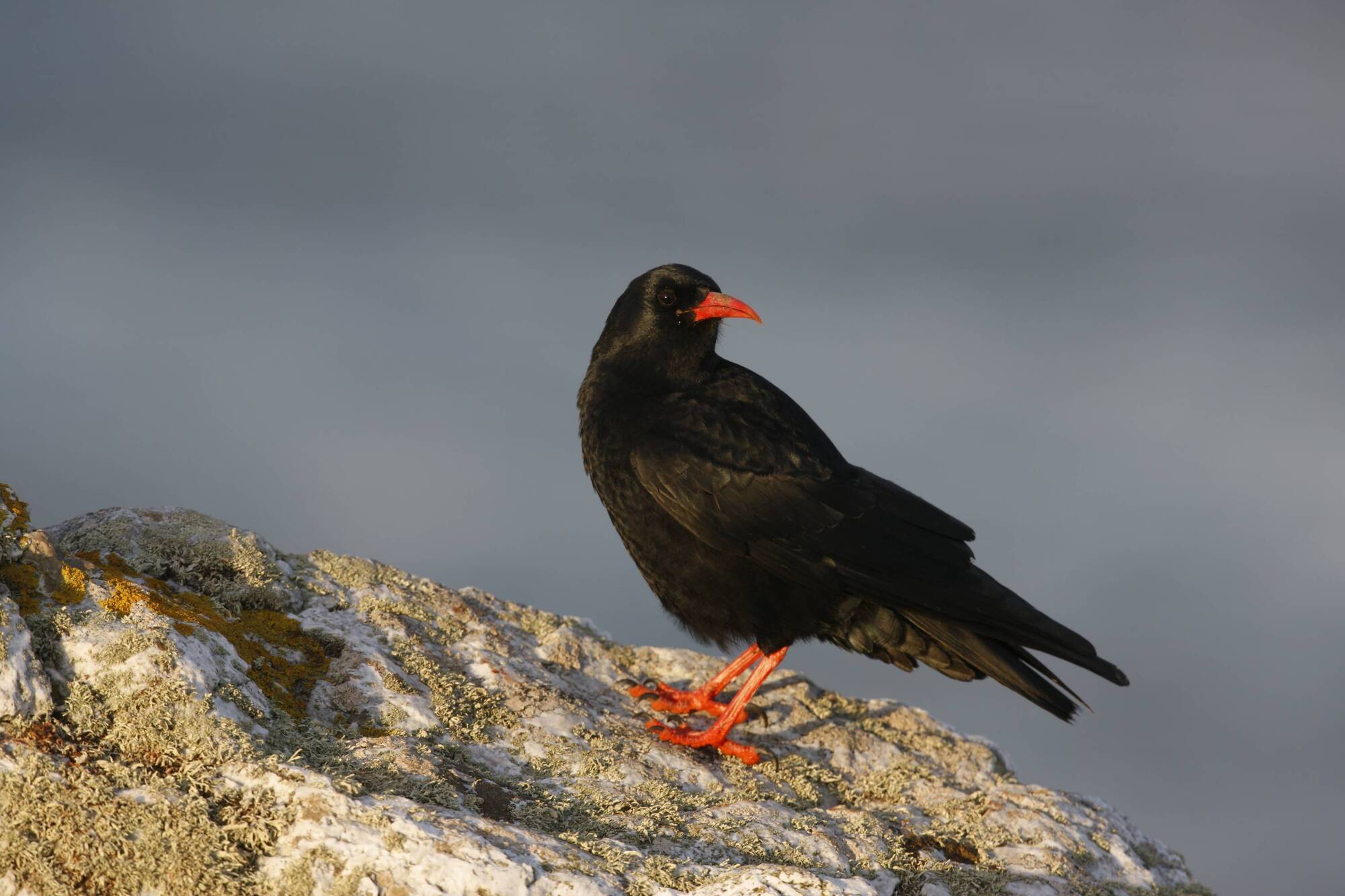
Chough (Pyrrhocorax pyrrhocorax) — members of the crow family with distinctive red legs and a red beak

It's easy to love birds. They sing sweet melodies and are cute to watch. We humans have a generally positive association with our feathered friends and neighbours. But crows are another matter. They are vocal — though it’s not exactly what we might call singing. They are seen as noisy and bothersome. People commonly go so far as to bait, trap, and shoot them.

I’m surrounded by crows and I enjoy their company. Even in Spring, when the jackdaws and rooks around the house are especially noisy in the early morning, chattering away between themselves, we get used to them. I try to look them in the eye whenever I can. When they look back at me, their savviness is obvious. If we could converse, it would surely be an enlightening discussion. I know that the ones around the house probably recognise me, because crows remember human faces well, even long after a one-off encounter. They don’t tar us all with the same brush as we do them. Many of us can’t even distinguish between various species of crow let alone identify individuals.


Two jackdaws: One thing that all members of the crow family have in common is the tendency to mate for life.

In addition to having excellent memory, each of the seven crow species that occur in Ireland have a lot of very similar traits, including an impressive ability to reason and to learn. They can distinguish between three and four objects, four and five objects, five and six objects, and six and seven objects... which is almost the same as being able to count. They are better at problem-solving than an average human four-year-old.

Their ability to use tools is now widely known, but members of the corvid family can also make tools specific to whatever challenge might be presented them. In the wild, they don’t have much need for tools, having evolved strong bills and capable feet that can help them do whatever they need to survive and thrive.

In academic experiments, however, jays, one of the crow family, consistently demonstrate their ability to innovate and fashion new tools to help them achieve a particular outcome, which involves thinking about the future. Studies from Cambridge University have been demonstrating that jays and other corvids commonly apply complex logical thinking, for example, being able to predict what others might think based on experience and inference.

Like most intelligent creatures, crows are playful too. There's a popular video on You Tube of a crow picking up a plastic lid and sliding down a snowy roof on it, over and over, just for fun.

While two-thirds of Ireland’s commonly occurring bird species are red or amber listed as birds of conservation concern, corvids (the correct term for crows) are generally doing well. Hooded crows, rooks, jackdaws, magpies, ravens, and jays have all been able to adapt to rapidly changing landscapes brought about by human activities. As predators and scavengers, they have a crucial role in every ecosystem. It helps that they are intelligent and will eat just about anything: invertebrates; fruit and seeds; eggs of other birds; human leftovers; and carrion such as roadkill.

Choughs, however, are an exception. Choughs have a red beak and red legs that stand out against the pure black of their feathers, and live along the coast. Being exceptionally playful and agile, they soar out over sea cliffs and swoop back on buoyant air streams, doing barrel rolls and even flying completely upside-down, seemingly just for their own entertainment.

Choughs are highly sensitive to disturbance and have been very much in decline in the past 40 years, though West Cork has become a stronghold for them, especially Mizen Head, Baltimore, and the Beara Peninsula. Recently, these West Cork choughs have begun to change where they nest; rather than nesting exclusively in the cervices of sea cliffs, they have begun to nest in stone-built ruins, abandoned factories, church towers and even modern cattle sheds. Choughs are keeping up with the innovative tendencies of their corvid family.

Jackdaw: They are sociable, highly communicative, cooperative, and empathise with one another — all essential skills for living well in large groups. They have strong family bonds that last a lifetime.

Rooks, hooded crows and jackdaws, all much more common across Ireland, tend to go about together, foraging in large, mixed groups.

Hooded crows occur all over Ireland, but not in England. Instead, the closely related carrion crow occurs almost exclusively in England, Wales and most of Scotland. It seems that these two species don’t mix, there is only either one or the other.

Ravens are the largest of the crow family here, even bigger than a buzzard. They are not keen on human company, so tend to keep themselves to uplands where people are few and far between. Magpies are probably the only crow that people readily recognise, widely disliked for their tendency to eat eggs from the nests of other birds. This is a common trait among predatory birds. They don’t do near as much harm to song birds as domestic cats do, not to mention rats and grey squirrels.

One thing that all members of the crow family have in common is the tendency to mate for life. They are sociable, highly communicative, cooperative, and empathise with one another — all essential skills for living well in large groups. They have strong family bonds that last a lifetime. They come together to mark the passing of a loved one. Crows are a lot more like us than we care to think.

The Axeman's Carnival by Catherine Chidgey

Last year I was gifted a book that is narrated by a magpie. The Axeman's Carnival by Catherine Chidgey is a wonderful read, a fictional account of an awful human relationship, told from the perspective of a clever magpie who finds itself cared for as a pet in the home of a New Zealand sheep farmer. The observant magpie’s perspective is surprisingly effective as a witty and wise narrator.

Encounters with Corvids. Written by Dr Fionn Ó Marcaigh, illustrated by Aga Grandowicz

Freshly published in Ireland is a delightful book all about corvids here. Encounters with Corvids by Fionn Ó Marcaigh, with illustrations by Aga Grandowicz, is published by Natural World Publishing. In each bite-sized chapter, the author, a zoologist, shares first-hand stories and anecdotes that attest to the intriguing ways of these most intelligent birds. With a gentle way of telling, this endearing little book reveals the wonders of these much maligned and hugely underestimated birds.

x

More in this section

Revoiced

Newsletter

Sign up to the best reads of the week from irishexaminer.com selected just for you.

Cookie Policy Privacy Policy Brand Safety FAQ Help Contact Us Terms and Conditions

© Examiner Echo Group Limited