Sky Matters: Supermoon, second moons, and Comet C/2023 A3
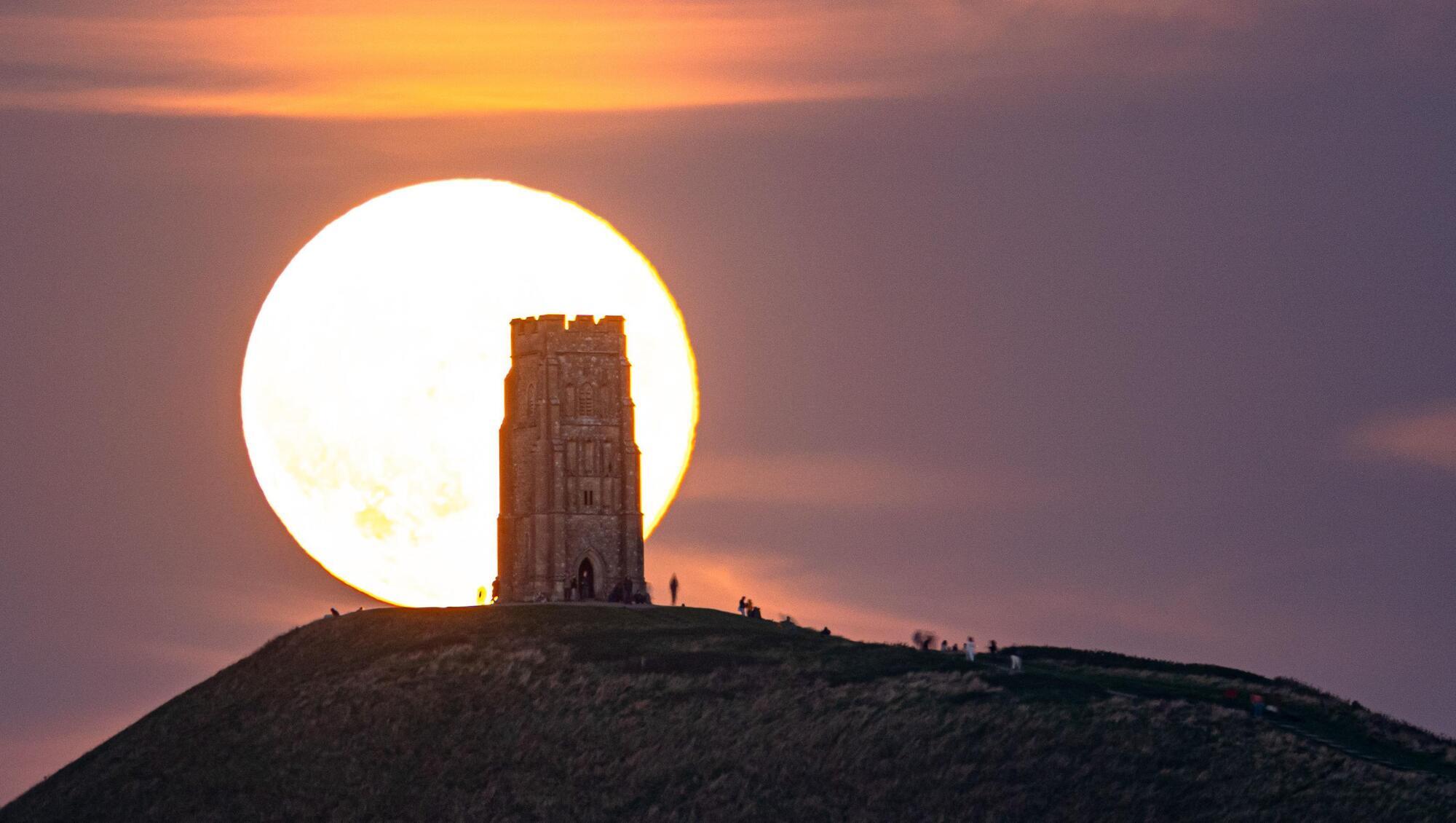
People gather as the supermoon rises over St Michael's Tower, atop Glastonbury Tor, which occurs when the moon appears 30% brighter and 14% bigger in the sky. Picture date: Wednesday September 18, 2024. PA Photo. Photo credit should read: Ben Birchall/PA Wire
Another month. Another supermoon. On October 17. We could almost be forgiven for taking the phenomenon for granted.
The Moon orbits the Earth in a slightly oval movement, so sometimes the Moon is closer to the Earth and sometimes it’s farther away.
These variations in distance make supermoons possible – if the Moon’s orbit was exactly circular every full Moon would be a supermoon, possibly making the term itself rather meaningless.
While there is no absolutely accepted definition of a supermoon, it’s generally accepted that they occur whenever the Moon is full and within 90% of its closest approach to Earth.
Supermoons are larger and brighter than non-supermoons, but the difference is not discernible to all but the most diligent of lunar observers.
The fact that we have supermoons begs the question, could we have super-earths? The answer is yes.
A lunar astronaut would see the Earth up to 30% brighter when the two objects are closest compared to when they are farthest apart.
But a fully illuminated Earth in the skies above the Moon would be a whopping 50 times brighter than the Moon we see from Earth. That would be impressive, almost intimidating perhaps.
Some years back our research team at Blackrock Castle Observatory did a small piece of research to see if it would be possible to use the brightness of the Earth to act as a kind of solar power source on the Moon.
Think of the Earth as a mirror reflecting the Sun’s light. And indeed we found it would be possible to power small devices.
This has interesting possible applications for the new generation of lunar astronauts, maybe in the 2030’s.
(NASA hopes to land people on the Moon before the end of the decade, with China not far behind.)
While we’re used to Earth having one Moon, it will actually have two (kinda) during October and November.
Our second Moon will not, however, be one for landing people on. At a diameter of 10 metres and named 2024 PT5 it will do a partial orbit around Earth before returning to its usual orbit (which itself is close to the Earth).
This second Moon won’t be visible with amateur telescopes, with the exception of a small cohort of dedicated individuals with sufficient funds to own their own large telescopes.
It is a reminder, however, that we’re not completely isolated in space, but rather surrounded by tens of thousands of small objects which thankfully pose no significant threat.
There are some larger objects that could be dangerous, but none are known that cause us to worry at this time.
If 2024 PT5 is too faint to see, a comet known as Comet C/2023 A3 (Tsuchinshan-ATLAS) might be visible in our evening skies (just after sunset and close to where the Sun sets) from October 12th until about 30th.
Much depends on what happens around the end of September and early October as it screeches around the Sun.
This is the time when it is most likely to break up, but if it survives then we might be in for a treat. However, comets are notoriously fickle and predicting their brightness or the length of their tail with any degree of accuracy is something of a foolish past-time. Nevertheless, given its current behaviour at time of writing the indications are promising.
If you do miss the comet this month, you’ll have another chance in 80,000 years, so probably best to make the effort on this visit!
Comets were often considered as portents of doom.
Comet Halley was blamed for the defeat of the Saxons at the Battle of Hastings in 1066.
With our own general election in the offing, for whom will Comet C/2023 A3 be seen as a portent of doom?

CONNECT WITH US TODAY



Be the first to know the latest news and updates