Sky Matters: How to see an eclipse, supermoon and Harvest Moon all at once tonight
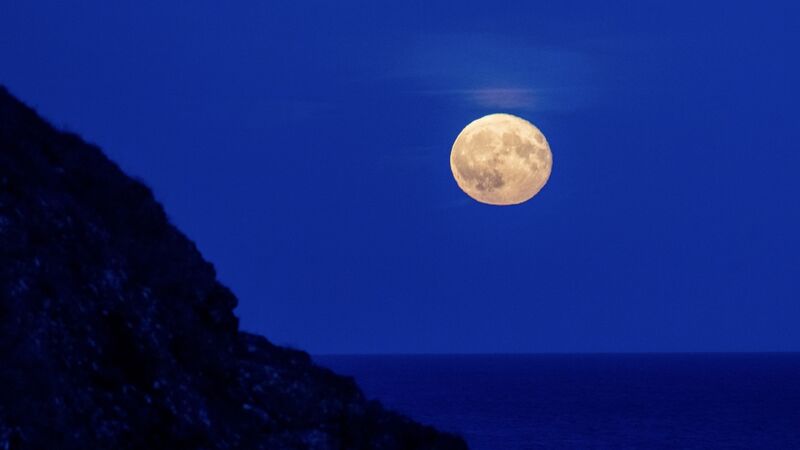
Last month’s Blue Supermoon rises behind Robert’s Cove. Picture: Chani Anderson
As September rolls around again, the nights begin to lengthen noticeably and the summer constellations find themselves disappearing into the daylight hours for another year. On Sunday, Sep 22, 2024, at 1:43 pm, the Sun will be directly overhead the equator, and the days and nights will be of equal length across the globe, giving us the annual Autumnal Equinox. For those of us in the Northern Hemisphere this is a time associated with bringing in the last of the summer’s harvest bounty.
The Full Moon closest to the Autumnal Equinox is, not surprisingly, often referred to as the Harvest Moon. It is said that ancient farmers used the light of the rising Harvest Moon to enable them to continue to work the fields after sunset. Whether this is accurate or not, as anyone who has ventured outdoors under a full moon will tell you, the light cast by our nearest celestial neighbour is certainly bright enough to prolong the working day.
This year’s Harvest Moon takes place on 17th September. Unusually, on the same night there will be a partial lunar eclipse and the Harvest Moon itself will also be classed as a supermoon. The two phenomena are not linked – it is chance that they both occur on the same night.
A lunar eclipse is caused by the Earth blocking some of the Sun’s light and casting a shadow on the Moon. This September about 10% of the Moon will be thrown into a deep shadow at around 3:44am, making this a shallow eclipse, although the Moon will be high in the sky and therefore easy to spot from even urban locations with restricted horizons.
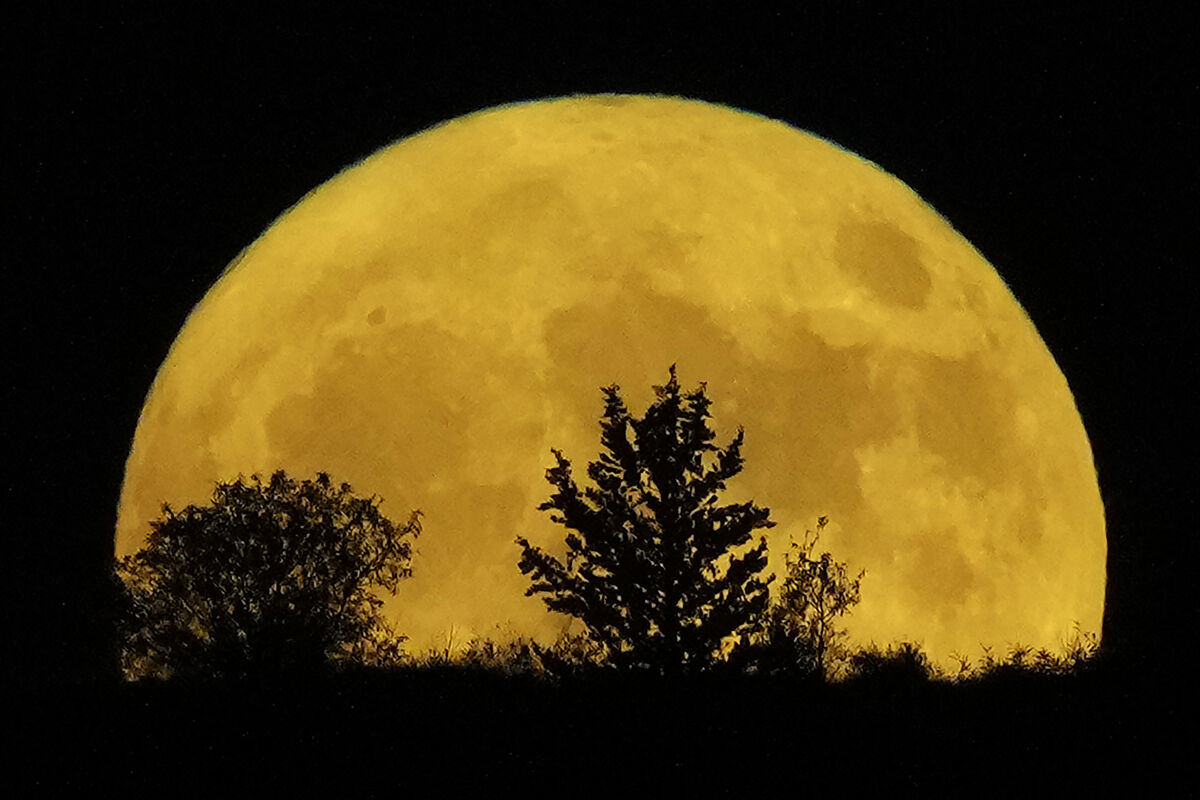
A supermoon, refers to when the Moon is both “full” and “closer than average”. On 17th September the Moon will be 357,000 km from Earth compared to an average distance of 385,000 km, and will appear about 8% larger and some 12% brighter. To the casual observer the effect is unlikely to be noticeable, and in any case a rising full moon close to the horizon is always a joy to watch irrespective of whether it’s full or not. The variation in the Earth-Moon distance is due to the Moon having an elliptical rather than a circular orbit. Pretty much every object we know of – planets, comets, asteroids, stars - have elliptical orbits, so it’s not unusual for celestial bodies that orbit each other to do so with variable distances.
There are also supermoons in October (which is actually the closest of the year, though by a mere 100km) and another in November. One thing to watch out for on all occasions is the so-called “Moon illusion”. This refers to an observer perceiving the Moon to be much larger when it’s close to the horizon than when it’s high in the sky, while in reality there is no change in its size. If you mostly look at the Moon when it’s a supermoon you might think it looks big because it’s a supermoon, but it’s an illusion, albeit a very convincing one. My advice – watch out for the full moon as it rises every month. Don’t wait for a supermoon and don’t fall for the supermoon “hype” that seems to accompany every occurrence in recent times!
You may have noticed the Moon being particularly red during August, the result of tiny particles being lifted high up into the atmosphere by the wildfires in Canada. There are already tiny particles in the upper atmosphere and a rising Moon is often reddish in hue as a result, but the extra particles from the wildfires enhanced the reddish hue into a deep red colour. If some of the wildfire particles are still high in the atmosphere come September 17th, then the rising full moon could again be especially red. A nice photo opportunity – if the weather plays nice.


CONNECT WITH US TODAY



Be the first to know the latest news and updates