Summer Solstice: Why it's earlier this year and how many hours of daylight to expect

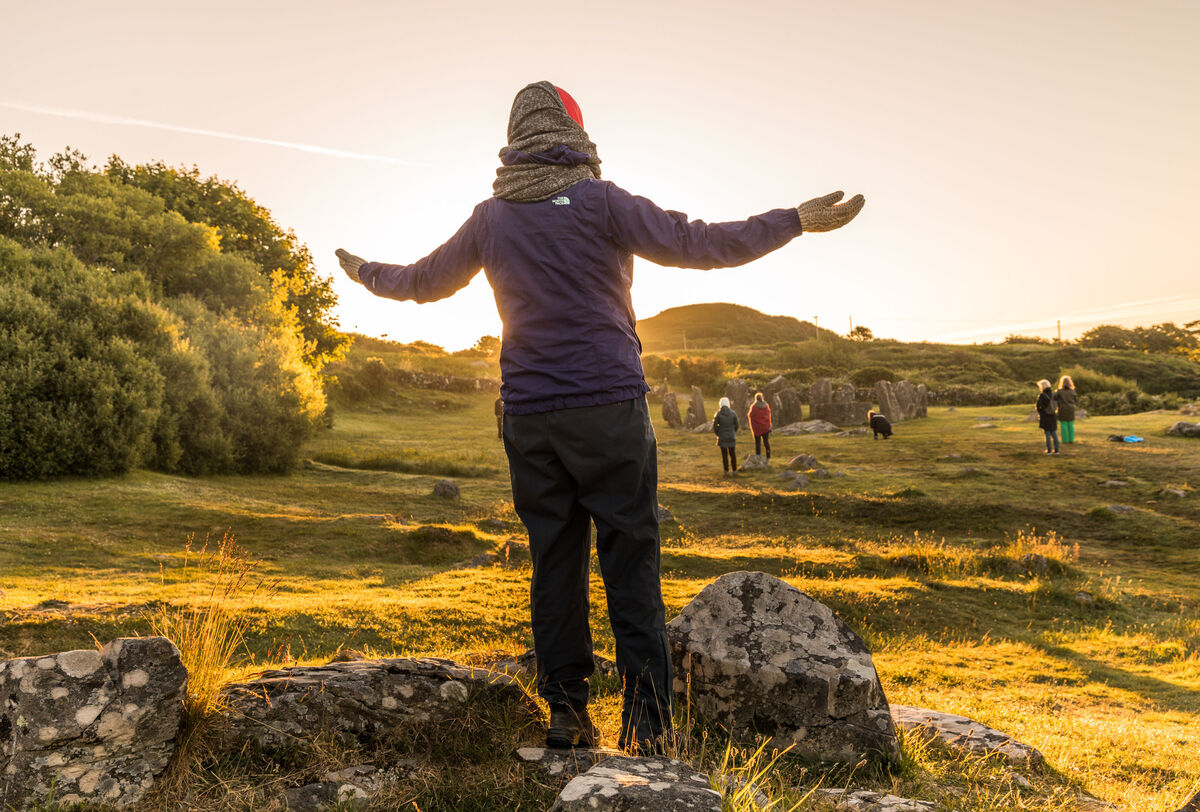
Visitors wait to welcome the summer solstice at Drombeg Stone Circle outside Glandore, Co Cork. This year the solstice falls on June 20, the earliest since 1796. Picture: David Creedon
June 20 marks the longest day and the shortest night of the year for those of us in the northern hemisphere with the Summer Solstice taking place just before 10pm.
Here in Ireland up to 16 hours of daylight can be expected.
While most of us are familiar with the event surrounding the Winter Solstice at the world-famous Newgrange, the Summer Solstice is an important day in the calendar for other ancient landmarks in Ireland.
According to Niall Smith, Head of Blackrock Castle Observatory, the Summer Solstice occurs when the sun is at the highest point in the sky, directly over the Tropic of Cancer and roughly an altitude of 70° above the horizon in Ireland. As a result, countries in the northern hemisphere experience maximum hours of daylight.
The Summer Solstice is an ancient Celtic tradition. It was believed that since the sun was at its highest, it was also at its most powerful and it became a sacred time of year. The opposite — the Winter Solstice — takes place in December and marks the shortest day of the year.
Shortly after the Summer Solstice, June 23 marks St John’s Eve which is also the date of a Celtic celebration that was held in honour of the goddess, Áine. The tradition is also known as Bonfire Night or ‘Bonna’ night in Cork.
Yes. 2024 marks the earliest Summer Solstice since 1796. This is due to the fact that 2024 is a leap year and the Gregorian calendar does not align with the amount of time it takes for the earth to orbit around the sun.
In Ireland, Lough Gur in County Limerick is home to the Grange Stone Circle which was built around 2200 BC and is aligned with sunrise during the Summer Solstice.
Drombeg Stone Circle outside Glandore often sees visitors on the morning of Summer Solstice. Locally known as Druid's Altar, it is a circle comprised of 17 standing stones and is believed to date back to between 153 BC and 127 AD. The monument marks sunrise during the Summer Solstice and sunset during the Winter Solstice.
In the Boyne Valley in County Meath, Townley Hall passage tomb also aligns with the rising sun on the morning of the Summer Solstice. Only two of its 16 stones that once made up the neolithic chamber remain today.
The Hill of Tara in County Meath is another popular location to mark the Summer Solstice. Each year people gather to celebrate at the landmark which is known as the ancient seat of the high kings of Ireland. In Sligo, the 5,000-year-old Carrowkeel Cairns is illuminated at sunset in the days around the Summer Solstice.
Luckily, the forecast for the Summer Solstice looks promising with dry weather and sunny spells hopefully making the most of the long evening. Highest temperatures will be between 16° to 21° or 22°, according to Met Éireann.
A 'Strawberry' moon also returns to Irish skies this weekend and will be visible from Thursday to Saturday.
Despite the name, the dull moon appears as a yellow/orange shade but on rare occasions, it looks red as a result of dust in the air.
CONNECT WITH US TODAY



Be the first to know the latest news and updates